- Sonesh Chainani at the Neglected Books page.
- R.I.P. Raymond Federman; see also Charles Bernstein.
- The new issue of Five Dials from Hamish Hamilton has Ali Smith on Céline & Julie Go Boating and Geoff Dyer, among others.
- Steven Fama on Robert Kelly’s Cities.
Yearly Archives: 2009
the only realistic artist
“Where was it written that you were obliged to recite the catechism of all things seen? My father would have to be selective or he wouldn’t be able to live with himself, as the expression puts it. All these memoirs he read with faltering interest and smarting eyes had been selected from other stuff, and if God was the only realistic artist, as Camus said, then why compete? Yet I could tell that some absolute of memory taunted him, as if not to remember the all insulted memory itself, but how could you snub memory, that random exchange of fluctuating chemicals ever under the duress of the so-called present? It haunted him nonetheless, maybe because he thought he would be the only survivor, Ishmael of the Somme, deputed to do duty on Remembrance Day as if Woodcock and Race did not exist and never had. I tried to coax myself into tracing my father’s mental processes year after year, noting how, of what he elected to remember, nothing fell away, but stuck there like the images in some altar-screen, all encrusted paint and holy permanence.”
(Paul West, My Father’s War: A Memoir, pp. 152–3.)
october 1–october 5
Books
- Dara Wier, Remnants of Hanna
- Toby Olson, The Blond Box
- Robert Kelly, Cities
Films
- A Serious Man, dir. Joel & Ethan Coen
injured books
Near the top of each page a new story would begin, go on
for a while, reach the end of the page, and never end. One
would become lost in story after story, set on edge, anxious
to find out what would finally happen. And always, nothing,
no matter where one found oneself in any story at the
end of the page it was over. You would never know how each
story might have ended. At the end of the page it was over.
We took these books with us to desert islands.
(Dara Wier, from Remnants of Hannah.)
september 27–september 30
Books
- Thomas M. Disch, The Dreams Our Stuff Is Made Of: How Science Fiction Conquered the World
- Brian Evenson, Fugue State: Stories
Exhibits
- “In & Out of Amsterdam: Travels in Conceptual Art, 1960–1976,” MoMA
thinking about sermons
“Beauty’s simultaneity with the pure fire of living poetry is outside contemporary critical interest. The professional discipline of literary scholarship tends to dismiss Jonathan Edwards’ religious intensity as embarrassingly outmoded. Mention his name and the title of one sermon, “Sinners in the Hands of an Angry God,” is sure to follow; that is usually that. In 2008 we see through speculative knowledge and are unwilling to embrace the imaginative and aesthetic crossing he makes between our material world – the world of types – and the spiritual world as it actively flows from revelation into human history. For Edwards, new truths are suggested through inspiration, but such light is only understood and revealed int he Word of God; it can’t be given without the Word. This Calvinist minister who spent his life in the eighteenth-century Connecticut River Valley, and didn’t write in verse, had the imagination of a poet. He believed that precise word choices, when disciplined into becoming bare embodiments of ideas, would become the source or occasion of conceptual discovery.”
(Susan Howe, “Choir Answers to Choir: Notes on Jonathan Edwards and Wallace Stevens,” pp. 52–53 in the Chicago Review 54:4.)
barthelme’s sources
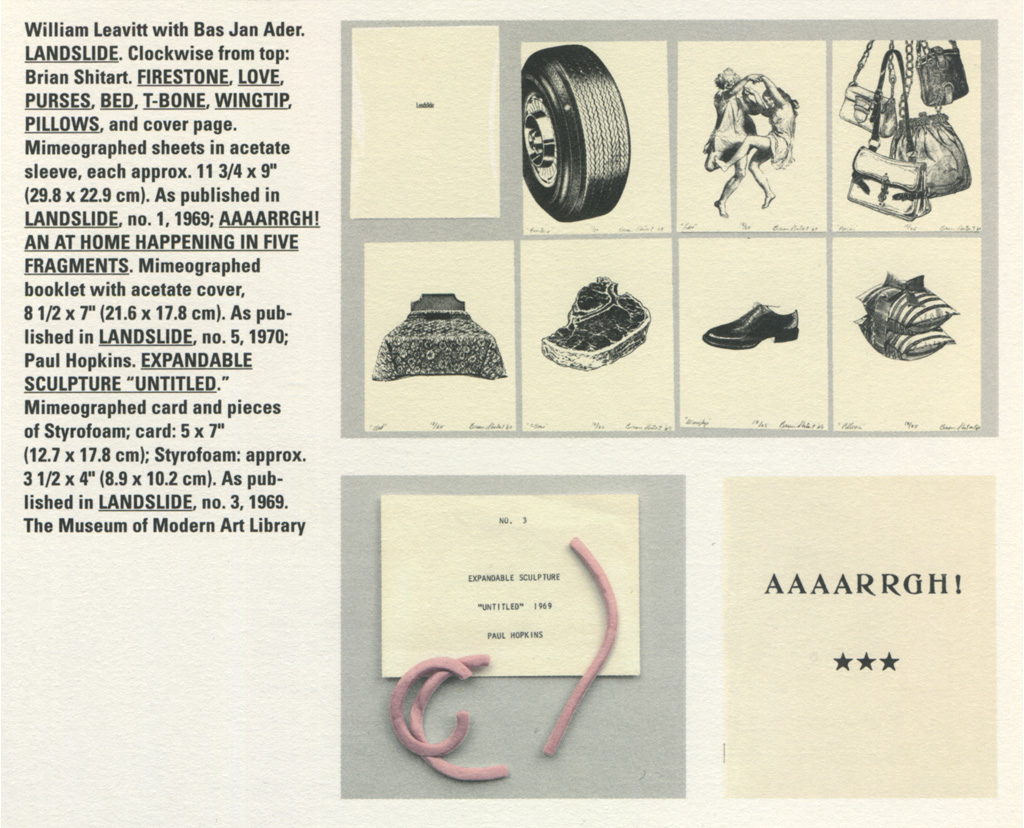
(Image from In & Out of Amsterdam: Travels in Conceptual Art 1960–1976, ed. Cristophe Cherix; note particularly issue 1, dated February 13, 1969.)
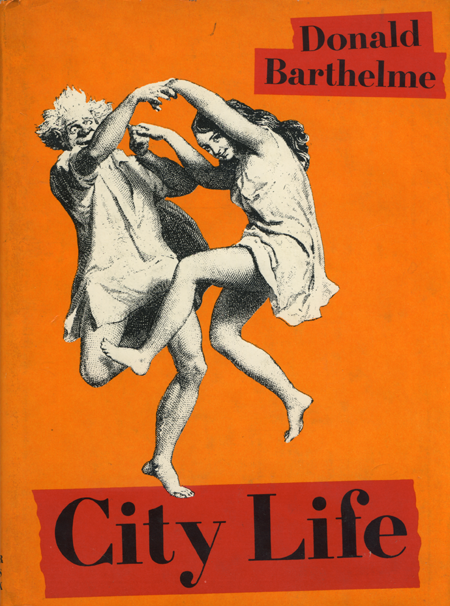
(Cover of first edition of Donald Barthelme’s City Life, 1970.)
bewogen beweging

(Poster for Bewogen Beweging, design by Dieter Roth, 1961.)
september 23–september 26
Books
- David Shields, Enough About You: Notes Toward the New Autobiography
- Brian Evenson, The Open Curtain
Films
- The Divorcée, directed by Robert Z. Leonard
- Brief Interviews with Hideous Men, dir. John Krasinski
- Sarabande & Winter, dir. Nathaniel Dorsky
- A Free Soul, dir. Clarence Brown
Exhibits
- “David Novros,” Paula Cooper Gallery
- “Carl Andre,” Paula Cooper Gallery
- “Zig Zag,” Sperone Westwater
- “Heinz Mack: Paintings, 1957–1964,” Sperone Westwater
- “James Turrell: Large Holograms,” PaceWildenstein
- “Bernadette Corportation,” Greene Naftali
- “Peter Hujar: Photographs 1956–1958,” Matthew Marks Gallery
- “Dennis Hopper: Signs of the Times,” Tony Shafrazi Gallery
- “A Matter of Light,” Elga Wimmer
boetti/joyce
“[Alighiero] Boetti was just about to embark on his major work of the early ’70s, the compilation of a list of the world’s one thousand longest rivers, which would be published as a book in 1977. It may not be immediately apparent that this was a huge undertaking in geographical research, calling not for consultation with available reference works but for extensive inquiries with scientific institutes around the world. As Anne-MArie Sauzeau-Boetti wrote in the book’s preface, of the various ways of comparing rivers according to size, that of length is ‘the most arbitrary, the most naive, but even today the most common.’ Any true measurement of a river’s length, as Sauzeau-Boetti points out, is rendered ambiguous by ‘its meanders and its passages through lakes, its branching around islands or displacements in the delta, by human intervention along its course, by the ungraspable limits between fresh and saltwater. . . .’ Boetti’s task in compiling his list of the thousand longest rivers was to give an apparently logical and scientific structure to an obsession, an irrational project – to produce a disinterested contribution to knowledge that would be not only useless but perhaps not even really knowledge. One wants to ask, as a narratorial voice in Ulysses does of its hero, ‘What in water did Bloom, waterlover, drawer of water, watercarrier returning to the range, admire?’ And to answer, as did its oddly Whitmanesque interlocutor: ‘Its universality: its democratic equality and constancy to its nature in seeking its own level.’ ”
(Barry Schwabsky, “Imaginary Itineraries: Alighiero Boetti’s Dossier Postale,” The Print Collector’s Newsletter, vol. 26 no. 3 (July–August 1995), p. 91.)