Archive for March, 2006

a fine poster

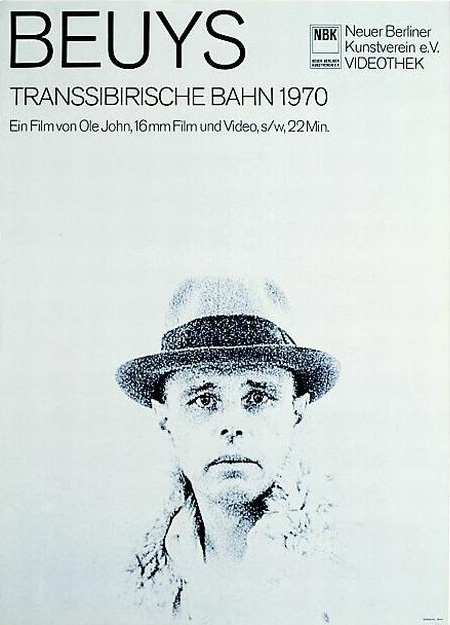
beuys poster

(Seen at the George Maciunas show at Maya Stendhal. This reproduction really doesn’t do it justice: the actual poster is crisp as can be and Beuys looks really fantastic in that hat.)

(Bonus: Joseph Beuys, “Sonne Stat Reagen” (MP3, 3:03, 2.8Mb), originally released in 1982, on Fluxus Anthology. Poppy in the nicest way.)

(Bonus bonus: To Rococo Rot & I-Sound, “Fishermen Dressed Like Joseph Beuys” (MP3, 3:38, 5.4Mb), from 2001, not quite as nice as the song by Beuys himself (it’s an instrumental), but with one of the best song titles ever.)


at the vitalic show

at the vitalic show

going to providence

providence 1providence 2providence 3providence 4

mallarmé on madison avenue

mallarmé on madison avenue

(The Whitney Biennial, alas, is largely boring.)

color

“The idea that colours inhere in objects is, naive as it may seem, strengthened by evidence that, unlike objects, non-existent colours cannot be imagined. Fusions of existing colours can, as hybrid creatures can – a centaur, a mermaid – but a colour as such cannot. Imaginative combinations of colour with objects, to convey, by metaphor, a mood or special tone attaching to the object as it is felt, are commonplace. But imagination cannot, in a dream or otherwise, contrive a blue that never existed. ‘A blue such as you never saw,’ somebody might say; but that blue is only a potentiated colour, and the statement about it is tinged with hyperbole. Even colours manufactured (in the pursuit of novelty) for textiles are only invented variations on existing ones, with the hues chemically intensified or softened. So we content ourselves with combinatory codes, such as the alligator-mouth red of oilcloth on the kitchen table, the dawn-rose cheeks of a Japanese schoolgirl. Forget the self-evident dog’s tongue, stoplight, the Burgundy, the bayonet.”

(Christopher Middleton, “In the Vale of Soul-Making”, pp. 79–80 in Crypto-Topographia: Stories of Secret Places)

locus solus industries 011

No. 11 is a shirt for the disaffected youth one hears so much about these days. It looks like this:

disaffected shirt

And that is all I have to say about that.

often we saw magritte

panini pantheon

Giovanni Paolo Panini, Interior of the Pantheon, ca. 1734. In the National Gallery, Washington.

(Bonus: John Cale, “Magritte” (MP3, 6.9Mb, 4:58).)

failure in america

“I used to be fond of saying that America, which was supposed to be a land of success, was a land of failure. Most of the great men in America had a long life of early failure and a long life of later failure.”

(Gertrude Stein, Everybody’s Autobiography, p. 88)

Bonus Steinage:

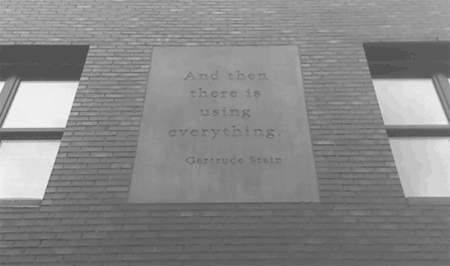
using everything

(The outside of the McCormack Family Theater, site of some of the recent Brown efest, not full of any great men (or women) as far as I could tell.)

the economics of prestige

“Although this bit of figuring work need not be taken too literally, it quite adequately serves to show what technology has enabled us to do: namely, to reduce the amount of time actually spent on production in its most elementary sense to such a tiny percentage of total social time that it pales into insignificance, that it carries no real weight, let alone prestige. When you look at industrial society in this way, you cannot be surprised to find that prestige is carried by those who hep fill the other 96½ per cent of total social time, primarily the entertainers but also the executors of Parkinson’s Law. In fact, one might put the following proposition to students of sociology: “The prestige carried by people in modern industrial society varies in inverse proportion to their closeness to actual production.”

(E. F. Schumacher, Small Is Beautiful: Economics as if People Mattered, pp. 159–160)

thomas edison predicts abu ghraib

“One would want, too, all the scenes of torture, from the very beginning of social life down to recent events in the prisons of the Holy Inquisition, when the Monks of Redemption, equipped with their instruments of iron, spent their leisure time over the years in massacring Moors, heretics, and Jews. And the cruel interrogations that have gone on in the prisons of Germany, Italy, France, the Orient, everywhere, why not those too? The camera, aided by the phonograph (they are near of kin), could reproduce both the sight and the different sounds made by the sufferers, giving a complete, an exact idea of the experience. What a salubrious course of instruction or the grade schools, to purify the intelligence of modern children – perhaps even adults! A splendid magic lantern!”

(Villiers de l’Isle Adam, The Future Eve, trans. Robert Martin Adams, pp.542–543 in The Decadent Reader)