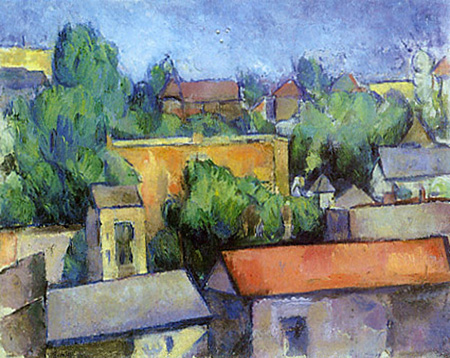
the city

You said: “I’ll go to some other land, I’ll go to some other sea.
There’s bound to be another city that’s better by far.
My every effort has been ill-fated from the start;
my heart – like something dead – lies buried away;
How long will my mind endure this slow decay?
Wherever I look, wherever I cast my eyes,
I see all round me the black rubble of my life
where I’ve spent so many ruined and wasted years.”

You’ll find no new places, you won’t find other shores.
The city will follow you. The streets in which you pace
will be the same, you’ll haunt the same familiar places,
and inside those same houses you’ll grow old.
You’ll always end up in this city. Don’t bother to hope
for a ship, a route, to take you somewhere else; they don’t exist.
Just as you’ve destroyed your life, here in this
small corner, so you’ve wasted it through all the world.

(C. P. Cavafy, 1894–1910, trans. Daniel Mendelsohn; Mendelsohn reads it here.)

in the same space

House, coffeehouses, neighborhood: setting
that I see and where I walk; year after year.

I crafted you amid joy and amid sorrows:
out of so much that happened, out of so many things.

And you’ve been wholly remade into feeling; for me.

(C. P. Cavafy, trans. Daniel Mendelsohn.)

oh, ezra!

“During the war, Pound tried to persuade a number of bureaucrats in Italy that the cultivation of peanuts would solve Italy’s food shortages – just as he later had syrup-producing American maples planted near Brunnenburg Castle in the South Tyrol, but in the process only managed to introduce poison ivy into the region.”

(note to Canto 74.812 (“and the wops do not use maple syrup”) in Richard Sieburth’s edition of Ezra Pound’s The Pisan Cantos, p. 130.)

the problem with tangerine

“In tangerine-orange subtle differences between red and yellow are so difficult to perceive as a single color that one eye seems to see red while the other sees yellow. A person walking for too long on a tangerine hued carpet eventually begins to stagger because his eyes can’t any longer decide where to put his feet.”

(Malcolm de Chazal, Sens-plastique, trans. Irving Weiss, p. 247.)

april 6–april 11

Books

  • Paul Fattaruso, Bicycle
  • Samuel R. Delany, The Fall of the Towers
  • Dorothy Kosinski, Dialogues: Duchamp, Cornell, Johns, Rauschenberg

Exhibits

  • “Cézanne & Beyond”, Philadelphia Museum of Art
  • “Henri Matisse and Modern Art on the French Riviera”, Philadelphia Museum of Art
  • “Daidō Moriyama: Tokyo Photographs”, Philadelphia Museum of Art
  • Pennsylvania Academy of the Fine Arts

train rising out of the sea

It is written in the Book of Usable Minutes
That all things have their center in their dying,
That each is discrete and diaphanous and
Has pointed its prow away from the sand for the next trillion years.

After that we may be friends,
Recognizing in each other the precedents that make us truly social.
Do you hear the wind? It’s not dying,
It’s singing, weaving a song about the president saluting the trust,

The past in each of us, until so much memory becomes an institution,
Through sheer weight, the persistence of it, no,
Not the persistence: that makes it seem a deliberate act
Of duration, much too deliberate for this ingenious being

Like an era that refuses to come to an end or be born again.
We need more night for the sky, more blue for the daylight
That inundates our remarks before we can make them
Taking away a little bit of us each time

To be deposited elsewhere
In the place of our involvement
With the core that brought excessive flowering this year
Of enormous sunsets and big breezes

That left you feeling too simple
Like an island just off the shore, one of many, that no one
Notices, though it has a certain function, though an abstract one
Built to prevent you from being towed to shore.

(John Ashbery, from As We Know.)