Author Archives: dbv
bochner on borges on wells
Mel Bochner: (Laughs) I’ll tell you my Borges story. Dore [Ashton] invited him to give a talk at the School of Visual Arts in 1966, or ‘67, and every hip artist in New York was in the audience. Everyone was expecting to hear him talk about his own work, but instead, he delivered a talk on an obscure topic in Old Norse literature. It was so erudite that no one there had a clue what he was talking about. It was clearly deliberate on his part and a great piece of Surrealist theater. Anyway, there was a reception for him afterwards to which I was invited. As I was sitting in the living room he sat down on the sofa right next to me. I thought, here I am sitting next to Borges, this is probably the only chance I’ll ever have to meet him, I have to try to engage him in a conversation. Across the room from us was sitting a man who looked exactly like Claude Rains, the old English actor. Desperate to think of something, anything, to say, I turned to Borges and said, “That man over there looks very much like Claude Rains.” Borges replied disinterestedly, “Oh, really.” I forged ahead anyway, “It’s interesting because Claude Rains became a famous movie actor without ever having been seen, because the first movie he starred in was H.G. Wells’ The Invisible Man.” To which Borges responded, “Hmm.” But I was in too deep to turn around, so I continued, “Well, I know how much you admire H.G. Wells.” “No, I don’t,” he replied. Confused by his response, I said, “But I’ve read your writings on Wells, and I remember how much you admired Wells’ great short story “In the Valley of the Blind, the One-Eyed Man is King.” To which he replied, “Wells was a failure.” Totally baffled, I asked, “Why?” “For one example,” he said, “in the novel The Time Machine, the time machine is such a clumsy metaphor. It would have been so much more elegant if it had been a magic ring. If he had rubbed a magic ring and been transported through time.” “But,” I anwered, “a magic ring doesn’t make any sense in the context of a parable about the politics of technology.” “Oh no, a magic ring would have been much better,” Borges said, and with that he stood up and walked away.
Rail: So he got annoyed.
Bochner: I have no idea what it was about, because early on he had written so brilliantly, and so positively, about Wells. But the mystery, and what I still don’t understand to this day, was how he was able to just stand up and walk away, because, as you know, he was totally blind.
(From an interview with Mel Bochner by Phong Bui in the Brooklyn Rail.)
locus solus editions 1/02

The second edition of My Voyage to Idaho has been published. Rather than buying it, you can download a screen-formatted PDF here. Someday this will improve, but not yet.
two things
locus solus editions 1/01

Because we don’t have enough unfinished projects around here, here is another one: Locus Solus Editions. Using Lulu, I intend to keep publishing the same book, provisionally titled My Voyage to Idaho, until it is finished or can be left definitively unfinished. The first edition is up at Lulu; you can download a screen-readable PDF here. I wouldn’t bother buying it.
the shoulder
The shoulder of a man is shaped like a baby pig.
It terrifies and it bores the observer, the shoulder.
The Greeks, who had slaves, were able to hitch back and rig
The shoulder, so the eye is flattered and feels bolder.
But that’s not the case in New York, where a roomer
Stands around day and night stupefied with his clothes on
The shoulder, hung from his neck (half orchid, half tumor)
Hangs publicly with a metabolism of its own.
After it has been observed a million times or more
A man hunches it against a pole, a jamb, a bench,
Parasite he takes no responsibility for.
He becomes used to it, like to the exhaust stench.
It takes the corrupt, ectoplasmic shape of a prayer
Or money, that connects with a government somewhere.
(Edwin Denby, from In Public, In Private, 1948.)
things, things, things
in the beginning
There was the famous photographer, Walker Evans,
who started by photographing old signs and ended
by filling his bathtub with them and washing
himself in the kitchen sink. There was the Harlem
man whose pet tiger cub grew so big that first
his family and finally he himself fled
the 12th-floor, three-bedroom apartment in the housing
project, returning every day to fling raw chickens
through a crack in the front door. Love displaces
everything. All over the city the signs peer
from beneath modern facades, fade in the sun and rain
high up on sides of buildings: BEST QUALITY TWINE. Ghosts
on brick, cockeyed atop demolition dumpsters, tin
worn delicate as paper, pale lettered – mint,
red, black: ELEVATOR APARTMENTS AVAILABLE:
INQUIRE ON PREMISES. If you stare at them words
are faces; everyone who ever spelled them out,
ever debated whether to buy twine or rent
an apartment fades up into view wearing shadowy
Homburgs, black veils, parcels in their arms, the winter
air freshening for snow. Or imagine the face
of a tiger waiting behind a thin metal door,
your furniture demolished, your family living
on friends’ floors, your neighbors smelling urine and fur
and losing their tolerance, a policeman
rappelling outside your windows with a dart gun.
Imagine a hunger for the invisible world
so deep it must have existed before you were born.
(Anne Pierson Wiese, from Floating City.)
variously/joseph kosuth
- Jenny Diski has a blog.
- There’s a new Ray Johnson show at Richard Feigen. Focuses on “a significant body of Johnson’s collages that reference other artists, his peers and his friends.” Preview tonight from 6–8. Info here.
- Jenny Kronovet hosts a reading for poets from Crowd (Mary Jo Bang, Eric Baus, and Matthew Rohrer) at the Marquise Dance Hall in Williamsburg. Sunday 12 November at 7 pm.
- And there are poems by Stefania Heim online at Harp and Altar. Also: some criticism.
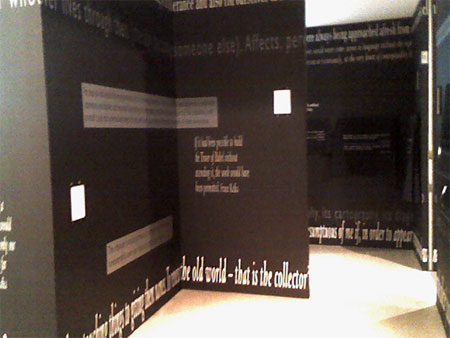
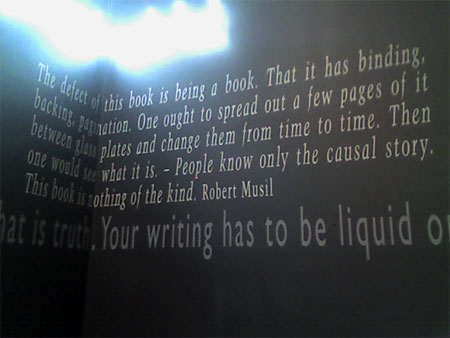
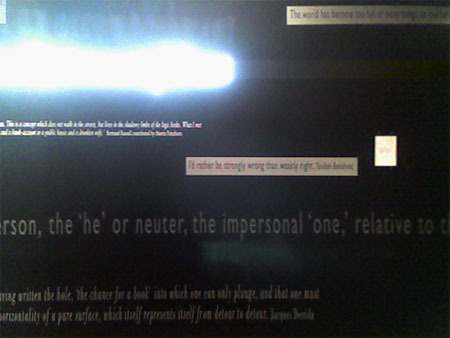
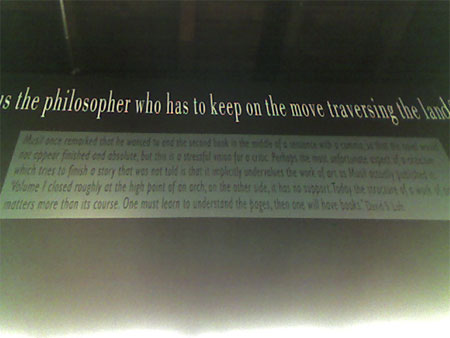
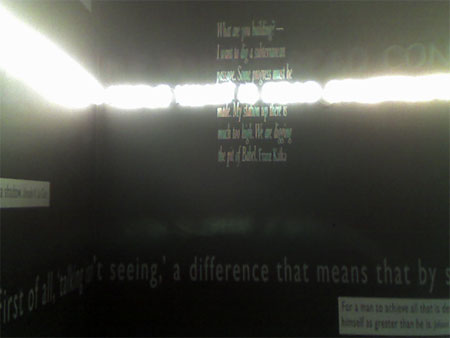
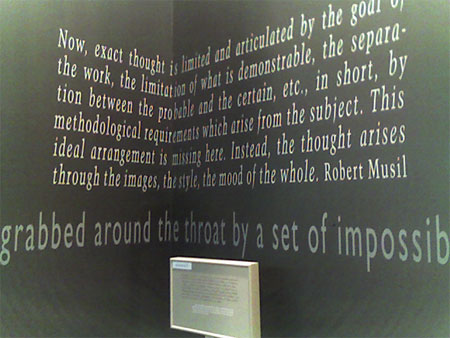
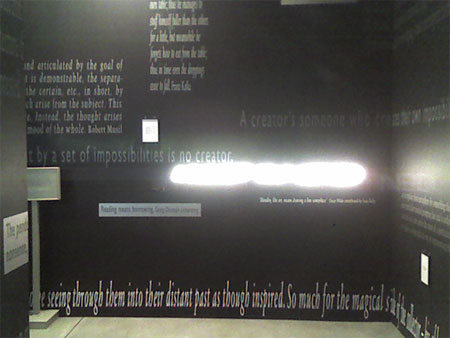
Also: a bunch of illicit photographs from the recent Joseph Kosuth installation at Sean Kelly:
eye reflecting the gold of fall
Silver is the ruby’s faded glare
Awkward silence taking it out to sea
And you away. The morning
Is its own highway, interleaded
With ears at the important points,
Each the size of a key of typewriter type.
To hornets we are all electroencephalographically
Neutral. Everyone is speaking jargon, especially
The ducks which look orange in this light;—
Sunny as a fruit tree, or as a lime drawn
From the tops of the fruit trees to the telephone wire
Dividing the ocean, whose neck is the horizon.
Some words (“like ‘fuck’”) require objects some of the time; others
Are content to be themselves, suspended like a chair,
Covered in green ink. Everyone’s comet
Strikes the earth, in a way.
The birds stay where they are, stretching to get the birdseed
Until they resemble the clothesline, white
With a dark shimmer. Half-cocked, except for a hay
Riding the air, the sky pushed branches against a screen
Where some T-shirts have caught, drying in powder
That will make them stiff and fragrant. As sound is released
By the head in front, the back of the neck
In back, and out and beyond the honking.
Everyone sleeps at least part of the time, the pilot
In the plane, the oceanographer in the bathysphere,
The judge on the bench, everyone else between eating and
Going to the bathroom, the window pouring
It through like the boat.
Some of the harvest words are
Also used for hunting, making them doubly unresonant,
Like an agglutinative language
Condensed to a single word, unspoken; or
The moon with no breath on it, touching your forehead in a complete
Absence of what meteorologists call weather
In a country on the verge of capitulating
To its smallest city. One would steer
Carefully to the south towards the lighthouse.
Slowly the lawn quiets down.
Each berry is a species of robin, all inflect night
Like the ocean’s rush over a bumpy road. As the radio
Spars with air, random to the space it occupies
To the inclusion of skin. Not the argument
From design since there are no stars to push, but thin
Points of maroon beside some gold
Letters which thud, far
Out of their cosmological depth.
Then the berries leave the trees;
The birds chase them, delivered to a prior spot where ech,
Like the ocean, is inflated and simplified,
Marooned no more than late afternoon mist dispensed
From an apple tree claiming to be the air outside the room,
Supporting everything in it. In the turtle’s mouth.
The turtle looks up. Trees and grass, chairs and clouds,
Sit in the middle of the lawn, the snowy lawn of the air.
With a breeze the ocean stutters, in the middle of
Mumbling. But the ship is already a blur,
Each point created for the benefit of others
Which react to it as if it were poison ivy, catching the same spray.
A chorus steps out of the spray. Two, in fact;
Astonished at not having made themselves known before,
With brandied snows, burning eyelashes.
You are the hotel, but you are also
The vandal, as well as the house detective.
Every spray accelerates, stops, so you can watch it;
Banging like grain like the door against ice air.
(Charles North. Reprinted in The New York Poets II, pp. 148–149. Originally from Six Buildings, Swollen Magpie Press, 1977.)