And a bonus Jean Painlevé:
Author Archives: dbv
fluxus outcroppings
from the NY Times:
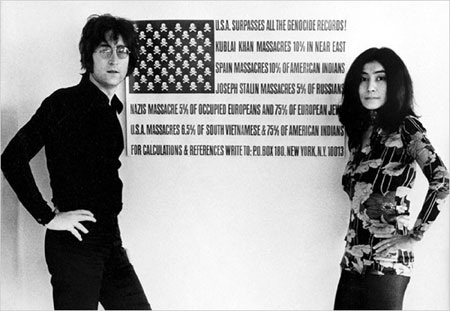
Lennon & Ono standing in front of George Maciunias’s U.S.A. Surpasses All the Genocide Records!.
Also worth mentioning if entirely unconnected: wood s lot has a collection of Michel Butor material.
things around
- Alain Resnais & Chris Marker’s film Les statues meurent aussi.
- Two poems by David Foster Wallace: “Peoria (4)” and “Peoria (9)”.
- A couple of Dada reviews from the new issue of the Brooklyn Rail: David Markus on the Hans Richter show & Valery Oisteanu on Daughters of Dada.
- Also in the Rail: Jennifer Scappettone’s translations of Ameria Rosselli; Scappettone’s translations appeared in Issue 2 of Circumference.
circumference reading
There’s a Circumference reading this Sunday, September 17th at 4pm. Hosted by the Bowery Poetry Club‘s World of Poetry bilingual poetry series. Anne Twitty reads translations of Maria Negroni; Ilya Bernstein reads Osip Mandelstam; and Anita Naegeli reads Raphael Urweider. 308 Bowery (at Bleaker), NY, NY. $7. Eventually we’ll have Issue 5 out, but that’s taking a while.
(Also noteworthy: Ron Silliman, Debra di Blasi, and Samuel R. Delany at KGB on Friday at 7pm.)
back once again
This was broken, but now it’s fixed. I don’t know what happened. Variously:
night fishing in antibes
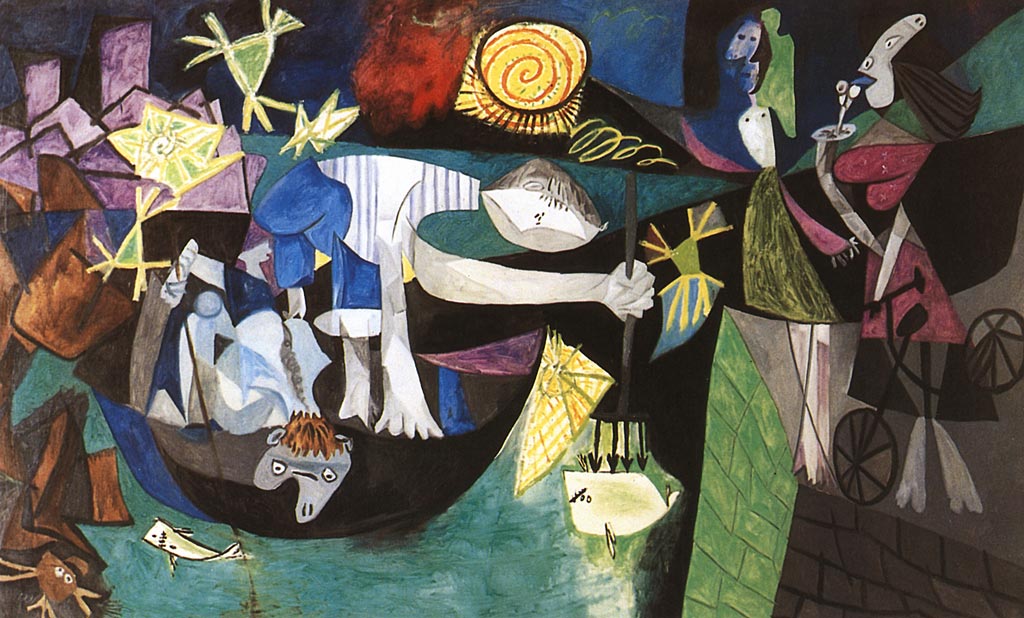
“—Was it you I saw this afternoon? a little while ago?
—Me? Why? Where?
—Were you there, where they’re showing Picasso’s new . . .
—Night Fishing in Antibes, yes, yes . . .
—Why didn’t you speak to us?
—Speak to who? You? Were you there?
—I was there, with a friend. You could have spoken to us, Wyatt, you didn’t have to pretend that . . . I was out with someone who . . .
—Who? I didn’t see them, I didn’t see you, I mean.
—You looked right at us. I’d already said, There’s my husband, we were near the door and you were bobbing . . .
—Listen . . .
—You went right past us going out.
—Look, I didn’t see you. Listen, that painting, I was looking at the painting. Do you see what this was like, Esther? seeing it?
—I saw it.
—Yes but, when I saw it, it was one of those moments of reality, of near-recognition of reality. I’d been . . . I’ve been worn out in this piece of work, and when I finished it I was free, free all of a sudden out in the world. In the street everything was unfamiliar, everything and everyone I saw was unreal, I felt like I was going to lose my balance out there, this feeling was getting all knotted up inside me and I went in there just to stop for a minute. And then I saw this thing. When I saw it all of a sudden everything was freed into one recognition, really freed into reality that we never see, you never see it. You don’t see it in paintings because most of the time you can’t see beyond a painting. Most paintings, the instant you see them they become familiar, and then it’s too late. Listen, do you see what I mean?
—As Don said about Picasso . . . she commenced.
—That’s why people can’t keep looking at Picasso and expect to get anything out of his paintings, and people, no wonder so many people laugh at him. You can’t see them any time, just any time, because you can’t see freely very often, hardly ever, maybe seven times in a life.
—I wish, she said, —I wish . . .”
(Gaddis, The Recognitions, pp. 91–92.)
things for sunday
curated poetry systems
Ubu has posted the Giorno Poetry System recordings. A capricious selection – all links are to MP3s:
William Carlos Williams:
Edwin Denby:
Frank O’Hara:
John Ashbery
Kenneth Koch:
Joe Brainard:
Ron Padgett:
Ted Berrigan:
Charles Olson:
Ishmael Reed:
John Cage:
Claes Oldenburg:
Emmett Williams:
Jackson Mac Low:
economics of art
“It was in the early 1950s that Picasso’s earning power and wealth became fabulous to this degree. The decisions which so radically affected his status were taken by men who had nothing to do with Picasso. The American government passed a law which allowed income tax relief to any citizen giving a work of art to an American museum: the relief was immediate, but the work of art did not have to go to the museum until the owner’s death. The purpose of this measure was to encourage the import of European works of art. (There is still the residue of the magical belief that to own art confirms power.) In England the law was changed – in order to discourage the export of art – so that it became possible to pay death duties with works of art instead of money. Both pieces of legislation increased prices in salerooms throughout the art work.”
(John Berger, The Success and Failure of Picasso (1965), p. 4)
locus solus industries 013
After an extended absence, Locus Solus Industries returns:

(apologies to Designers Republic.)