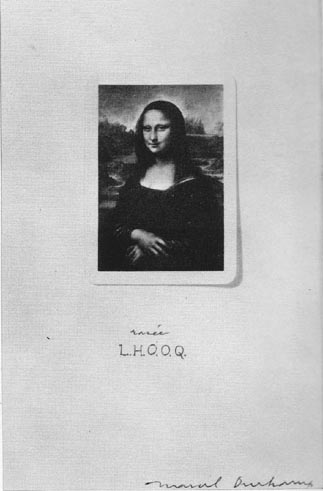
litany for marcel duchamp, who recently shaved the wife of francesco del giocando

lhooq shaved

Mona Chauss 21, rue Moines 17e MAR 04.58
Mona Mme F 79, avenue Bosquet 7e SOL 75.20
Mona F entrepr. peint 38, rue François-ler 8e ELY 79.16
Mona F 26, avenue Marceau 8e ELY 71.09
Mona Mme 73, avenue Bosquet 7e INV 17.61
Mona D’Arvy 12, rue Ganneron 18e EUR 25.69
Mona-Dol art dram 25, rue Caulaincourt 18e MON 45.73
Mona Goya art dram. 27, rue Pier-Demours 17e MAC 53.54
Mona Lisa tric couture sports luxe 56, rue de Rennes 6e LIT 83.50
Mona-Lise maroq. 231, rue St-Honoré OPE 21.42
Mona-Rybert couture bonnet. 22, rue Douai 9e TRI 42.38
Monacevitch L 183, rue Alésia 14e BLO 58.26
Monacevitch Mme march. chauss. 63, rue Didot LEC 87.98
Monaco (secret S.A.S. le Prince de) 2, rue Conseiller-Collignon 16e TRO 17.15
Monagaz 148, bd Haussmann 8e CAR 51.03
Monahan F avec cour app. 52, avenue Champs-Elysées 8e BAL 86.24
— même addresse BAL 34.97
Monahan F 6, place Palais-Bourbon 7e INV 41.46

Emmett Williams. First printed on the poster of the exhibition La Fête à la Gioconde, Paris, October 1965. Appears in the last french-fried potato and other poems, originally a Great Bear Pamphlet of the Something Else Press in 1967, now available as a PDF from Ubuweb.

(Apologies if the table formatting is severely messed up – I still don’t know very much useful HTML. Can RSS feeds have tables in them? I suspect not.)
descartes on urban planning

“. . . . Among these one of the first I examined was that often there is less perfection in works composed of several separate pieces and made by different masters, than in those at which only one person has worked. So it is that one sees that buildings undertaken and completed by a single architect are usually more beautiful and better ordered than those that several architects have tried to put into shape, making use of old walls which were built for other purposes. So it is that these old cities which, originally only villages, have become, through the passage of time, great towns, are usually so badly proportioned in comparison with those orderly towns which an engineer designs at will on some plain that, although the buildings, taken separately, often display as much art as those of the planned towns or even more, nevertheless, seeing how they are placed, with a big one here, a small one there, and how they cause the streets to bend and to be at different levels, one has the impression that they are more the product of chance than that of a human will operating according to reason. And if one considers that there have nevertheless always been officials responsible for the supervision of private building and for making it serve as an ornament for the public, one will see how difficult it is, by adding only to the constructions of others, to arrive at any great degree of perfection.”

(René Descartes, Discourse on Method, beginning of Discourse 2, pp. 35–36 in the translation of F. E. Sutcliffe.)

a fine poster

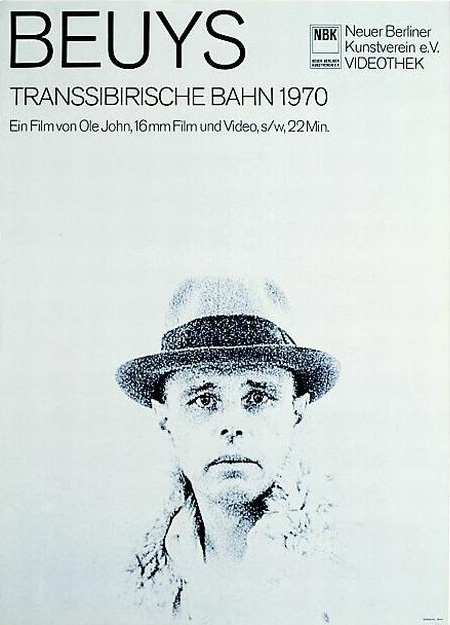
beuys poster

(Seen at the George Maciunas show at Maya Stendhal. This reproduction really doesn’t do it justice: the actual poster is crisp as can be and Beuys looks really fantastic in that hat.)

(Bonus: Joseph Beuys, “Sonne Stat Reagen” (MP3, 3:03, 2.8Mb), originally released in 1982, on Fluxus Anthology. Poppy in the nicest way.)

(Bonus bonus: To Rococo Rot & I-Sound, “Fishermen Dressed Like Joseph Beuys” (MP3, 3:38, 5.4Mb), from 2001, not quite as nice as the song by Beuys himself (it’s an instrumental), but with one of the best song titles ever.)

color

“The idea that colours inhere in objects is, naive as it may seem, strengthened by evidence that, unlike objects, non-existent colours cannot be imagined. Fusions of existing colours can, as hybrid creatures can – a centaur, a mermaid – but a colour as such cannot. Imaginative combinations of colour with objects, to convey, by metaphor, a mood or special tone attaching to the object as it is felt, are commonplace. But imagination cannot, in a dream or otherwise, contrive a blue that never existed. ‘A blue such as you never saw,’ somebody might say; but that blue is only a potentiated colour, and the statement about it is tinged with hyperbole. Even colours manufactured (in the pursuit of novelty) for textiles are only invented variations on existing ones, with the hues chemically intensified or softened. So we content ourselves with combinatory codes, such as the alligator-mouth red of oilcloth on the kitchen table, the dawn-rose cheeks of a Japanese schoolgirl. Forget the self-evident dog’s tongue, stoplight, the Burgundy, the bayonet.”

(Christopher Middleton, “In the Vale of Soul-Making”, pp. 79–80 in Crypto-Topographia: Stories of Secret Places)