as wonderful as being a strain
“If my life means anything, it is that I am always forgetting just what it is that I want. How’s that for meaning? I have found a way to be unsatisfied by everything and always somewhat pleasantly excited. Or painfully excited. What’s Zen compared to that? What’s Academia’s compelling suture? its compiling future? I want to know who has ever found anything as wonderful as being a strain – not the strainer or the strained, but the thing itself, held tight between two eternities (what is that?) like a dog, held on two leashes, by two enraged furies, the eyes of the world, the peacemakers of eternity (that word again, you would think I wanted to die, if you didn’t know me better, it is more that in truth I would like to vanish, but into this prose study to live forever here but also be eternally writing, my ideal would be a text that was always writing, but then on the other hand I have never been aware of being interested in that, and I can’t imagine actually as I read it over what it means – I have to get out of this sidetrack: I have something important to say), the stones that are never lying in the grass but are always bouncing around. And I’m held between them. They tug me. And I resist. I run and they chase me. The can never stop me from moving and I can never completely get away. What’s Dante’s Paradise compared to that? You always think I am kidding. I am trying to define happiness by what I have actually got and go on from there. Afterwards we can have something to eat and drink and re-enter the process, you who seem more comfortable in the process but who are, I imagine, inside, like me, a watcher of Essaouiras. Do I love you for that? I don’t know if I love you or have ever loved anything or anyone. I am a desert. Kill me. And now a town. Signed, ‘Zagora.’ “
(Kenneth Koch, from “Reflections on Morocco,” pp. 355–356 in The Collected Poems of Kenneth Koch. Quoted by Tanya Larkin in the Boston Review here.)
the bees
1
When the last of the sunlight goes,
and shadows stretching from the shade
of trees and bushes, long hedgerows,
join up together to invade
wild grasses and the flat pasture,
turning from shadows into night,
then the bees, scattered far and near,
take notice, and start on their flight
back to those walls and roofs they know,
beehives where their small bodies rest
between dark and dawn; they go
over the threshold, noisy, fast,
massing in hundreds at the doors,
and pour past into their close cells,
cramming chambers and corridors
while the last of the daylight fails:
sleep silences the working hive
and leaves it quiet as the grave.
2
For bees put no trust in the sky
when storms come up with an east wind,
and seldom venture far away
from their stations when downpours impend:
instead, they draw the water off
and stick close to their city walls
where any flights they take are brief;
as the wind blows and the rain falls
they steady themselves through turbulence
by taking with them little stones
(as frail boats, faced with violence
of gales and tides, take ballast on),
and hold their given course along
the clouds, balanced, and balancing.
3
A wonder, how they reproduce:
without courtship, or lovemaking,
without letting their hearts unloose
nerves and sinews like so much string,
without the agony of birth,
they gather offspring from the leaves
and softer hearts, draw with each breath
pollen and children for the hives,
providing themselves with a fresh
ruler, and tiny citizens,
to take the place of some who crash
against the earth, onto hard stones,
brought level by their single love
for flowers and honey-vintages
(the glorious legacy they leave
behind them, in trust for the ages),
although the time that waits for them
is short enough, and not beyond
a seventh summer; yet the same
nation and race will soldier on,
deathless in spite of time’s attacks,
in cells and palaces of wax.
4
All of these things have given pause
to the bees’ watchers and guardians
whenever they ascribe the cause
to some influx, some influence
over and above the natural,
an exhalation from beyond
or an element more ethereal
than air itself – maybe the mind
of God, that strengthens as it runs
in earth and sky, or turns in deep
acres of churning oceans,
in herds of cattle, flocks of sheep,
the wild beasts and the harmless beasts,
in life that feels along a thread
from its first movement to the last,
finishing where it all started,
and never reaching a true end:
this keeps the bees away from death
when, at the last, they all ascend
into the skies they lived beneath,
to fly between undarkened spheres
in heaven, and the many stars.
(Virgil, from the Georgics, book IV. Translated from the Latin by Peter McDonald. Published in the 26 January 2007 Times Literary Supplement.)
visual poetry / peter greenaway / hollis frampton
circumference issue 5 / bernhard reading
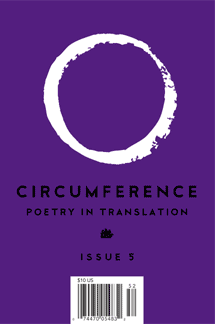
Circumference issue 5 is out and in better book stores, if not online. It is a fine issue, I think. Launch party is Thursday, 8 February at 7 pm at the Swiss Institute (495 Broadway, NYC); there will be readings of poetry translated from Spanish, Arabic, and Romanian by Emily Moore, Wendy Walker, and Matthew Zapruder.
ALSO in reading news: Jonathan Taylor has organized a Thomas Bernhard-themed reading at KGB (85 E. 4th St., NYC) for 7pm on the 18th of February. Readers to be Wayne Koestenbaum, Rhonda Lieberman, Ben Marcus, Geoffrey O’Brien, and Dale Peck.
the people have the right / to remove a government from power
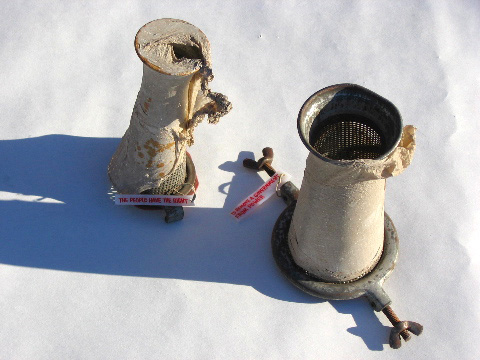
(Alison Knowles, from Time Samples, 2006. PDF – with photos of the book & an essay by George Quasha – available here.)
pietà
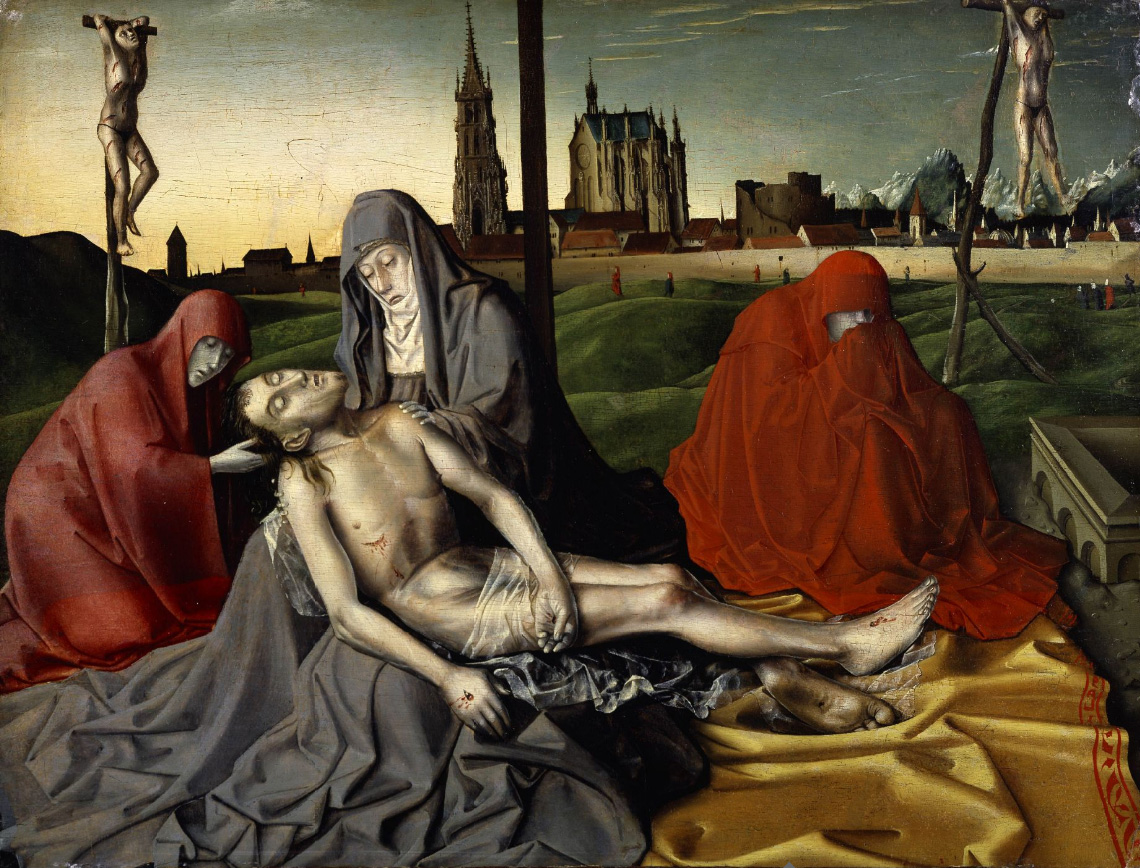
(Konrad Witz, Pietà, c. 1440. Tempera and oil on panel. The Frick Collection.)
delany explains things
“One person’s fantasy is another’s reality. The difference between fantasy and the real, however, is that the ethical and moral implications the fantasy has for the person who indulges in it are always ones brought to it from a prior reality. The ethical and moral implications for those who live through what might once have been for them a fantasy situation can come from the reality of the situation; and so may be very different.”
(Samuel R. Delany, Heavenly Breakfast: an essay on the winter of love, p. 22)
the python that will devour it
“As soon as I realized this I felt panic within me. The calm which I had just sampled was the first appearance of the great but intermittent force which would struggle within me against pain and against love, and would ultimately overcome them. What I had just had a foretaste and foreboding of, if only for a moment, was that which would later become a permanent state for me, a life where I would no longer suffer because of Albertine, where I would no longer love her. And my love, which had just recognized the only enemy able to vanquish it, the act of forgetting, started to tremble, like a lion enclosed in a cage which has suddenly seen the python that will devour it.”
(Proust, The Fugitive, trans. Peter Collier, p. 415.)
that everything is surface
But your eyes proclaim
That everything is surface. The surface is what’s there
And nothing can exist except what’s there.
There are no recesses in the room, only alcoves,
And the window doesn’t matter much, or that
Sliver of window or mirror on the right, even
As a gauge of the weather, which in French is
Le temps, the word for time, and which
Follows a course wherein changes are merely
Features of the whole. The whole is stable within
Instability, a globe like ours, resting
On a pedestal of vacuum, a ping-pong ball
Secure on its jet of water.
And just as there are no words for the surface, that is,
No words to say what it really is, that it is not
Superficial but a visible core, then there is
No way out of the problem of pathos vs. experience.
You will stay on, restive, serene in
Your gesture which is neither embrace nor warning
But which holds something of both in pure
Affirmation that doesn’t affirm anything.
(John Ashbery, from “Self-Portrait in a Convex Mirror”)