“Who ever wins a war as he would wish it?”
(Diomedes, in Scene 4 of Heinrich von Kleist’s Penthesilea, trans. Joel Agee)
“Who ever wins a war as he would wish it?”
(Diomedes, in Scene 4 of Heinrich von Kleist’s Penthesilea, trans. Joel Agee)
“A dream party of some of the most celebrated people of the day, whom one can never hope to meet, or, if met, be remembered by: Einstein, Mr. Charles Chaplin, Freud, Virginia Woolf, Stella Benson, Mussolini, P. G. Wodehouse, Mistinguett, Lydia Lopokova and Jean Cocteau.
TOMATES À L’ESPAGNOL
*
CONSOMMÉ A L’INDIENNE
*
SAUMON EN SURPRISE
*
POULET AUX CHOUX
*
GLACE AUX FRUITS”
(from Ruth Lowinsky, Lovely Food: a cookery notebook, 1931, The Nonesuch Press, London, pp. 54–55. This particular menu is llustrated with a drawing of “flat circles of chromium-plated metal arranged in tiers pierced for candles between which the heads of flowers are placed” by Thomas Lowinsky.)
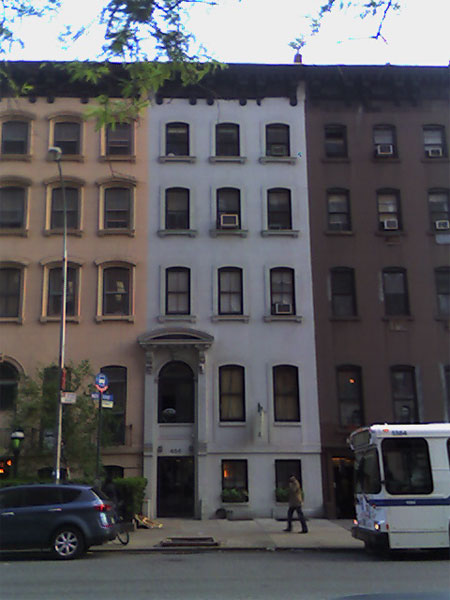
Fortunato Depero evidently moved to New York in 1947, and this is the apartment building he lived in, at 464 West 23rd Street.
“MARGARET. All right, Grandma ’ll tell us a story.
GRANDMOTHER. Sit, sit.
Once upon a time there was a poor little boy who had no father and mother; everything was dead and there was no-one left in the whole world. Everything was quite dead, so he went off, whimpering. All day and all night. And since there was no-one left on earth he decided to go up to heaven where the moon shone down so kind. But when he got to the moon it was a lump of rotten wood. Then he went to the sun, but when he got there it was a withered-up sunflower. And when he got to the stars they were little spangled midges stuck there, like the ones shrikes stick on blackthorns. So he went back to the earth, but the earth was an overturned pot. He was completely alone, and he sat down and cried. He’s sitting there still, all alone.”
(Georg Büchner, Woyzeck, p. 31, trans. John Mackendrick)
Courtesy of MOMA, here (mentioned in this NY Times article on museum podcasts).
VISÉE
À Madame René Berthier

AIM
To Madame René Berthier

(The New Directions edition of Apollinaire, translated by Roger Shattuck, is a facing page edition, but while the French version is laid out as Apollinaire published the poem, there’s been no attempt to lay out the English version. Thus this. These have both been put together in Adobe Illustrator; they’re not accurate to the original &ndasd; presuming that New Directions accurately copied the layout themselves! – because I eyeballed the layout; the type isn’t the same, and the alignment isn’t perfect. Will fix this later.)
(Previously.)
First:
Also:
Although:
“Unity of plot does not, as some persons think, consist in the unity of the hero. For infinitely various are the incidents in one man’s life which cannot be reduced to unity; and so, too, there are many actions of one man out of which we cannot make one action. Hence the error, as it appears, of all poets who have composed a Heracleid, a Theseid, or other poems of the kind. They imagine that as Heracles was one man, the story of Heracles must also be a unity. But Homer, as in all else he is of surpassing merit, here too – whether from art or natural genius – seems to have happily discerned the truth. In composing the Odyssey he did not include all the adventures of Odysseus – such as his wound on Parnassus, or his feigned madness at the mustering of the host – incidents between which there was no necessary or probable connection: but he made the Odyssey, and likewise the Iliad, to center round an action that in our sense of the word is one. As therefore, in the other imitative arts, the imitation is one when the object imitated is one, so the plot, being an imitation of an action, must imitate one action and that a whole, the structural union of the parts being such that, if any one of them is displaced or removed, the whole will be disjointed and disturbed. For a thing whose presence or absence makes no visible difference, is not an organic part of the whole.”
(Aristotle, Poetics, section VIII, trans. S. H. Butcher)
“It all begins with the stately splendour of the swelling counterpoint. The frontline is still sufficiently clear in the expanded portion of the stroke, but the contrast relies on its contraposition with a thin stroke in which the frontline spins about on an imploded counterpoint. When even contrast is renounced as superfluous ornament, writing is altogether without orientation. Now the barbarians can have their say with their plans to improve the alphabet so it will be easier for children, computers and other illiterates. Whatever they say is completely true in advance because the criterion is annihilated: a line can be drawn in any direction through a point, just as an echo chamber confirms any piece of nonsense.”
(Geerit Noordzij, The Stroke: theory of writing, trans. Peter Enneson, p. 70)