From the show at Michael Werner, where there are a series of women with crazy eyes that Picabia worked on for a while:
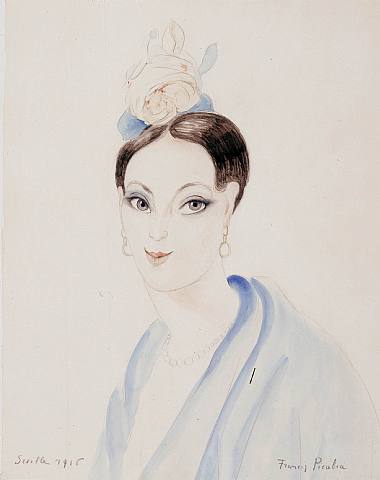
Francis Picabia, Espanole a la rose, 1916

(Francis Picabia, Espanole, c. 1926–27.)
From the show at Michael Werner, where there are a series of women with crazy eyes that Picabia worked on for a while:
Francis Picabia, Espanole a la rose, 1916
(Francis Picabia, Espanole, c. 1926–27.)
“. . . . Among these one of the first I examined was that often there is less perfection in works composed of several separate pieces and made by different masters, than in those at which only one person has worked. So it is that one sees that buildings undertaken and completed by a single architect are usually more beautiful and better ordered than those that several architects have tried to put into shape, making use of old walls which were built for other purposes. So it is that these old cities which, originally only villages, have become, through the passage of time, great towns, are usually so badly proportioned in comparison with those orderly towns which an engineer designs at will on some plain that, although the buildings, taken separately, often display as much art as those of the planned towns or even more, nevertheless, seeing how they are placed, with a big one here, a small one there, and how they cause the streets to bend and to be at different levels, one has the impression that they are more the product of chance than that of a human will operating according to reason. And if one considers that there have nevertheless always been officials responsible for the supervision of private building and for making it serve as an ornament for the public, one will see how difficult it is, by adding only to the constructions of others, to arrive at any great degree of perfection.”
(René Descartes, Discourse on Method, beginning of Discourse 2, pp. 35–36 in the translation of F. E. Sutcliffe.)
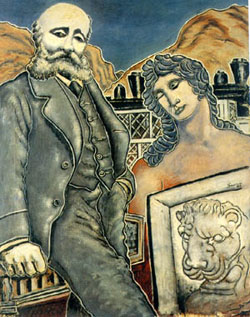
And another, Le troisieme jour, from 1929 in the Palazzo Cavour in Torino:
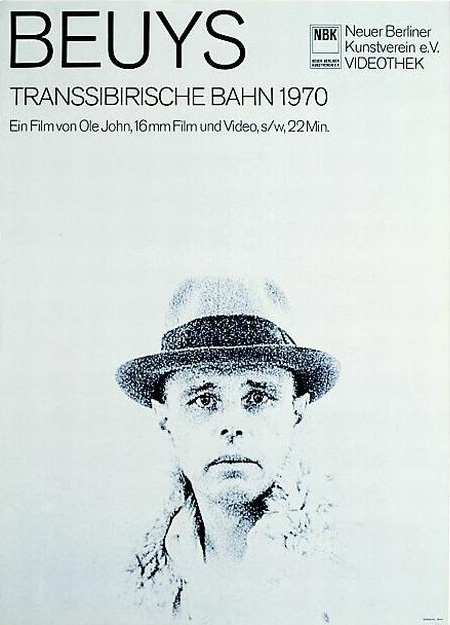
(Seen at the George Maciunas show at Maya Stendhal. This reproduction really doesn’t do it justice: the actual poster is crisp as can be and Beuys looks really fantastic in that hat.)
(Bonus: Joseph Beuys, “Sonne Stat Reagen” (MP3, 3:03, 2.8Mb), originally released in 1982, on Fluxus Anthology. Poppy in the nicest way.)
(Bonus bonus: To Rococo Rot & I-Sound, “Fishermen Dressed Like Joseph Beuys” (MP3, 3:38, 5.4Mb), from 2001, not quite as nice as the song by Beuys himself (it’s an instrumental), but with one of the best song titles ever.)





“The idea that colours inhere in objects is, naive as it may seem, strengthened by evidence that, unlike objects, non-existent colours cannot be imagined. Fusions of existing colours can, as hybrid creatures can – a centaur, a mermaid – but a colour as such cannot. Imaginative combinations of colour with objects, to convey, by metaphor, a mood or special tone attaching to the object as it is felt, are commonplace. But imagination cannot, in a dream or otherwise, contrive a blue that never existed. ‘A blue such as you never saw,’ somebody might say; but that blue is only a potentiated colour, and the statement about it is tinged with hyperbole. Even colours manufactured (in the pursuit of novelty) for textiles are only invented variations on existing ones, with the hues chemically intensified or softened. So we content ourselves with combinatory codes, such as the alligator-mouth red of oilcloth on the kitchen table, the dawn-rose cheeks of a Japanese schoolgirl. Forget the self-evident dog’s tongue, stoplight, the Burgundy, the bayonet.”
(Christopher Middleton, “In the Vale of Soul-Making”, pp. 79–80 in Crypto-Topographia: Stories of Secret Places)
No. 11 is a shirt for the disaffected youth one hears so much about these days. It looks like this:

And that is all I have to say about that.

Giovanni Paolo Panini, Interior of the Pantheon, ca. 1734. In the National Gallery, Washington.
(Bonus: John Cale, “Magritte” (MP3, 6.9Mb, 4:58).)
“I used to be fond of saying that America, which was supposed to be a land of success, was a land of failure. Most of the great men in America had a long life of early failure and a long life of later failure.”
(Gertrude Stein, Everybody’s Autobiography, p. 88)
Bonus Steinage:
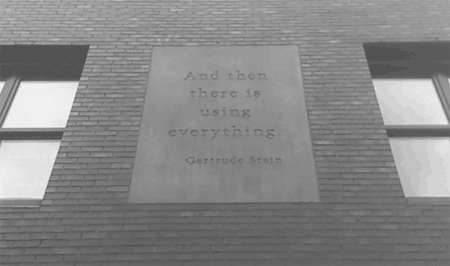
(The outside of the McCormack Family Theater, site of some of the recent Brown efest, not full of any great men (or women) as far as I could tell.)