working, two theories

I’ve never worked for a living. I consider working for a living slightly imbecilic from an economic point of view. I hope that some day we’ll be able to live without being obliged to work.

(Marcel Duchamp, interview with Pierre Cabanne, 1966)

In answer to your question – Fluxus way of life is 9 a.m. to 5 p.m. doing socially constructive and useful work – earning your own living, 5 p.m. to 10 p.m. spending time on propagandizing your way of life among other idle artists & art collectors and fighting them, 12 p.m. to 8 a.m. sleeping (8 hours is enough).

(George Maciunas, letter to Tomas Schmit, January 1964)

“the poem is not completely diverting, but appears sometimes odd.”

With the end you are tired of this old world

Shepherdess ô Eiffel Tower the herd of the bridges bleats this morning

You have enough of it to live in Greek and Roman antiquity

Here even the cars seem to be old
The religion alone remained very new the religion
Remained simple like the hangars of Port-Aviation

Only in Europe you are not ancient ô Christianisme
European most modern it is you Black and white Pape X
And you that the windows observe shame retains you
To enter daN a church and of you to confess this morning to it
You read the leaflets the catalogues the posters which sing high
Here is poetry this morning and for prose there are the newspapers
There are the deliveries with 25 centimes full with adventure police
Portraits of the great men and thousand titles various

I saw this morning a pretty street of which I forgot the name
New and clean of the sun it was the bugle
Directors workmen and beautiful shorthand typists
Monday morning at Saturday evening four times per day pass there
The morning by three times the siren groans there
A rageuse bell barks there about midday
Inscriptions of the signs and the walls
The plates the opinions the made-to-order of the parrots criaillent
I like the grace of this industrial street
Located in Paris enters the street Aumont-Thieville and the avenue of the Terns

(Google translation of the start of Guillaume Apollinaire’s “Zone”, from here, complete in French here, and an anonymous translation – not that of LeRoy C. Breunig, Donald Revell, or Samuel Beckett –into English here.)

(Perhaps related: bpNichol’s Translating Translating Apollinaire.)

la musica ideal

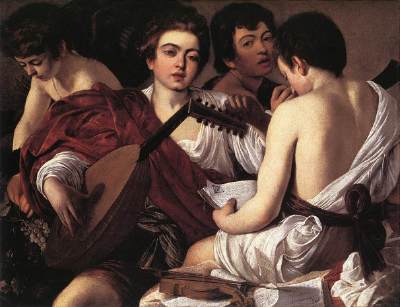
caravaggio, _the musicians_ thumbnail

“In La Musica Ideal (known in the English-speaking world as ‘The Musicians,’ not a translation but, then, the titles were not always given by Caravaggio), what is the young man at the left doing? Why isn’t he playing an instrument? Does he provide the musicians with an audience?”

(Dick Higgins, “The Importance of Caravaggio”, in Modernism Since Postmodernism: essays on intermedia, p.152)

noted: proust, quotation marks

There’s a nice post at The Valve which nicely gets at how deeply weird Proust gets w/r/t jealousy towards the end of the book.

And a nice post at pas au-delà on the connotations of punctuation. There’s a fine discursion on this (more precisely, what it means to emphasize things in the German style, by increasing letterspace in the emphasized word) towards the end of Agamben’s The Time That Remains. And there was another one recently about dashes – where was that?