[display_podcast]
copyright arguments, 1863
“Nogent-Saint-Laurent, who is a member of the Committee on Literary Copyright, said that he favored perpetuity of rights. Sainte-Beuve protested violently: ‘You are paid by the smoke and noise you stir up. You ought to say, every writer ought to say: “Take it all: you’re welcome to it!” ’ Flaubert, going to the opposite extreme, exclaimed: ‘If I had invented the railways I shouldn’t want anybody to travel on them without my permission!’ Thoroughly roused, Sainte-Beuve retorted: ‘No more literary property than any other property! There should be no property at all. Everything should be regularly renewed, so that everybody can take his turn.’
In these few words, sprung from the most secret and sincere depths of his soul, I saw the fanatical revolutionary bachelor in Sainte-Beuve, and he seemed at that moment to have the character and almost the appearance of one of the levellers of the Convention. I saw the basic destructive urge in that man who, rubbing shoulders with society, money, and power, had conceived a secret hatred for them, a bitter jealousy which extended to everything, to youth, to the conquest of women, to the good looks of his neighbour at dinner, Nieuwerkerke, who had slept with real society women without having to pay.”
(Edmond & Jules de Goncourt, 14 February 1863, Pages from the Goncourt Journal, trans. Robert Baldick, p. 80.)
a lion owns a man
INTERVIEWER
How does your interest in flying technology fit into your view of technology in general, which is fairly suspicious? You’ve written several times, and eloquently, about cars, for instance, about how they’ve changed our views of space, of the city, of our own bodies.
DAVENPORT
The point of view I take is the point of view of Diogenes, which is that when a man owns a lion, a lion owns a man. The thing about technology is that it owns us. I know several desperately poor people, practically beggars, who own cars. On the other hand, you have people who drive their cars to work, to make a living, or to have a delightful excursion in it with the wife and children. But the point is that all progress asks that we pay a kind of ransom or blackmail in order to have it.
(Guy Davenport interviewed by John Jeremiah Sullivan, The Paris Review, fall 2002.)
december 16–31, 2013
Books
- Gilbert Highet, Poets in a Landscape
- Guy Davenport, Thasos and Ohio: Poems and Translations 1950–1980
- Evelyn Waugh, Vile Bodies
- Andre Furlani, Guy Davenport: Postmodern and After
- Edmond & Jules de Goncourt, Pages from the Goncourt Journals, ed. & trans. Robert Baldick
Films
- The Source Family, directed by Jodi Wille & Maria Demopoulos
- Amore e rabbia, dir. Marco Bellocchio, Bernardo Bertolucci, Jean-Luc Godard, Carlo Lizzani, Pier Paolo Pasolini & Elda Tattoli
- おんなの河童 (Underwater Love), dir. Shinji Imaoka
- American Hustle, dir. David O. Russell
december 1–15, 2013
Books
- Evan Dara, Flee
- Guy Davenport, The Guy Davenport Reader, ed. Erik Reece
Film
- The Ugly American, directed by George Englund
- 重庆森林 (Chungking Express), dir. Wong Kar-Wai
- Snowpiercer, dir. Bong Joon-ho
- Blackfish, dir. Gabriela Cowperthwaite
- Le Streghe, dir. Luchino Visconti, Franco Rossi, Pier Paolo Pasolini, Mauro Bolognini & Vittorio De Sica
- Room 237, dir. Rodney Ascher
- The Bitter Tea of General Yen, dir. Frank Capra
- L’Amour existe, dir. Maurice Pialat
- Le Chant du styrène, dir. Alain Resnais
- Charlotte et son Jules, dir. Jean-Luc Godard
- Le Coup du Berger, dir. Jacques Rivette
- Une Histoire d’eau, dir. François Truffaut & Jean-Luc Godard
- Le Labratoire de l’angoisse, dir. Patrice Leconte
- Les Surmenés, dir. Jacques Doniol-Valcroze
- 24 Heures de la vie d’un clown, dir. Jean-Pierre Melville
m. r. kukrit pramoj, “many lives”
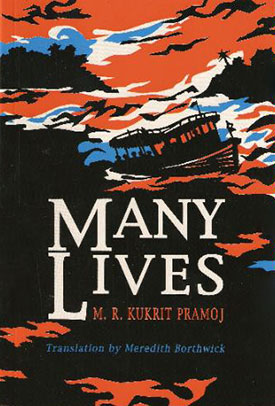 M. R. Kukrit Pramoj
Many Lives
(translated by Meredith Borthwick)
(Silkworm Books, 1996; originally 1954)
I moved to Thailand knowing no Thai writers, an embarrassing situation that’s not uncommon. Thinking of a representative Thai filmmaker or visual artist is easy; thinking of a Thai poet or prose writer, even a dead one, is much more difficult: the science fiction and horror writer S. P. Somtow might be the only current candidate. The nineteenth-century court poet Sunthorn Phu gets his own holiday here (June 26th), though he barely exists in English. I can’t really say why Thai literature is so invisible in the English-speaking world; right now I’m reading indiscriminately trying to catch up.
M. R. Kukrit Pramoj is an interesting figure, simply because he was so all over the place. He wrote a great deal of both fiction and non-fiction, and had a serious political career, including a brief stint as the prime minister. He’s undoubtedly best known in the English-speaking world for playing a prime minister alongside Marlon Brando in The Ugly American. After his death in 1995, his house, on Sathorn Road, has been turned into a museum, beautiful if poorly attended. Wikipedia gives an overview of his work, though there’s not as much detail as one would like. It does seem odd that his solitary translation should be Jonathan Livingston Seagull, though that might be Wikipedian caprice.
One notes in Wikipedia’s list of his writings the number of works that are adaptations – from John Wyndham, Giovanni Guareschi, Kurosawa; Khun Chang Khun Phaen is a retelling of an epic poem. Though not noted as such, Many Lives also falls into this category: one of the first things one notices reading the book is that it’s a fairly straightforward reworking of Thornton Wilder’s The Bridge of San Luis Rey. In that book a bridge in South America collapses and a monk wonders what the different people who died did to deserve their fate; in this one, a river boat bound for Bangkok sinks and an omniscient narrator wonders the same thing. The translator’s introduction notes that Kukrit’s book was written after seeing a bus accident in which a variety of people died; nothing is said about Wilder’s book, though it seems likely that he would have known of it or the 1944 film.
There are, it has to be said, fairly substantial differences between the books which might be usefully inspected. In Wilder’s book, the dead characters turn out to have been interlocked in life, while in Kukrit’s book there are no connections: each character gets fifteen pages about his or her life. Brief introduction and closing sections wrap up the book, but the characters are strictly isolated. Perhaps this betrays the origin of Many Lives: it was originally serialized, and even in book form it feels strongly episodic. While the reader can’t help but notice the contrasts between the character, there’s little tying them together.
Religion is inescapable. While Wilder’s book is nominally about Catholic theodicy, its argument is more clearly with the idea of predestination inherent in the American Puritan tradition. Though Wilder is remembered as a sentimentalist, his is essentially a world without God, something that Gertrude Stein gets at when she ends “A portrait of Thornton Wilder” with the lines:
He has no fears
At most he has no tears.
For them very likely he is made of them.
Wilder explicated these lines in a letter to Richard Goldstone in 1968:
“For them” means for a large part of the reading public – and for you – The Bridge of San Luis Rey and Our Town are tender, tear-drenched, and consoling. But they aren’t, they’re hard and even grimly challenging, for “He has no fears”(The Letters of Gertrude Stein & Thornton Wilder, p. 307n6.)
It’s worth emphasizing this point, because Kukrit is writing from an entirely different perspective. This becomes clear at the end of the story of the Venerable Sem, a monk whose life has been exemplary:
When his body was retrieved the next morning, everyone marvelled to see that he was still in the posture of Indra’s thunderbolt, or the diamond position. The purity and fullness of his existence had led the god of death to spare him the agony of a protracted illness. The peaceful life paused, then halted, in the water with a coolness which was like water itself. Sem had been swept out on the current to the sea, never to return to the cycle of birth and death. (p. 48)
There’s no obvious authorial distance from the voice narrating this passage; similar conclusions are given to most of the lives narrated here. The reader is asked to understand their deaths as being not senseless (as is the case with Wilder) but as part of the cycle of karma. One also notes that there’s no sense of society as a whole: though Loi, the first character introduced, is a sociopath, his villainy has no effect on anyone else; nor does the presence of the monk save them.
I find myself interested in how Kukrit’s literary career seems to included large numbers of cover versions; I can’t tell exactly what that signifies. A straight translation of The Bridge of San Luis Rey probably wouldn’t have gone very far with a Thai audience; the religious argument that Wilder was making would have seemed nonsensical. Remaking a text, as this book does, might be more sensible. Most of Kukrit’s other reversionings aren’t available in English, so it’s difficult for me to compare strategies.
disclaimer
“So that the reader of these pages may be under no misapprehension I hasten to tell him that he will find in them little information. This book is the record of a journey through Burmah, the Shan States, Siam and Indo-China. I am writing it for my own diversion and I hope that it will divert also such as care to spend a few hours in reading it. I am a professional writer and I hope to get from it a certain amount of money and perhaps a little praise.”
(Somerset Maugham, The Gentleman in the Parlour, chapter IV, p. 8.)
lavoro
Un tempo
la mia vita era facile. La terra
mi dava fiori frutta in abbondanza.
Or dissodo un terreno secco e duro.
La vanga
urta in pietre, in sterpaglia. Scavar devo
profondo, come chi cerca un tesoro.
(Umberto Saba, from Ultime cose 1935–43.)
november 16–30, 2013
Books
- Germaine Krull & Dorothea Melchers, Bangkok: Siam’s City of Angels
- Roberto Saviano, Gomorrah: A Personal Journey into the Violent International Empire of Naples’ Organized Crime System, trans. Virginia Jewiss
- Robin Fulton, An Italian Quartet: Versions after Saba, Ungaretti, Montale, Quasimodo
- Silpa Bhirasri, An Appreciation of Sukhothai Art
- William Warren, Bangkok
- W. Somerset Maugham, The Magician
- M. R. Kukrit Pramoj, Many Lives, trans. Meredith Borthwick
- S. P. Somtow, The Other City of Angels
- Antonio Tabucchi, Declares Pereira, trans. Patrick Creagh
Films
- วังพิกุล (Village of Hope), directed by Boonsong Nakphoo
- Tabu, dir. Miguel Gomes
- The Rocket, dir. Kim Mordaunt
- ประชาธิป’ไทย (Paradoxocracy), dir. Pen-ek Ratanaruang
- Insects in the Backyard, dir. Tanwarin Sukkhapisit
november 1–15, 2013
Books
- M. L. Manich Jumsai, Understanding Thai Buddhism
- Don DeLillo, Point Omega
- Somerset Maugham, The Gentleman in the Parlour
- Lawrence Osborne, Bangkok Days
- Bernard Malamud, The Assistant
- Bernard Malamud, The Fixer
Films
- It Gets Better, directed by Tanwarin Sukkhapisit
- Christiane F.: Wir Kinder vom Bahnhof Zoo, dir. Uli Edel
- Los amantes pasajeros (I’m So Excited!), dir. Pedro Almodóvar
- Raising Arizona, dir. Joel Coen
- The Buddha’s Forgotten Nuns, dir. Wiriya Sati
Exhibits
- MOCA Bangkok
- “Resort,” BACC
- “Re-Think: Art Exhibition for Reduce ‘Waste’ Renew ‘Think’,” BACC
- “Oscillation,” Speedy Grandma
- “Manit Srisuwan: Me My Mind,” Number 1 Gallery
- “Ekkarat Punyatara: It’s Personal,” Kathmandu Photo Gallery
- “Jittima Sa-ngeamsunthron: My World,” Numthong Gallery at Aree
- “Here Is Zine: 7th Bangkok-Tokyo Exhibition,” Next To Normal, Centralworld
- “Alain Soldeville: Once Upon a Time on Bugis Street,” Kathmandu Photo Gallery