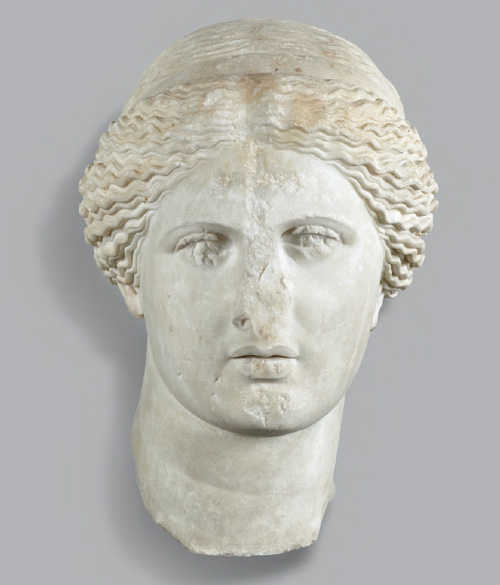
(Head of Aphrodite with cross carved in it; 1st century, Parian marble, found near the Tower of the Winds, in the Roman Agora in Athens. Usually in the National Archeological Museum in Athens; currently at the Onassis Cultural Center as part of “Transition to Christianity: Art of Late Antiquity, 3rd–7th Century A.D.”.)
list of names for the biblical nameless
“Note: We are expressly told in Exodus 2:21 that Moses was given for his wife, Zipporah, the daughter of Reuel (aka. Jethro) the Midianite, the priest of Midian. We are not expressly told that he married anyone else. It is possible for Zipporah to be of Cushite/Ethiopian ancestry if Reuel’s wife was an Ethiopian, or even the mind-staggering possibility that Abraham’s 3rd wife Keturah was an Ethiopian. (His 2nd wife Hagar was an Egyptian.)”
(from “The Cushitic wife of Moses” in Wikipedia’s List of names for the biblical nameless.)
december 1–december 15
Books
- Bruce Chatwin, In Patagonia
- L. S. Asekoff, Dreams of a Work
- Lauren Beukes, Zoo City
- Cecily Mackworth, The Destiny of Isabelle Eberhardt: A Biography
Films
- A Time to Love and a Time to Die, dir. Douglas Sirk
- The Tarnished Angels, dir. Douglas Sirk
- Pootie Tang, dir. Louis C.K.
- Gray’s Anatomy, dir. Steven Soderbergh
- And Everything Is Going Fine, dir. Steven Soderbergh
- The Accidental Tourist, dir. Lawrence Kasdan
- To Be or Not To Be, dir. Ernst Lubitsch
- Rare Exports, dir. Jalmari Helander
Exhibits
- “Fluxus and the Essential Questions of Life,” Grey Art Gallery
- “Transition to Christianity: Art of Late Antiquity, 3rd–7th Century A.D.,” Onassis Cultural Center
- “Elizabeth Bishop: Objects & Apparitions,” Tibor de Nagy
- “Jess: Paintings,” Tibor de Nagy
- “Material Witness,” Pavel Zoubok
- “Yoko Ono: Uncursed,” Galerie Lelong
- “Hiroshi Sugimoto: Surface of the Third Order,” Pace Gallery
- “Matta: A Centennial Celebration,” Pace Gallery
- “Peter Hujar: Three Lives: Peter Hujar, Paul Thek, & David Wojnarowicz,” Matthew Marks
- “Karen Knorr: India Song,” Danziger Gallery
- “Ben Vautier: Solo Show,” Vicky David Gallery
november 16–november 30
Books
- Steven Levy, Hackers: Heroes of the Computer Revolution
- Samuel R. Delany, Times Square Red, Times Square Blue
- L. S. Asekoff, The Gate of Horn
- L. S. Asekoff, Freedom Hill
- Renee Gladman, The Ravickians
- Anka Muhlenstein, Balzac’s Omelette, trans. Adriana Hunter
Films
- Roma, directed by Federico Fellini
- You Can’t Cheat an Honest Man, dir. George Marshall & Edward F. Cline
- Little Shop of Horrors, dir. Roger Corman
- The Creature from the Haunted Sea, dir. Roger Corman
- King of the Hill, dir. Steven Soderbergh
- Inside Job, dir. Charles Ferguson
Exhibits
- “Art in Renaissance Venice, 1400–1515: Paintings and Drawings from the Museum’s Collection,” Met
- “Perino del Vaga in New York Collections,” Met
- “Picasso’s Drawings, 1890–1921: Reinventing Tradition,” Frick
- “Georges Braque: Pioneer of Modernism,” Acquavella Galleries
- “Influential Friends by Peter Hujar,” John McWhinnie at Glenn Horowitz Bookseller
the unicorns in patagonia
“‘O Patagonia!’ he cried. ‘You do not yield your secrets to fools. Experts come from Buenos Aires, from North America even. What do they know? One can but marvel at their incompetence. Not one paleontologist has yet unearthed the bones of the unicorn.’
‘The unicorn?’
‘Precisely, the unicorn. The Patagonian unicorn was contemporary with the extinct megafauna of the Late Pleistocene. The last unicorns were hunted to extinction by man in the fifth or sixth millennium B.C. At Lago Posadas you will find two paintings of unicorns. One holds its horn erect as in Psalm 29: “My horn shalt thou exalt like the horn of an unicorn”. The other is about to impale a hunter and stamps the pampas, as described in the Book of Job.’ (In Job 38:21 it is the horse that ‘paweth the valley’, while in verses 9–10 the unicorn is found unfit to haul a plough.)”
(Bruce Chatwin, In Patagonia, p. 73.)
the indolent security of the germans
“Jovinus, who had viewed the ground with the eye of a general, made his silent approach through a deep and woody vale, till he could distinctly perceive the indolent security of the Germans. Some were bathing their huge limbs in the river; others were combing their long and flaxen hair; others again were swallowing large draughts of rich and delicious wine.”
(Edward Gibbon, The Decline and Fall of the Roman Empire, vol. II, chapter XXV; p. 990 in volume 1 of the Penguin edition.)
like a skilful politician
“101. At first Constantine threatened in speaking, but requested in writing, και αγραφως μεν ηπειλει δε, ηξιον. His letters gradually assumed a menacing tone; but while he required that the entrance of the church should be open to all, he avoided the odious name of Arius. Athanasius, like a skilful politician, has accurately marked this distinctions (tom. i. p. 788), which allowed him some scope for excuse and delay.”
(Edward Gibbon, The Decline and Fall of the Roman Empire, vol. II, chapter XXI; p. 798 in volume 1 of the Penguin edition.)
the almost invisible and tremulous ball of orthodoxy
“Within these limits the almost invisible and tremulous ball of orthodoxy was allowed securely to vibrate. On either side, beyond this consecrated ground, the heretics and dæmons lurked in ambush to surprise and devour the unhappy wanderer. But as the degrees of theological hatred depend on the spirit of war, rather than on the importance of the controversy, the heretics who degraded, were treated with more severity than those who annihilated, the person of the Son. The life of Athanasius was consumed in irreconcileable opposition to the impious madness of the Arians; but he defended above twenty years the Sabellianism of Marcellus of Ancyra; and when at last he was compelled to withdraw himself from his communion, he continued to mention, with an ambiguous smile, the venal errors of his respectable friend.”
(Edward Gibbon, The Decline and Fall of the Roman Empire, vol. II, chapter XXI; p. 783 in volume 1 of the Penguin edition.)
demilitarization
“I let it be known to my friends, and even strangers as I was wandering around the country that what was interesting me was making English less understandable. Because when it’s understandable, well, people control one another, and poetry disappears – and as I was talking with my friend Norman O. Brown, and he said, ‘Syntax,’ which is what makes things understandable, ‘is the army, is the arrangement of the army.’ So what we’re doing when we make language un-understandable is we’re demilitarizing it, so that we can do our living.”
(John Cage, interviewed about Empty Words, 8 August 1974.)
november 1–november 15
Books
- Parker Tyler, Florine Stettheimer: A Life in Art
- John Crowley, Conversation Hearts
- Roberto Arlt, Mad Toy, trans. Michele McKay Aynesworth
- Percival Everett, Glyph
- Robert Kelly, Queen of Terrors
Films
- Rome Against Rome, directed by Giuseppe Vari
- Nothing Sacred, dir. William Wellman
- A Bucket of Blood, dir. Roger Corman
- Absolute Wilson, dir. Katharina Otto-Bernstein
- Nóż w wodzie (Knife in the Water), dir. Roman Polanski
Exhibits
- “Stieglitz and His Artists: Matisse to O’Keeffe,” Met
- “Photographic Treasures from the Collection of Alfred Stieglitz,” Met
- “Historic Images of the Greek Bronze Age: The Reproductions of E. Gilliéron & Son,” Met
- “John Ashbery: Recent Collages,” Tibor de Nagy
