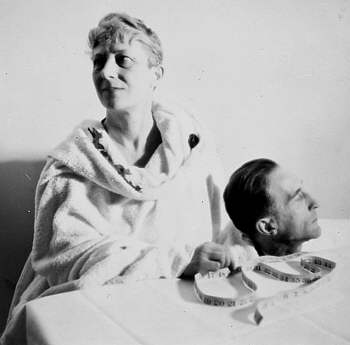
(Man Ray. Photograph of Mary Reynolds and Marcel Duchamp. Gelatin silver print; 15 x 14.9 cm. The Art Institute of Chicago)
(Man Ray. Photograph of Mary Reynolds and Marcel Duchamp. Gelatin silver print; 15 x 14.9 cm. The Art Institute of Chicago)
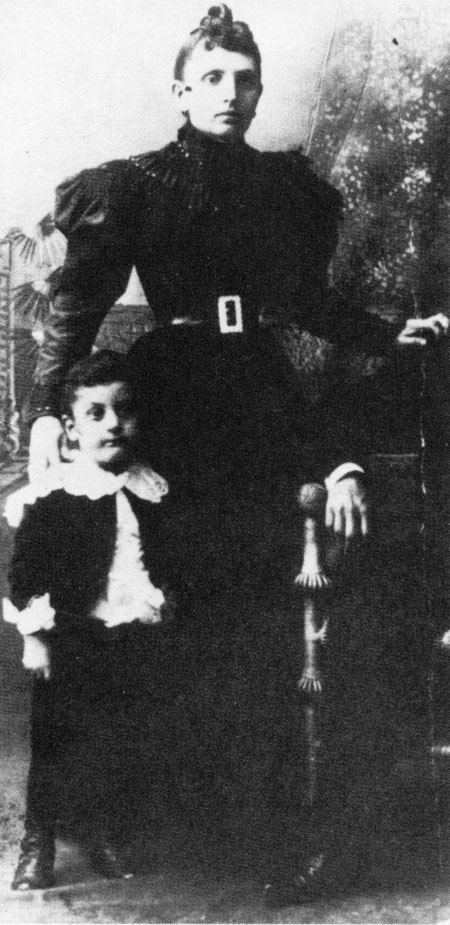
(the earliest known photo of Man Ray (with his mother) from his autobiography Self Portrait, p. 14)
“Having looked at them without talking to them, he took his eyes away but he directed them to the one who rushed out from my skull in the form of thick grey smoke and sat one one of the chairs. then he said loudly: ‘Yes, Mr “Memory”, what are your accusations against Mr First “Mind”?’ Then when the thick grey figure which was my ‘memory’ stood up, he first bowed for the deceptive judge which was my ‘kidney’ and he explained to him with a sad voice: ‘Yes, Judge “Kidney”, my accusations against Mr First “Mind” are that when we were with our Possessor,’ my ‘memory’ called me their possessor, ‘as his partners and advisers, while he went and returned safely on his two dangerous journeys, Mr First “Mind” misled our Possessor several times, which nearly ran our Possessor to death. But if I were not with him, and also Mr Second “Mind”, our Possessor would have perished in the wild jungles or when he and his wife were sacrificed to the god of the river. So for this reason, Mr First “Mind” must be severely punished even to death!’ Thus Mr ‘Memory’ explained to the deceptive Judge ‘Kidney’ and then he bowed and sat back.”
(Amos Tutuola, The Witch-Herbalist of the Remote Town (1981), p. 199)
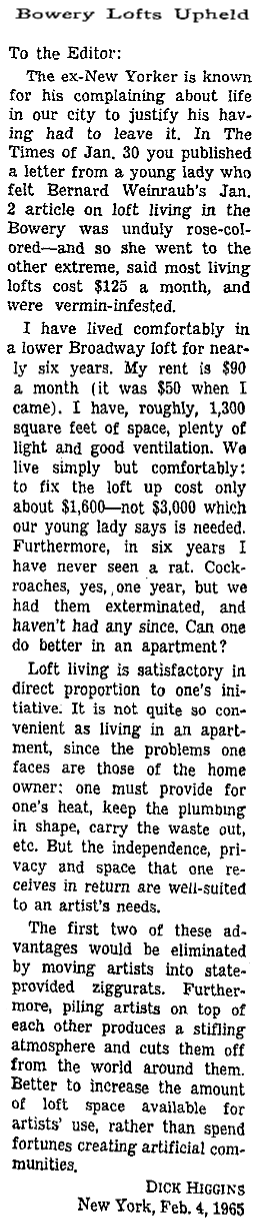
Here’s a letter from Dick Higgins about rent from 13 February 1965:
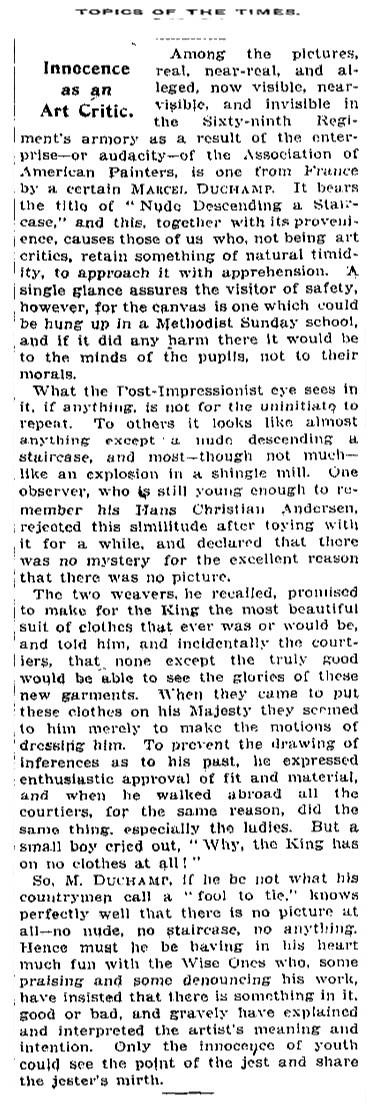
And here’s what appears to be Marcel Duchamp’s first appearance in the Times, an unsigned note in the “Topics of the Times” section from Sunday, 1 March 1913:
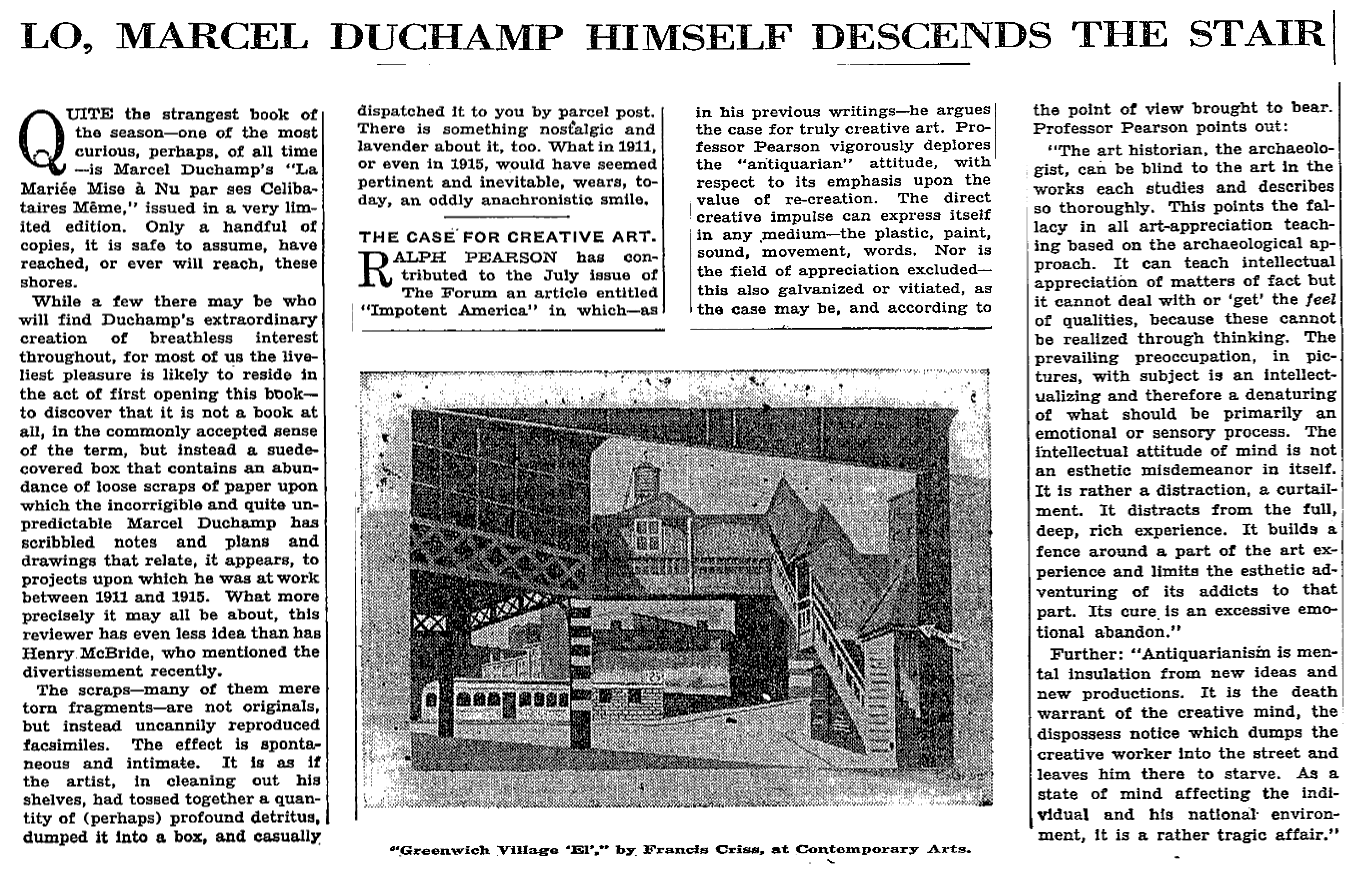
An unsigned notice on the publication of Duchamp’s Green Box with a lovely turn of phrase: “there is something nostalgic and lavender about it, too”. From 30 June 1935; also seems to be unsized. Click the thumbnail for the full-sized scan.
And a bonus Jean Painlevé:
from the NY Times:
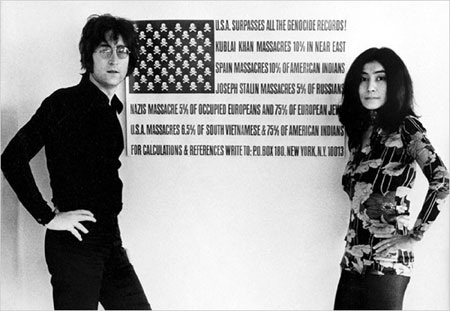
Lennon & Ono standing in front of George Maciunias’s U.S.A. Surpasses All the Genocide Records!.
Also worth mentioning if entirely unconnected: wood s lot has a collection of Michel Butor material.
There’s a Circumference reading this Sunday, September 17th at 4pm. Hosted by the Bowery Poetry Club‘s World of Poetry bilingual poetry series. Anne Twitty reads translations of Maria Negroni; Ilya Bernstein reads Osip Mandelstam; and Anita Naegeli reads Raphael Urweider. 308 Bowery (at Bleaker), NY, NY. $7. Eventually we’ll have Issue 5 out, but that’s taking a while.
(Also noteworthy: Ron Silliman, Debra di Blasi, and Samuel R. Delany at KGB on Friday at 7pm.)
This was broken, but now it’s fixed. I don’t know what happened. Variously:
“—Was it you I saw this afternoon? a little while ago?
—Me? Why? Where?
—Were you there, where they’re showing Picasso’s new . . .
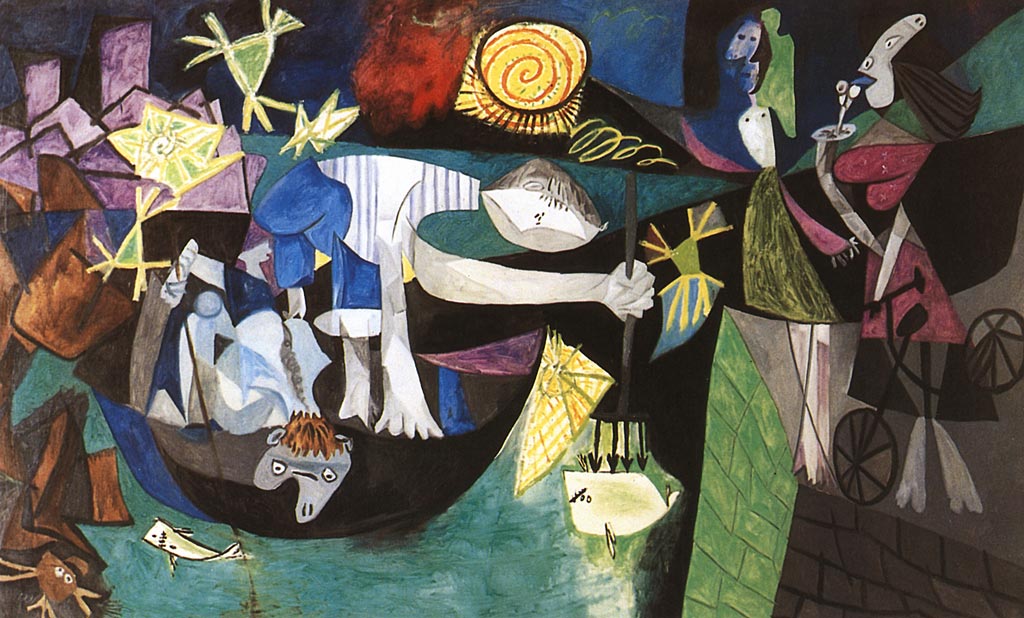
—Night Fishing in Antibes, yes, yes . . .
—Why didn’t you speak to us?
—Speak to who? You? Were you there?
—I was there, with a friend. You could have spoken to us, Wyatt, you didn’t have to pretend that . . . I was out with someone who . . .
—Who? I didn’t see them, I didn’t see you, I mean.
—You looked right at us. I’d already said, There’s my husband, we were near the door and you were bobbing . . .
—Listen . . .
—You went right past us going out.
—Look, I didn’t see you. Listen, that painting, I was looking at the painting. Do you see what this was like, Esther? seeing it?
—I saw it.
—Yes but, when I saw it, it was one of those moments of reality, of near-recognition of reality. I’d been . . . I’ve been worn out in this piece of work, and when I finished it I was free, free all of a sudden out in the world. In the street everything was unfamiliar, everything and everyone I saw was unreal, I felt like I was going to lose my balance out there, this feeling was getting all knotted up inside me and I went in there just to stop for a minute. And then I saw this thing. When I saw it all of a sudden everything was freed into one recognition, really freed into reality that we never see, you never see it. You don’t see it in paintings because most of the time you can’t see beyond a painting. Most paintings, the instant you see them they become familiar, and then it’s too late. Listen, do you see what I mean?
—As Don said about Picasso . . . she commenced.
—That’s why people can’t keep looking at Picasso and expect to get anything out of his paintings, and people, no wonder so many people laugh at him. You can’t see them any time, just any time, because you can’t see freely very often, hardly ever, maybe seven times in a life.
—I wish, she said, —I wish . . .”
(Gaddis, The Recognitions, pp. 91–92.)