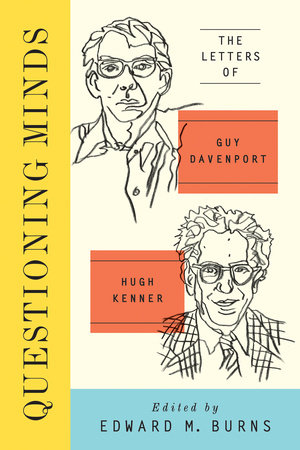
Questioning Minds: The Letters of Guy Davenport and Hugh Kenner
Edward Burns, editor
(Counterpoint, 2018)
One of my reading projects for the year has been to make my way through this immense collection of letters, which has been in my life for a while, though I hadn’t managed to get around to it. Kenner’s The Pound Era seemed crucial to me when I was in college, though it isn’t something that I’ve returned to (maybe to my detriment); his writings on literature and technology have also been useful. Guy Davenport is someone I started reading at around the same time – at that point, he might have been reviewing books for Harper’s – and has sustained my interest more, shooting off tendrils into any number of imaginative directions – though he still seems opaque as a person. As a project, this is astounding – Edward Burns, the editor, did a phenomenal amount of work, annotating a massive amount of content with extraordinary thoroughness. There’s an extremely useful index. This is clearly the product of years of work. The books are beautiful; I can’t imagine the market for this is big enough that Counterpoint could have made back their money. I’m glad it exists; I wonder how many readers it has found.
These volumes present the relationship between Kenner and Davenport over a long period of time: Davenport starts out as a junior academic complimenting Kenner on his style; Davenport is adept at finding sources. This balances out a bit over time, though it stays consistent. The book climaxes with the publication of The Pound Era, early in the second volume; one has the distinct impression that book wouldn’t have existed without Daveport. After this, the work becomes less interesting; Ezra Pound is succeeded by Buckminster Fuller as the presiding genius that Kenner wants to explicate. A little bit of Fuller goes a long way; Davenport gamely makes geodesic spheres out of dowels, but you can tell his heart isn’t in it. As time goes by, Davenport spends more of his energy on fiction; Kenner says relatively little about it his letters, and it’s not clear what should be read into that.
I don’t know that Ezra Pound matters as much to me as he once did, though I can see here that the things that excited me excited them as well. At the same time, looking at how Pound functioned in their lives inevitably makes me wonder about politics, and how much the aesthetic can be separated from the political. A good deal of this book is about the process of laundering the reputation of a poet who was at least for a while a Fascist; Kenner and Davenport are publishing in conservative magazines and journals (the National Review, later the Cato Institute’s Inquiry). Kenner is the more enthusiastic conservative, happy to pal around with William F. Buckley on skis and boats; at one point he comes out in favor of Goldwater. Somewhat predictably he converts to Catholicism. Davenport’s politics seem more circumspect. Neither misses a chance to use an ethnic slur; Kenner is dismissive of gay people and women. In the mid-1970s, Kenner proposes an anthology of twentieth-century writing, which initially contains only one woman (Sylvia Plath, who he doesn’t want to include); Davenport doesn’t point this out, though he suggests women who could be included.
Kenner puts much more effort into being a public intellectual and a successful academic; Davenport is more private, spending time on work and correspondence. (Davenport refers to interactions with students more often; for Kenner, they seem incidental.) There’s something admirable about Kenner’s range – trying to explain Fuller’s math to the common reader, for example, or his computer guide, or his book about Chuck Jones – but I suspect the interest of this aspect of Kenner’s work has faded over time. Davenport’s friendships seem more interesting – Marianne Moore, Eudora Welty, Stan Brakhage, Thomas Merton, Robert Kelly – and end up in unexpected places: besides Brakhage, he seems to have interacted with a lot of people in the American experimental film world, as well as Fluxus-adjacent artists like Daniel Spoerri. Jonathan Williams seems to have started as Kenner’s correspondent and ended up as a repeated houseguest of Davenport.
And it’s dated. It’s hard now to imagine how much time could be spent trying to find if a word was spelled in some way somewhere in some edition of some book. Meaning is ascribed to things that later turn out to be transcription errors – maybe fifty years later in the book one of them notes that Pound typed and retyped things, often misspelling things out of carelessness. More than this, the religious necessity to pick sides feels more distant than it might – is it really necessary to choose either, for example, Wyndham Lewis or the Bloomsbury Group? There seems to be the assumption that there’s a single correct answer to that question which seems strange now. Kenner’s reading of Pound feels almost religious in character – if Pound believed it, it must be right, which feels necessarily problematic. (Davenport’s fixation on Pound does seem to recede over time: Pound’s method of reading the past seems more important to him than Pound himself, and Davenport seems more naturally polytheist.)
The book has an extremely good index, and it’s possible that entering the text that way that is a smarter way of reading the book than just going straight through as I did; though by following along their long path, one picks up any number of incidental details and pointers to interesting things, a large part of the pleasure of this book. They both get extremely excited about The Lord of the Rings and spend a long time talking about that; at one point, they wonder if they should use an extract as an epigraph for The Pound Era. Kenner confesses that he has been writing about Buster Keaton without ever having managed to see any of his movies, which I suppose might have been something that could have happened back then. There is, however, a long decline over the second half of it: it’s hard to tell if correspondence is missing, or things just happened by telephone, or if they just stopped engaging with each other as much. It’s slightly disappointing if you’re hoping for biographical detail: it feels like if not a falling out, there was a falling off, but the reader is firmly outside of what happened, maybe as it should be. Kenner feels a bit smaller to me after reading this; Davenport still seems like a thorny enigma.
Mentions
Books Charlie Kaufman, Antkind Naomi Mitchison, Memoirs of a Spacewoman Questioning Minds: The Letters of Guy Davenport and Hugh Kenner, edited by Edward Burns Henri-Pierre…