marina

Quis hic locus, quae regio, quae mundi plaga? 

What seas what shores what grey rocks and what islands
What water lapping the bow
And scent of pine and the woodthrush singing through the fog
What images return
O my daughter.

     Those who sharpen the tooth of the dog, meaning
Death
Those who glitter with the glory of the hummingbird, meaning
Death
Those who sit in the sty of contentment, meaning
Death
Those who suffer the ecstasy of the animals, meaning
Death

     Are become insubstantial, reduced by a wind,
A breath of pine, and the woodsong fog
By this grace dissolved in place
     What is this face, less clear and clearer
The pulse in the arm, less strong and stronger—
Given or lent? more distant than stars and nearer than the eye

     Whispers and small laughter between leaves and hurrying feet 
Under sleep, where all the waters meet. 

     Bowsprit cracked with ice and paint cracked with heat.
I made this, I have forgotten
And remember.
The rigging weak and the canvas rotten
Between one June and another September.
Made this unknowing, half conscious, unknown, my own.
The garboard strake leaks, the seams need caulking.
This form, this face, this life
Living to live in a world of time beyond me; let me
Resign my life for this life, my speech for that unspoken,
The awakened, lips parted, the hope, the new ships.

     What seas what shores what granite islands towards my timbers
And woodthrush calling through the fog
My daughter.

(T. S. Eliot, 1930)
disorder, mental, strikes me; i

Disorder, mental, strikes me; I
Slip from my pocket Dante to
Chance hit a word, a friend’s reply
In this bar; bare, dark avenue
The lunge of headlights, then bare dark
Cross on red, two blocks home, old Sixth
The alive, the dead, answer, ask
Miracle consciousness I’m with
At home cat chirps, Norwegian sweater
Slumped in the bar, I mind Dante
As dawn enters the sunk city
Answer a one can understand
Actual events are obscure
Though the observers appear clear

(Edwin Denby, from “Later Sonnets” in The Complete Poems.)

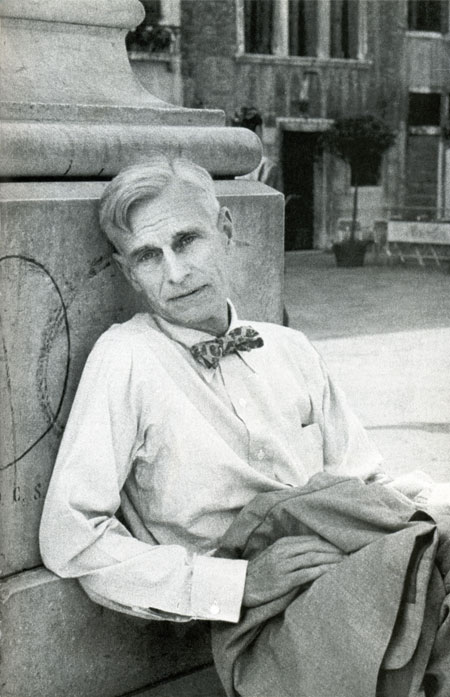
edwin denby by jerome robbins

(photo by Jerome Robbins)

pages

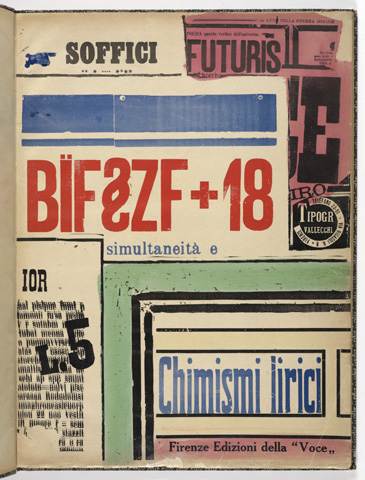
“So the notion of a book needs defining. The concept employed here is simply this: a book is something that unfolds itself. It is always offering portions of its self, withdrawing others, suggesting still others. Emerging, present, receding: there is how a book is. It is a manufactured thing. It works in certain ways; it cannot work in others. It has pages. There is the embarrassingly primitive essence of it.

We do not do nearly enough with what we have invented. Our sense of event, of plot, ought to be keyed to that, to the simple fact that a book is a thing of pages, and to the fact that a page will turn.

The turning of a page is an aesthetic event; or at any rate, it should be. Anyone who writes will know how oddly crucial it can be that a certain page end with a certain word, that the next one begin with a certain other.”

(Eugene Wildman, afterward to Anthology of Concretism (1969), pp. 161–162)

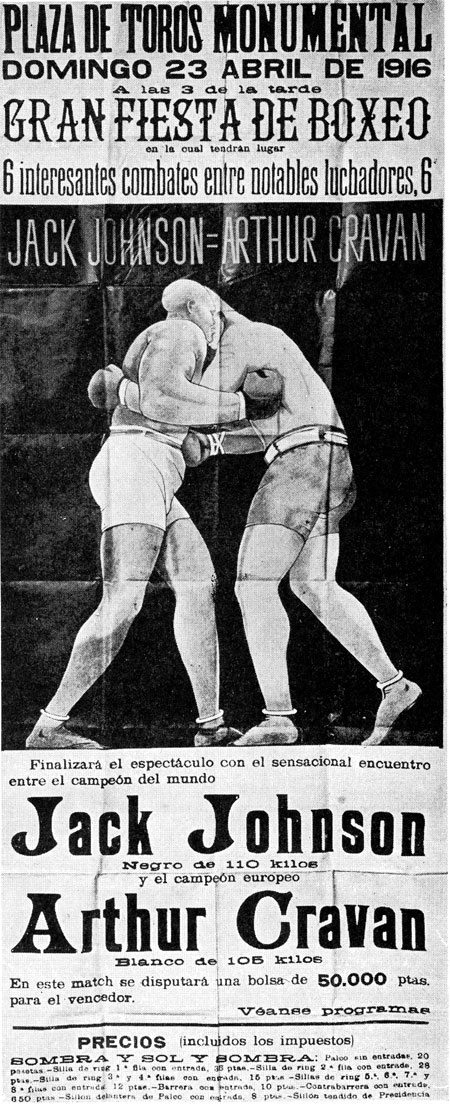
arthur cravan, boxer & art critic

poster again

“. . . . Soon you won’t see anyone but artists in the street and the one thing you’ll have no end of trouble in finding is a man. They are everywhere: the cafés are full of them, new art schools open up every single day. I’ve always wondered how a teacher of painting, unless he teaches a locksmith how to copy keys, has ever been able to find a single pupil since the beginning of the world. People make fun of those who frequent palm-readers and other fortune tellers and never indulge in any irony about the simple souls who go to art school. Can anyone learn to draw or paint, to have talent or genius? And yet we find in these studios big dadoes of thirty or even forty and God forgive me, ninnies of fifty, yes, sweet Jesus! poor old fogies of fifty . . . .

It may be argued that art schools provide painters with heat in winter and a model. And for a true painter a model is life itself. At any rater you can judge for yourself whether a professional model is more alive than the plaster statues people copy in the Ecole des Beaux-Arts; but the frequenters of the Academie Matisse are full of contempt for the pompous deadheads at the Beaux-Arts; why, just imagine: they are turning out advanced art. It is true that some among them believe that art is superior to nature. Yes, my dear!

I am astonished that some crook has not had the idea of opening a writing school.”

(Arthur Cravan, “Exhibition at the Independents” (1914). Reprinted in Robert Motherwell’s The Dada Painters & Poets: An Anthology, p. 4. Translated by Motherwell, I assume.)

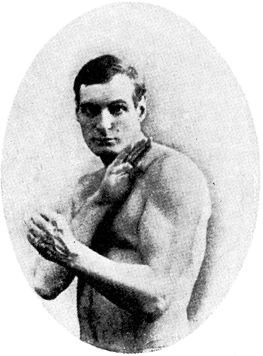
arthur cravan in fighting stance, 1916?