I’m taking part in a group reading of Marguerite Young’s enormous and seldom read Miss Macintosh, My Darling over at World’s Least Popular Book Club. Others involved are Damion Searls, Will Schofield, Levi Stahl, Ed Park, and Stephen Sparks. It should be entertaining . . .
anna maria ortese, “the iguana”
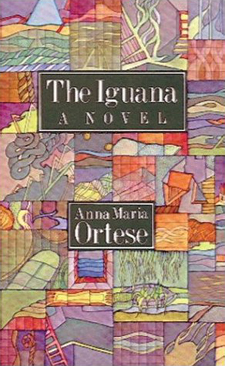 Anna Maria Ortese
The Iguana
(trans. Henry Martin)
(McPherson & Company, 1987; originally 1965)
When I was young, I had a great love of books that eschewed realism: the predictable science fiction in junior high, followed by Kafka, Vonnegut, Borges, and García Márquez in high school. The reasons behind this aren’t particularly hard to ferret out: when you’re growing up in an environment as dreadfully prosaic and generally deprived of stimuli as the rural Midwest was then, any offer of escape is tempting. It’s exciting when Gregor Samsa wakes up and finds himself turned into a beetle when you’ve woken up thousands of times and that never happens: the pull is that something different might be possible. Dalí’s soft watches, Redon’s floating heads, Magritte’s flaming tubas were attractive because they weren’t what you saw in the boring world. Baudelaire’s “Anywhere out of the World” might be a credo for this sort of thinking. This wasn’t, of course, the only reason that I found value in those writers or artists; but it was a not insignificant part. And in part this was a reactive impulse: narratives in which anything could happen were more entertaining than the Dickens or Hawthorne we were presented in class as examples of serious literature.
As time went on, I found myself less drawn to this sort of writing: re-reading Moby-Dick in college, I finally realized it wasn’t a book about hunting a whale; re-reading Ulysses, I finally understood that style could be as interesting that what you were taking about, no matter how boring it might appear. The world became interesting in its own right. And with this turn came the thinking that the fantastic was a little cheap, perhaps lazy: a crutch to be inserted when the regular story wasn’t interesting enough on its own. Inventiveness became less valuable than ability. There’s nothing to stop a writer who’s broken the bounds of the ordinary world from continuing to do so, deflating all tension. If you’ve decided that angels are going to float around your hospital, there’s not really anything to stop them from winding up your plot for you. Constraint of some sort is necessary. Kafka still works because the one moment of strangeness he inserts becomes the absent center of his story; The Metamorphosis isn’t about insects.
I don’t know that this is a general principle of my reading; but when there are more books to be read than I can feasibly read, it’s a useful principle for pruning. I don’t think there’s any sort of dichotomy between the realistic and the fantastic, and I’m not by any means attempting to mount a defense of realism, whatever that might be construed as. But all of this brings me to Anna Maria Ortese’s The Iguana, which has ignominiously sat on my shelves along with two volumes of short stories since I bought them from a McPherson booth at a book fair a few years ago. Henry Martin is a fantastic translator & the co-author, with Gianfranco Baruchello, of two of my favorite books, and McPherson’s taste is next to impeccable; I have, really, no excuse for taking so long to read this. Better late than never, I suppose.
From the beginning of this book, the reader is unsettled. The book is written in the style of a fairy tale; an immensely wealthy Count, sometimes Aleardo, sometimes Daddo, lives with his mother in Milan. Technology is absent; the date is difficult to pin down, though there’s criticism of the Milanese (too property-oriented, too in love with business) that comes from a recognizably southern Italian perspective. One assumes that because of the persistence of nobility, we are sometime before the creation of the Italian Republic in 1946, maybe the late nineteenth century; but one also remembers that Italian nobility does persist, though it’s no longer legally recognized. That we are in the present becomes apparent in a description of Daddo’s best friend:
[Daddo] had not yet married, and had no marital intentions, even in spite of the pressures of his mother the Countess, who had already paid visits to several prominent Swiss families. He felt marriage would have limited him, yet one couldn’t say how. He led the simplest life conceivably, the almost monotonous life of a monk. He spun out his days in the studio, drawing houses like a child, and his sole evening amusement was the company of Boro Adelchi, a young publisher of the nouvelle vague, extremely ambitious, but with still garbled finances. We’ll add, parenthetically, that Daddo was careful to keep mother in the dark about constantly backing his friend with notable amounts of cash. (p. 3)
Adelchi seems to be created in the mode of Giangiacomo Feltrinelli, discoverer of Doctor Zhivago and The Leopard; The Iguana was published seven years before Feltrinelli wound up dead, but Adelchi’s desires to publish the new (which he hopes that Daddo can discover in his travels) are very much in his form:
Here we have to offer a few words about a strange confusion that dominated Lombard culture at the time, thereby setting the tone of publishing – a confusion concerning the character of oppression and consequent revolt. Perhaps attempting to polemicize against the menaces of Marxist ideology, the Milanese saw oppression and revolt as no more than a question of feelings and the right to express them, forgetting that not even feelings survive – neither feelings nor any desire to express them – when people have no money (given the world’s time-honored conventions), or where money can buy everything, or where penury cohabits with great ignorance. Briefly put, the Milanese were persuaded that some world of oppression had something to say, whereas the oppressed don’t even exist, or can’t, at least, have any awareness of being oppressed when their condition is authentic and a legacy from a distant past. The only thing left is the oppressor, who likewise has no knowledge of what he is, even while sometimes, out of habit, aping the stances and behavior that would legitimately befit his victim, if any such victim had escaped extinction. But these of course are sophistries that could never have assuaged the publishers’ hunger for things with which to whet the public’s languid appetite. Such arguments slow the rhythms of production. But to turn the issue upside down – an issue very fashionable at the time – and to see oppression in frankly traditional and therefore reassuring terms, gave a fool-proof guarantee of approval, excitement, good will, and finally sales, coming again full circle to much-loved money. (pp. 4–5)
This lengthy excerpt presages, in certain terms, what will happen in the book. Daddo sails from Genoa out of the Mediterranean, in hopes of finding islands to buy for his mother and narratives to buy for Adelchi to publish. Somewhere off the coast of Portugal he finds the unmapped island of Ocaña. (An otherwise useful online biography of Ortese – embarrassingly, the English Wikipedia lacks a page on her – explains that “Ocaña” is the name used by Stevenson in Treasure Island, which doesn’t seem to be the case: an Italian translation of that book used “l’Isola dello Scheletro,” a straightforward version of “Skeleton Island.” There’s an Ocaña in Colombia, and an Ocaña in the middle of Spain – site of the Battle of Ocaña in the peninsular war – but neither of those seem to have anything to do with Ortese’s narrative.) Ocaña is inhabited by impoverished Portuguese gentry; conveniently, Don Ilario has both poetry that might be published, and it seems possible that Daddo might be able to convince him to sell his island. Again to quote from the beginning of the book, Daddo suggests to Adelchi what he might want:
“What you need are the confessions of some madman, how about the story of a madman in love with an iguana?” came Daddo’s playful reply, and who knows how such a thing managed to enter his head? In fact he quickly turned silent and felt ashamed of himself for making fun of illness and the innocent lives of animals. Like so many Lombards, he felt enormous compassion for both, despite never having had anything to do with them. (pp. 3–4)
This is, of course, exactly what ends up happening in the book. Don Ilario and his half-brothers have as their servant an iguana named Estrellita, whom they pay with rocks as they maintain that she is not human. Daddo sees this injustice and wants to relieve it; he falls in love with the iguana, who remains in thrall to Don Ilario. Complications ensue; theology comes into play; a bunch of people arrive who shouldn’t be there, and it appears that machinations have been set in place for Don Ilario to regain his fortune by marrying an American, a scheme which the existence of the iguana will foil. This builds and builds to a feverish pitch; a few chapters before the end of the book we learn that Daddo, from whose perspective the book has been narrated, has gone mad and has been imagining an old peasant woman to be an iguana; he dies, his mother cleans everything up, and the narrative is brought to a close.
What is this book about then? It’s not about the etiology of madness; Daddo’s madness is his fundamental approach to the world, which is wrong and untenable. Daddo has tried to live justly; his view of the world as something that can be bought makes that impossible and causes him to break down. Ortese presents Daddo sympathetically, which is what makes this book so haunting; but it is always clear that her sympathies are elsewhere, in a harder-edged world.
june 16–june 30
Books
- Marcel Allain, Juve in the Dock, trans. A. R. Allinson
- Marcel Allain, Fantômas Captured, trans. A. R. Allinson
- Marcel Allain, The Revenge of Fantômas, trans. Afred Allison
- Mario Bellatin, Beauty Salon, trans. Kurt Hollander
- Mario Bellatin, Chinese Checkers: Three Fictions, trans. Cooper Renner
- Victor Papanek, Design for the Real World: Human Ecology and Social Change
- Marcel Allain, The Yellow Document, or Fantômas of Berlin, trans. unknown
- Anna Maria Ortese, The Iguana, trans. Henry Martin
- Dino Buzzati, Larger Than Life, trans. Henry Reed
- Carlo Levi, The Linden Trees, trans. Joseph M. Bernstein
- Dino Buzzati, Restless Nights, trans. Lawrence Venuti
the end of the world
“One morning around ten o’clock an immense fist appeared in the sky above the city. Then it slowly unclenched and remained this way, immobile, like an enormous canopy of ruin. It looked like rock, but it was not rock; it looked like flesh but it wasn’t; it even seemed made of cloud, but cloud it was not. It was God, and the end of the world. A murmuring, which here became a moan, there a shout, spread through the districts of the city, until it grew into a single voice, united and terrible, rising shrilly like a trumpet.”
(Dino Buzzati, “The End if the World,” trans. Lawrence Venuti, p. 7 in Restless Nights.)
artificial intelligence, italian style
“ ‘Excuse me,’ said Olga, interrupting her. She turned to her husband. ‘Does she speak too? The machine, I mean.’
‘Not in the normal sense, no. It doesn’t know languages. We’ve been firm about that. It would have been fatal if we’d taught it a language. Speech is the greatest enemy of mental clarity. Through wanting to express his thoughts in words at all costs, man has got himself into such a mess that—’ ”
(Dino Buzzati, Larger Than Life (1960), trans. Henry Reed, p. 72)
something you have never thought about
“Anyone whom God has given a fate of continuous encounters with Evil has been dealt a terrible blow, though Catholics, of course, don’t make the best example. For Catholics, Evil lies finally and exclusively in the absence of the Pleasures, whereas Protestants furnish a truer measure of the portent of really believing in the Devil, sometimes hanging him by the neck, sometimes cutting off his head, sometimes burning his body with billions of fiery sparks on a modernly invented chair. So, a terrible destiny has been allotted to people who have been thrown by God or their own ambitions (this is not yet clear) into continual conflict with perversity. But have you ever given a thought to the desperate plight of Perversity or Wickedness itself, deprived for virtually mathematical reasons of all possible struggle with itself, or of flight from itself, and therefore condemned to the constant horror of its own desperate presence, this presence being nothing other than itself? No, that’s something you have never thought about.”
(Anna Maria Ortese, The Iguana, pp. 92–3, trans. Henry Martin.)
the daring colloquialisms of modern slang
“ ‘I must be patient, by the Lord! of course I must . . . and I have been . . . Still, I mustn’t, either, show the energy of a jelly-fish!’
The journalist, who delighted in the daring colloquialisms of modern slang, need have had no fear of ever being credited with energy of that flabby sort.”
(Marcel Allain, Fantômas Captured, trans. A. R. Allinson (1926), p. 119)
noted
- William Gaddis (and his second wife Judith) evidently appeared as an extra in 1973’s Ganja & Hess, a cut-rate vampire movie. See him here, here, and here.
- A decent review of the new editions of Impressions of Africa and New Impressions of Africa at Open Letters Monthly.
- A newly translated (by Anne McLean) excerpt of Julio Cortázar’s From the Observatory at Agni.
- Amie Barrodale’s “William Wei” at the Paris Review.
june 1–june 15
Books
- Giuseppi Gioachino Belli, The Roman Sonnets of Giuseppi Gioachino Belli, trans. Harold Norse
- Raymond Roussel, Locus Solus, trans. Rupert Copeland Cuningham
- Harry Mathews, Trial Impressions
- Harry Mathews, Armenian Papers: Poems 1954–1984
- Harry Mathews, The New Tourism
- Robert Seydal, Book of Ruth
- Mark Ford, Soft Sift
Films
- The Hangover Part II, directed by Todd Phillips
- L’Illusionniste (The Illusionist), dir. Syvain Chomet
- Hold Me While I’m Naked, dir. George Kuchar
- Pink Flamingos, dir. John Waters
- Fughe e approdi (Return to the Aeolian Islands), dir. Giovanni Taviani
- One Lucky Elephant, dir. Lisa Leeman
- The Trip, dir. Michael Winterbottom
Exhibits
- “Temporary Antumbra Zone,” Janet Kurnatowski Gallery
- “Collecting Matisse and Modern Masters: The Cone Sisters of Baltimore,” Jewish Museum
- “Maira Kalman: Various Illuminations (of a Crazy World),” Jewish Museum
- “Richard Serra Drawing: A Retrospective,” Met
- “Eugene Von Bruenchenhein: ‘Freelance Artist—Poet and Sculptor—Inovator—Arrow maker and Plant man—Bone artifacts constructor—Photographer and Architect—Philosopher’,” American Folk Art Museum
- “Ryoji Ikeda: The Transfinite,” Park Avenue Armory
raymond roussel, “locus solus”
 Raymond Roussel
Locus Solus
(trans. Rupert Copeland Cuningham)
(OneWorld Classics, 2008; originally published 1970)
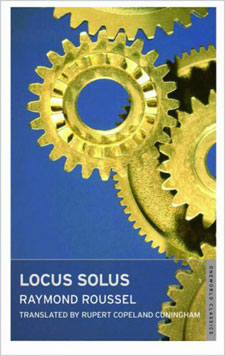
An uncommon amount of Raymond Roussel is in print in English: Mark Ford’s retranslation of New Impressions of Africa from Princeton, and Mark Polizzotti’s version of Impressions of Africa should be out soon from Dalkey Archive. Rounding out the trilogy of Roussel’s big books is a reissue of the Cuningham translation of Locus Solus, originally published by John Calder in 1970, brought back into print by OneWorld Classics, which seems to have enough American distribution that I could buy a copy in Brooklyn. I loaned my original copy of the book out years ago, so I can’t compare the original printing right now; the text has been reset, but no changes are noted to Cuningham’s translation. It’s fantastic that the Calder line is coming back into print, and OneWorld’s books have attractive covers (this one, unfortunately, seems to have been made from a JPEG); however, one always wishes that they’d do a little editorial work.
(One wonders, incidentally, who Rupert Copeland Cuningham might have been: as far as I can tell, this book seems to be the only thing his name was ever attached to. His name appears to be somewhat in flux: more often than not, there’s an extra “n” in Cuningham when he appears in bibliographies (where his translation is praised). There’s no discussion of Cuningham or Cunningham in the Ford or Caradec biographies; while I don’t have the special issue of Bizarre on Roussel, I have most of what’s available on Roussel in English, and it’s odd that the translator never reappears, as almost everyone else connected with Roussel seems to. One might imagine that R. C. C. never actually existed and is a pseudonym; the translation of Chapter 1 of Locus Solus by Harry Mathews that appears in the Exact Change How I Wrote Certain of My Books is decidedly different, John Ashbery must know the answer to this question.)
An introduction wouldn’t hurt; the omission of notes (aside from five by Roussel and two by the translator) seems like a fairly substantial mistake with a book like this, not least for the diction, which remains somewhat extraordinary. What exactly a paving beetle, also known, splendidly as a punner, might look like (especially in Cantarel’s modified form) is not going to be clear to the general audience of today, though they certainly might have been a century ago. One wonders (especially with punner) how the French that Roussel used would compare. The word subtunicle (not subtunical, something very different), only manages to get five hits on Google; it doesn’t make it into the OED, although tunicle does; while Roussel explains what he means by this, annotation would help. The same for colombophile: the OED says the word is French for “pigeon-fancier”; did anyone but Roussel use it to mean a specially thin kind of paper used to write messages to be carried by messenger pigeons? A cursory search of the Internet doesn’t turn it up; a good editor would find this out.
The typesetting is, unfortunately, shoddy. Italicization is applied (to, for example, aqua-micans) capriciously; a more severe error is found in the name of Martial Cantarel’s Siamese cat, “Khóng-dek-lèn,” which has a diacritical over the e in dek of Roussel’s own invention, half of an open semicircle, has been changed into ẵ (Unicode 7861), an e with a breve underneath a tilde, which is a character used in Vietnamese. The Calder edition did this correctly; a recent French edition presents it as a breve under a macron, which is better than a breve and a tilde. As both biographies point out, Roussel wanted an unpronounceable character, not one that might be pronounced by someone who could read Vietnamese; he went to the expense of having the character made specially for his book, and it would be nice if his example could have been followed – five minutes in Fontographer would have done the job. Roussel demands more attention than he’s been given here; probably best to stick with the older edition if you’re looking to buy an English Locus Solus.
That said: it’s fantastic to have Locus Solus so easily accessible in English again. Roussel’s writing remains intractably bizarre, down to the very structure of the book: in each of the seven chapters, Martial Canterel shows his visitors something inscrutably strange, described in exhaustive detail; then Canterel explains how entirely logical the tableau actually is, showing followed by telling. His audience remains entirely passive; even when they are allowed to interact with the tableaux in the case of the seahorse race, Cantarel explains that the results are entirely preordained. The sense of stillness in this book is almost oppressive: the scenes will go on being reenacted again and again, regardless of an audience. Perhaps this is so unnerving because we know that this is what happens every time we re-read a book or re-watch a movie. The house in Rivette’s Céline and Julie Go Boating would seem to be deeply influenced by Locus Solus; I don’t know if anyone’s written about the influence of Roussel on Rivette, though IMDB falsely claims that 36 vues du Pic Saint-Loup is a biopic about Roussel. But Céline and Julie is warm – repetition is a game – while Locus Solus almost radiates coldness, to borrow an image from the book. When Harry Mathews rewrote Roussel in The Conversions, the result is funny; but Locus Solus is deadly serious, even if the situations described are as ridiculous as those in Mathews’s book.
A paragraph near the center of the book might be excerpted for its almost metafictional turn. Here, Cantarel’s process for revivifying the dead is being described; the dead, when brought back to life, re-enact the same scene over and over, and an environment must be made to accommodate them:
During this phase of the investigation Cantarel and his assistants closely surrounded the animated corpse, watching his every movement in order to assist him from time to time when necessary. Indeed the exact reproduction of some muscular effort made in life to raise some heavy object – now absent – entailed a loss of balance which would have caused a fall, but for their prompt intervention. Furthermore, whenever the legs, with only flat ground before them, began to ascend or descend some imaginatry staircase, it was essential to prevent the body falling either forwards or backwards, as the case might be. A quick hand had to be held ready to replace some non-existent wall against which the subject might be about to lean his shoulder, and he would have tended to sit down on thin air from time to time if their arms had not received him. (p. 99)
One imagines Roussel laboriously constructing the situations in this book to fit the results of his procedure; did he expect the reader to guess? Or again at the end of the eighth section of Chapter 4, where François-Charles Cortier hides his confession to his crimes using codes; his son, having deciphered the code and found the confession, feels the word “son of a murderer” branded on his forehead. The reader who knows nothing of Roussel must suspect that something’s up; the informed reader sees Roussel’s breadcrumb trail.
Because of the lack of critical apparatus around this book (aside from the hint of “Roussel’s own uniquely eccentric principles of composition” on the back cover copy), it’s possible that readers are finding this book without any idea of how Roussel wrote his books. It’s difficult to imagine what such a reader might make of this book. It comes off almost as science fiction in the style of Villiers de l’Isle-Adam’s L’Eve future: but it’s essentially static. Nothing is being promised for the future: at best, the future seems to be endless replay of the past. The text of this book feels almost like being in the company of the insane: the hyperdetail about subjects that makes no sense to the outside world; the sense that the story’s being told regardless – maybe in spite of – whoever might be listening. Henry Darger’s scenes of girls and endless battles and over-regard for the weather aren’t that far away, in some sense; reading Locus Solus one can’t help but notice how many casually insane people are involved. But Roussel’s work is so intricately put together: although a scene in first description appears to be entirely random, every element is shown to be there for a reason. The precision is almost machine-like; there’s a coldness to this book that still chills. Even if one didn’t know about Roussel’s procedure, it might be sensed: something still pumps away deep inside this book.