october 26–october 31

Films

  • Dr. Mabuse, der Spieler (Dr. Mabuse: The Gambler), directed by Fritz Lang
  • Starship Troopers, dir. Paul Verhoeven
  • Suspiria, dir. Dario Argento
  • Invasion of the Body Snatchers, dir. Philip Kaufman
  • Morocco, dir. Josef von Sternberg

Exhibits

  • “Heroes: Mortals and Myths in Ancient Greece,” Onassis Cultural Center
  • “Dieter Roth, Björn Roth: Work Tables & Tischmatten,” Hauser & Wirth
  • “Roy Lichtenstein: Mostly Men,” Leo Castelli
  • “Bloodflames III,” Alex Zachary
  • “Paul Thek: Diver, A Retrospective,” Whitney Museum
  • “Sara Vanderbeek: To Think of Time,” Whitney Museum
  • “John Baldessari: Pure Beauty,” Met
  • “Katrin Sigurðardóttir at the Met,” Met
  • “The Spanish Manner: Drawings from Ribera to Goya,” Frick

noted

  • James Elkins on looking at Mondrian.
  • A new website on Pamela Moore’s Chocolates for Breakfast; includes the fantastic Robert Nedelkoff article from The Baffler years ago. Somebody reprint this and The Horsy Set?
  • An annotated gallery of Alasdair Gray’s art at The Guardian.
  • Hannah Tennant-Moore on Frederic Tuten’s Self Portraits, which I still need to read, at The New Republic.
  • And Harry Mathews has a new book of poems out.

october 16–october 25

Books

Films

  • Bubble, directed by Steven Soderbergh

Exhibits

  • “The Roman Mosaic from Lod, Israel,” Met Museum
  • “Man, Myth, and Sensual Pleasures: Jan Gossart’s Renaissance,” Met Museum
  • “Miró: The Dutch Interiors,” Met Museum
  • “Italy Observed: Views and Souvenirs, 1706–1899,” Met Museum
  • “Chaos and Classicism: Art in France, Italy, and Germany, 1918–1936,” Guggenheim

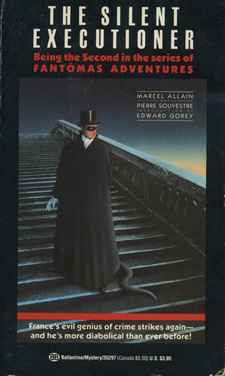
marcel allain & pierre souvestre, “the silent executioner”

Pierre Souvestre & Marcel Allain 
The Silent Executioner
(trans. unknown) 
(Ballantine, 1987)


This is the second Fantômas book, originally titled Juve contre Fantômas: here in a cheap Ballantine paperback distinguished by an Edward Gorey introduction. It’s unclear who translated this edition from the French; the copyright page has a notice saying that “Revised translation © 1987 by William Morrow and Company, Inc.”; Gorey, in his introduction, also seems confused by this as well. Penguin reissued the first Fantômas book a few years ago with a John Ashbery introduction, which I liked well enough. Having just acquired the Louis Feuillade Fantômas series on DVD, I thought it was time to go back and read the other books, which can be found used for practically nothing. Maybe it would be nice to have a Fantômas collection, but I don’t know.

A great deal happens in this book. In its rough outlines, it’s similar to the Feuillade film; the action in the book, however, is considerably more labyrinthine. The book will not particularly illuminate the film (which, for the record, I saw before reading the book); the film, with its simplifications, might make the broad outlines of the book more comprehensible than they might otherwise be: this is tremendously episodic writing, the chapter being the operative unit. 

The text of this volume isn’t quite as nice as the text of the first Fantômas, maybe because the language seems to have been updated for a mass-market audience of the 1980s. Nevertheless, one does occasionally find a sentence like this, after Fanômas and his cronies have wrecked a train for no appreciable reason:

Then cries of terror rose in the night as the frantic passengers fled from the luxurious train.

The “luxurious” makes this sentence for me; it could almost come from a Grand Guignol version of The Young Visiters, a fine thing to imagine. A few sentences later, still in the train wreckage, this passage presents a rare moment of humor:

The driver held out his two broken arms.
     “Give me a hand, for God’s sake! (p. 70)

Maybe this captures the appeal of the book. When Fantômas kills a bunch of people with a train, seemingly capriciously, it isn’t understood by the reader as an immoral act; carrying out evil deeds is just what Fantômas does, and it doesn’t seem like he can help it. This isn’t quite a detective book, because Juve and Fandor will not capture Fantômas, at least not for long; their struggle with him is almost an ouroboros, because even if they stop him from carrying out some act of villainy, he will certainly strike again. (One wonders, offhandedly, whether the citizens of Paris might do better if Juve and Fandor were not trying to stop Fantômas and simply acceded to his rule. Every generation gets the Fantômas it deserves.) The pleasure of this book is at least in part in transgression: evil for its own sake. Since re-reading Proust, Lucretius’ reflection on the pleasure of watching the misfortunes of others has been on my mind: one enjoys a book like this because it is nice to see what terrible things Fantômas will get up to. Maybe this reflects poorly on us as moral beings; but it is a response that’s there, and it’s hard to get around it entirely.

This edition is lurid in the right way; the reader couldn’t discover from the book itself when exactly this was written (Wikipedia says 1911), a subterfuge which one suspects was perpetuated by the marketing people at Ballantine in the hope of attracting a mass audience. There is a brief “About the Author” (sic) at the end of the book, which notes that after Souvestre’s death Allain married his widow. The cover, unattributed, shows a masked man on a stairwell with what appears to be a rubbery tail coming out of the bottom of his cape; possibly he is holding a non-descript snake behind his back. (A snake, though not a non-descript one, does play a role in the plot; there is, however, no scene where Fantômas elegantly hauls around a snake.)

*     *     *     *     *

A self-referential interjection: for the past year, I’ve been working under the constraint that I need to write a non-trivial amount about every book that I read that isn’t being discussed in some other way, i.e. those things that I read for book groups or that I read for work. Categorizing these posts as “reviews” is misleading to a degree: what’s intended isn’t quite the same as a review, rather the need to respond. This is largely motivated by a need to re-examine why exactly it is that I’m reading what I’m reading; it’s also being done under the supposition that in the changing environment that the book finds itself, the role of the reader – specifically the reader who is more than just another consumer of a book – is one of growing importance. The flip side of this, of course, is the suspicion that not all reading is of the same value; and this ineluctably influences the books that I choose to pick up. I suspect that I would find myself reading more things like this book – light, not requiring much investment on the part of the reader – were I not concerned that I didn’t have as much to say on certain books. I can find something to say about this Fantômas book, for example, in part because I can talk more generally about the series as a whole; however, it would presumably be harder for me to find something substantial to say about a third volume in the series. I don’t know whether this is specifically good or bad; rather, it points out that the rules we live under, examined or not, do tend to dictate a particular form of reading. A book might be useful to a reader even if it doesn’t immediately have a use in the way that I’m defining use; maybe there are other criteria that I need to discern.

noted

  • Joanna Scott on David Markson’s late books at The Nation.
  • An attempt to point out who owns who in the American publishing landscape.
  • A fine post by Waggish on difficulty in reading and music, with some reference to Steven Moore but mostly to Milton Babbitt.
  • A useful breakdown of the works of John Cowper Powys; and John Yau on Christopher Middleton.
  • There’s probably something to be said for this Chris Fujiwara essay on cinema and the problem of the contemporary; this seems like an argument that could be expanded beyond that medium.
  • And Triple Canopy is putting on Forms of Crisis with Joseph McElroy and Harry Mathews on Thursday October 21; unfortunately, I’ll be in L.A.

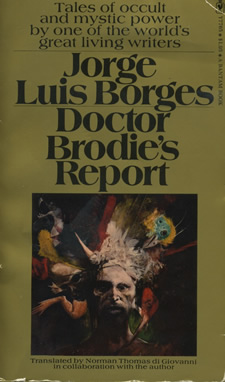
jorge luis borges, “doctor brodie’s report”

Jorge Luis Borges 
Doctor Brodie’s Report
(trans. Norman Thomas di Giovanni & Jorge Luis Borges)
(Bantam Books, 1973)


Continuing my re-reading of Borges: this is the original translation of his penultimate volume of short stories, here published as a lurid paperback while he could still be referred to on the cover as “one of the world’s great living writers.” It’s odd, somehow, to think of reading Borges while he was still alive, especially when he could have been read in paperback; it seems like Borges has always been dead, his corpus of works petrified and preserved, a feeling encouraged by generally seeing him now in the context of his complete fiction, which one tends to assume is a consistent whole. Borges in paperback seems like something different: this collection of short stories can be judged as a book. It’s strange to realize that, chronologically, the religious fantasia of “The Gospel According to Saint Mark” is might be seen as reminiscent of Gaddis’s The Recognitions rather than the other way round. It’s also odd to realize that at the point in time when this was published Cortázar was publishing better collections of Borges-influenced short stories.

The two stories that I remember from this are the title story and “The Gospel According to Saint Mark,” which I think I re-read a couple years ago for reasons I do not remember. Those two, as it turns out, are the standouts of this volume; as with The Book of Sand, this is decidedly minor Borges. The majority of the stories here do not come off as especially Borgesian, something those in The Book of Sand would actively attempt: here, there’s little preoccupation with paradox, and most of these are almost straightforwardly realistic, albeit depicting an imagined Argentina (and Uruguay – there’s a lot of Uruguay in this book) that may or may not have existed. There’s a great deal of knife-fighting, and if you’re not interested in knife-fighting much of this book may be lost on you. In his introduction, Borges notes that he was attempting to mimic the late short stories of Kipling, which I haven’t read; maybe some brave soul out there is making the case for Kipling today, but this seems like a strategy not likely to win many admirers. These stories of Kipling, he declares in his preface, “doubtless surpass” those of Henry James and Kafka; they are “laconic masterpieces” conceived when young but written when old. Henry James, meanwhile, is explicitly pastiched in “The Duel”; but the characters in the story, ostensibly about two female painters in Argentina of the 1960s, seems ludicrously unbelievable, as might perhaps be expected to be the case for a blind man writing about contemporary art. This might not be so bothersome if the story weren’t so mundane and the characters didn’t seem like they could have been borrowed, without changes, directly from James: perhaps Borges is trying to claim that Buenos Aires in the 1960s was the same as Boston or London in the 1880s, which seems bizarre to the point where this reader, at least, lost faith in the writer. 

What might be most interesting about this particular book is the translation: this is the original translation of this book, which is out of print. Penguin evidently brought out a version of this; they’ve replaced it with the Andrew Hurley version from the Collected Fiction. This is something of an odd choice, given that this particular edition was translated with the collaboration of Borges: it includes a forward cosigned by Borges and di Giovanni, as well as an afterword by Borges that don’t appear in the Collected Fiction; I assume they don’t appear in the new Penguin Brodie’s Report. The foreword explains how this volume came to be:

One difference between this volume and the last lies in the fact that the writing and the translation were, except in one case, more or less simultaneous. In this way our work was easier for us, since, as we were always under the spell of the originals, we stood in no need of trying to recapture past moods. This seems to us to be the best possible condition under which to practice the craft of translation. (p. viii)

It’s odd that this translation should appear to be deprecated; as a translation, I think it’s substantively better than the Hurley version. (As I don’t have a Spanish edition, I can’t make any arguments about which is more correct; but given Borges’s seemingly direct involvement in this one, it seems like it would be difficult to argue that the earlier translation swerved from Borges’ intention.) Compare the final paragraph of “The Gospel According to Mark,” first in the Hurley translation:

The three of them had followed him. Kneeling on the floor, they asked his blessing. Then they cursed him, spat on him, and drove him to the back of the house. The girl was weeping. Espinosa realized what awaited him on the other side of the door. When they opened it, he saw the sky. A bird screamed; it’s a goldfinch, Espinosa thought. There was no roof on the shed; they had torn down the roof beams to build the Cross. (p. 400 in Collected Fictions.)

Here’s di Giovanni:

The three had been following him. Bowing their knees to the stone pavement, they asked his blessing. Then they mocked at him, spat on him, and shoved him toward the back part of the house. The girl wept. Espinosa understood what awaited him on the other side of the door. When they opened it, he saw a patch of sky. A bird sang out. A goldfinch, he thought. The shed was without a room; they had pulled down the beams to make the cross. (p. 13)

Neither of these is without its infelicities: I don’t entirely understand why di Giovanni would use “mocked at him” rather than “mocked him”; “Bowing their knees” is a little strange; and “the back of the house” is better than “the back part of the house.” But on the whole, the di Giovanni seems much better to me: the “of them” in the first sentence seems extraneous; “stone pavement” is better than “floor”; “mocked” is better than “cursed”; “shoved” better than “drove”. “The girl wept” seems better than “The girl was weeping” as it brings to mind “Jesus wept.” The italics for Espinosa’s thought is unnecessarily distracting, and di Giovanni’s handling of these two phrases works better. Goldfinches don’t “scream,” they “sing.” And the capitalization of “Cross” makes it seems like a machine to be “built” rather than something made by human hands. 

There are numerous differences between these two editions, some seemingly more serious than others. In the Preface, for example, “The Gospel According to Mark” is attributed to “a dream of Hugo Rodríguez Moroni” in the di Giovanni but “Hugo Ramírez Moroni” in the Hurley; a Google search reveals Spanish hits for both, and a note in Hurley suggests that he hasn’t found an antecedent for this Moroni; in the next paragraph “Paul Groussac” in the di Giovanni” turns into “Paul Grossac” in the Hurley, which makes one wonder. David Brodie, protagonist of the title story, loses the “D.D.” that he’s given in the di Giovanni translation; perhaps Hurley decided that he wasn’t a real doctor. In the same story, a book is cited in di Giovanni as “one of the volumes of Lane’s Arabian Nights’ Entertainments (London, 1839)”; in Hurley this becomes “the first volume of Lane’s translation of the Thousand and One Nights (An Arabian Night’s Entertainment, London, 1840). A few sentences later in the story suggests the difference in tone – first the Hurley:

Their food is fruits, tubers, and reptiles; they drink cat’s and bat’s milk and they fish with their hands. They hide themselves when they eat, or they close their eyes; all else, they do in plain sight of all, like the Cynic school of philosophers. (p. 403)

Di Giovanni’s version of the same:

They take their nourishment from fruits, root-stalks, and the smaller reptiles; they imbibe the milk of cats and of chiropterans; and they fish with their hands. While eating, they normally conceal themselves or else close their eyes. All other physical habits they perform in open view, much the same as the Cynics of old. . . . (p. 135)

I like di Giovanni’s version much better, not least because he uses “chiropterans” rather than “bats”; but his version feels more like the ersatz nineteenth-century document that this story purports to be. Perhaps it’s less accurate; but it reads much better than the current translation. I don’t think this is an essential volume of Borges, but if it is to be read it deserves to be read in the original translation.

october 1–october 10

Books

Films

  • Boxing Gym, directed by Frederick Wiseman
  • Le nain, dir. Louis Feuillade
  • La nativité, dir. Louis Feuillade
  • The Bingo Long Traveling All-Stars & Motor Kings, dir. John Badham
  • North Dallas Forty, dir. Ted Kotcheff
  • Mistérios de Lisboa (Mysteries of Lisbon), dir. Raúl Ruiz