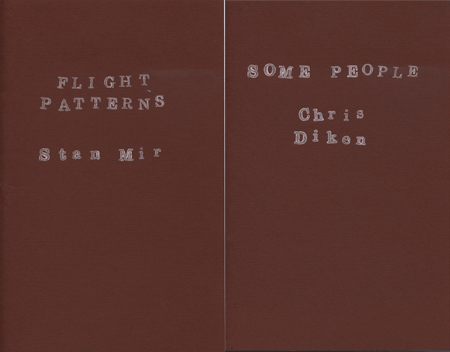
chris diken, “some people” / stan mir, “flight patterns”

Chris Diken, Some People
Stan Mir, Flight Patterns
(JR Vansant, 2009)


The number of people, I assume, who would buy books sight unseen from a press calling itself “JR Vansant” simply because it’s called that must be rather small; but I am in that number. Scott Bryan Wilson started publishing chapbooks under that name at the end of last year; my copies arrived last month. Production is straight-forward: silver type on heavy paper covers stapled around laser-printed interiors. The interior printing isn’t quite as nice as one might hope, and because of the long measure in Flight Patterns, the type is a bit small, but these are minor quibbles: this are very nice little books, better than I’d hoped for.

*     *     *     *     *

Chris Diken’s Some People is a short story, 18 pages long, and its plot is quickly related: a young man and woman visits an art museum, and the man uses the restroom. One is immediately caught by the style: the Gertrude Stein rhythm in the repetition of the fourth sentence:

They had hit a stride and each room in the museum seemed to reflect this overall greatening, each led them into a new age of new orientation of new medium of new dimension of new lender of new time of new overwhelming sense of standing before something ununderstandable yet still personally affecting.

Calling out Stein is something of a red herring. The dialogue in the story uses the Joycean dash; the voice is that of Gaddis, but more the Gaddis of The Recognitions than J R. There’s a little intrusion of Thomas Bernhard’s style if not his attitude: the long paragraphs, explanation piled on explanation; and maybe some David Foster Wallace. Another sentence, when the protagonist has found his way into the restroom, which he first wonders might be another exhibit:

As he went he though that while one arm had worked the flusher he’d used the other to undo himself with his free hand, thinking of himself in this situation as explicitly not free, that no one was free, that everyone was enchained by their urges, thinking of his free hand unjiggering his bebuttoned arrangement and of a three-dimensional model of the phrase free hand rotating like the precursor to human utterance in his mind, thinking how he used to be a mildly accomplished freehand sketcher before he gave it up for another pastime that too had passed, thinking that if only he didn’t find self-voiding the most horrendously outrageously horrible most distasteful and disgusting enterprise in the gamut of human activities that he could possibly take this opportunity to revisit his talent and how if he wasn’t in such a hurry to get it out and over with he could in a sense draw with his own acridity, employ self in lieu of stylus, practice here and then taken the honed skill to some more prominent canvas.

I like this sentence. It’s the italics that make me think of Wallace, but maybe the twisting baroque sentences of William Gass would be the best comparison. So much current fiction, especially fiction by young writers, tends to fall back on short, overly dramatic sentences: I feel like I don’t see long, wandering sentences like this enough: this is a sentence that’s trying to do something, and succeeding.

The protagonist of this story wanders into the bathroom wondering whether he’s left the art or whether he’s entering another exhibit; while at the urinal, a voice starts talking to him, engaging him in a conversation more philosophical than that of the typical bathroom voyeur. The possessor of the voice isn’t seen (and it’s unclear in the end whether he exists or not); the protagonist remains unsure whether he’s in the midst of some kind of performance. There’s an American suspicion of the visual arts: the fear that the crafty artist, probably European, might just be trying to trick us: it’s certainly at play in most of the descriptions of modern art in The Recognitions, for example. That’s certainly at play here. But there’s also a willingness to play along, to enter into a shared illusion, and I think that works here. It’s a good story: I’d like to see more from Chris Diken. 

*     *     *     *     *

Stan Mir’s Flight Patterns couldn’t be more different: a long poem (32 pages of small type) identified on the website as the first part of an even longer poem, another section of which is scheduled to be printed in the future by JR Vansant. The subtitle identifies it as a “Poem Beginning with a Line from Lax,” the line (“Birds dart over us, pulling shadows through us“) presumably from Robert Lax, though I have to admit not knowing his work and I’m not sure about the attribution. This is a meandering, meditative piece: carried out to full length, it feels very much like it could have been a Jargon Society book. An excerpt of an earlier version appeared online in the oddly presented GutCult: this is approximately the first sixth of what’s in the book, with some differences: italics have been added, and a phrase deleted (“a bird ripped apart” in the third line of the first stanza of the second section). 

The first section of this begins with a succession of thoughts, separated by colons, starting with birds and necessarily spreading onwards: the bird is a tremendously rich image, signifying an infinite number of different things. In the second section, the speaker’s voice appears: “I don’t / know where I belong nor where the pattern is”. From flocks of birds in the sky, the speaker takes his subject apart: “if change did occur // it did so long ago from the 3-fingered avian hand / flight’s feathers met modern birds’ basic form”. And then back to specifics: a warbler calling. Finally, a statement of purpose: “More things take flight / than we can count. I began with birds / to realize it’s more than birds.” 

The style loosens up after this introduction and becomes more conversational. Sections of prose and quotations are placed in the text; there’s a loose narrative, a trip to a farm in Vermont. The speaker is writing Flight Patterns (perhaps in this metafictional nod, we see what unifies JR Vansant); his companion plays Chopin and he reads Robert Duncan. A stanza lists the proper names of birds, all evocative. The speaker’s mother and father are introduced; the history of the land comes in, an enduring concern of the poem. In an extended prose section, the scene changes to Arizona: and there’s more digging into the familial past. Current events intrude: the death of Saddam Hussein, when “an Airbus’ engines / ingested Geese over the Hudson.” We move back and forth: to Philadelphia, back to Vermont, into the recounted past, to Arizona. A bit of what seems to be Mormon history intrudes, as does the mystic Johannes Kelpius who settled in Germantown, Philadelphia. Birds glue everything together:

When my father handed me many things he handed me
my mother. At various times she has been a Mimic
Thrush or a Thrasher. Hardly ever has she been
a Laughing Thrush or a Babbler.

Since 1960 my father has hung like late autumn
Starlings in Rome, omnipresent & not quite
despised. Each November the Starlings come
in from the countryside & fly about
sometimes in the shape of lungs
sometimes in the shape of a fist.

It is impossible to get them to do
otherwise – this is their pattern.

The image of starlings in Rome strikes me as exactly perfect: that’s how I remember them there. This is a rambling work, and it’s hard to come to a judgment of it knowing that there’s more to come; but this section is self-contained, coming, finally, to a conclusion:

Poetry is not
the third eye
It is an eye

Word & voice
Voice may
not remain

The word a
recast image
in ruin

The bird’s
image darts
through us

The cicada
a shadow
pulling through

I like this; I suspect I’ll be coming back to this, and I’m interested in Mir’s other forthcoming books. 
noted

detail

(Giovanni di Marco, called Giovanni dal Ponte, Madonna and Child enthroned between Saints Lawrence and Anastasia (detail), private collection; on show at Moretti’s “Dalla tradizione gotica al primo Rinascimento”.)

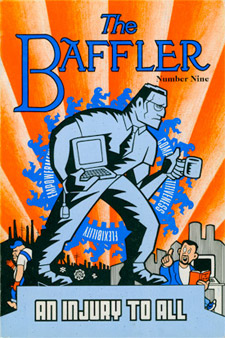
the baffler #9: an injury to all

The Baffler #9: An Injury to All
ed. Thomas Frank 


Still working my way through old Bafflers: this one’s from 1997. I might be reaching my saturation point: this one took me a while to get through, in no small part because of what the editorial note describes as this issue’s “particularly unhappy tone”. This issue is unusually focused; most articles are on the sorry state of the labor movement in this country in the mid-1990s. Chris Lehmann looks at labor in the academy; Peter Rachleff looks at strikes against Hormel in Minnesota; David Moberg looks at attempts at organizing hotel workers in Los Angeles; Bob Fitch inspects the current state of the AFL/CIO. There’s some history as well: Frances Reed looks back at textile worker strikes in Lawrence, Massachusetts; Hunter Kennedy looks at the forgotten history of cotton strikes in Mississippi; an illustrated piece by Jessica Abel looks at the legacy of labor unrest in Decatur, Illinois, and Jim McNeill talks about his time as a labor editor in Racine, Wisconsin. It’s hard to read now: if anything, things are worse, and one senses that a lot of concerned people have simply thrown up their hands.

But: it’s good for you. And: there’s a lot here that’s useful. Tom Frank’s lead-off essay, a survey of labor writing through the ages is still relevant:

As a rule, advertising, the highest form of information-age cultural production, intentionally avoids discussing where products come from. In a time in which, we are told, style and image transcend all – both for corporate marketers and ourselves as consumers – essays like Edmund Wilson’s long description of the brutal facts of automobile production in “Detroit Motors” come across as nothing short of revelation. For a writer in the 1990s to produce such a piece – insisting on the inherently local, inherently material facts of work in an age when the only journalistic game in town is to wax blissful about the cyber-universe is eclipsing the analog world – would be almost willfully contrary. (p. 11.)

Change the date and it still works. Tom Vanderbilt’s “The Gaudy and the Damned” seems to have discovered a source for Mad Men, reading Chicken Soup for the Soul at Work (still in print, in turns out):

One story, titled “Santa comes to Joan,” caught my eye: “Every office has a Joan, or should have. She’s the one everyone looks to when the workload gets too heavy. She’s the one with the good story and the ready laugh. For our Christmas party, she’s the one who transforms our sterile corporate conference room, Christmas after Christmas, with tiny white lights, real teacups, teapots and plates she had brought from home.” (p. 15.)

And reading Josh Mason’s “Three Scenes from the Bull Market” now, one is surprised to discover that Jim Cramer of Mad Money and the real estate bubble got his start at the New Republic, where he suggested that laid-off workers could be quieted with stock options. Still hilarious, and available online at the SEC, is Wired‘s first, failed IPO, excerpted by Doug Henwood; they had operated at increasing loses for their first four years, but they were hopeful about making a lot of money off of suck.com in the future. Another prospectus, from Vans, touts how they’ll be more profitable as they’ve moved all their shoe manufacturing to South Korea.

As its title suggests, Jim Frederick’s “Intern Camp: The Intern Economy and the Culture Trust” looks at the culture of interning, then in a relative infancy. Obviously interning for for-profit corporations is a terrible thing, and there have been any number of pieces written about that. But Frederick’s piece is notable in that it examines the legal basis for internships:

There is, however, another exemption in the FLSA [the Fair Labor Standards Act, passed in 1988 (!)]. Vaguely worded, it concerns “trainees,” or the oddly redundant “student learners.” It allows for-profit institutions to pay short-term employees less than the minimum wage if they are there in an educational capacity. The Department of Labor requires that six criteria be met before it considers someone not an “employee” but a “trainee” exempt from the FLSA: The training is similar to that one would get in school; the training is for the benefit of the trainees, not the employer; the trainees do not displace regular workers; the employer derives no immediate advantage from the activities of the trainees, and may even incur some loss; the trainees understand that they are not entitled to a job at the conclusion of the training; and the trainees understand that they are not entitled to wages for the time spent in training. (p. 53.)

Frederick points out that some industries (banks, law firms, tech companies, engineering companies, and federal agencies) generally follow this; it’s abused by the glamor industries, fashion, architecture, and publishing, which use internships as a source of free labor. There’s a distinct class-based element to intern labor: it’s only relatively affluent young people who can move to New York and work for free in the hopes of getting a job down the road. (David Foster Wallace, more attuned to class differences than one might expect, would get this exactly right in “The Suffering Channel” where he describes a hierarchy of extremely well-dressed interns and the discomfort of his protagonist, working class reporter’s discomfort, with them.) One wonders how much the publishing industry has been hollowed out by two decades of reliance on interns: somebody should be looking at this.

At the end of the book, Robert Nedelkoff’s “Remainder Table” takes a look at the two books of the novelist Alan Kapelner, still neglected. I don’t know Kapelner’s work; LibraryThing reports that All the Naked Heroes was in the libraries of Carl Sandburg and Marilyn Monroe and Lonely Boy Blues was owned by Hemingway. I’d love a compilation of Nedelkoff’s “Remainder Table” columns; the books in them that I’ve tracked down have been worth the time.

And finally, Damon Krukowski had taken on the job of poetry editor with this issue: the selection here focused on poems about labor. Two poems, by Lizinka Campbell Turner (“Distinguo,” poorly scanned but in its original context here) and Edwin Rolfe (“Asbestos”), were rescued from The Liberator (1918) and The Daily Worker (1928); there’s also Kenneth Fearing’s “X Minus X” from 1934 plus Muriel Rukeyser’s “Metaphor to Action” from 1935. It’s an interesting selection, not least because it works well with the rest of the issue: one forgets that there was a sustained tradition of poems about labor, and that labor magazines published poetry. Somebody must have made a good anthology of this by now; I’m impressed that all four can now be found online.

february 6–february 10

Books

Films

  • Possession, directed by Andrzej Żuławski
  • Depeche Mode 101, dir. D. A. Pennebaker, Chris Hegedus & David Dawkins
  • L’enfant, dir. Luc & Jean-Pierre Dardenne

Exhibits

  • “Hélio Oiticica: Drawings 1954–58,” Galerie Lelong
  • “Primary Atmospheres: Works from California 1960–1970,” David Zwirner
  • “Jack Tworkov: True and False: Paintings 1960–1975,” Mitchell-Innes & Nash
  • “David Maisel: Library of Dust,” Von Lintel Gallery”
  • “Carlos Ginzburg: Fractalizations and Other Works,” Susan Berko-Conde Gallery

frederic tuten, “tintin in the new world”

Frederic Tuten
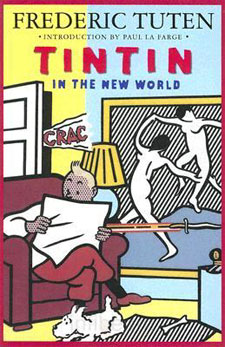
Tintin in the New World: A Romance
(Inprint Editions, 2005; original, 1993)


This is not a book that is well-served by the Internet. The Amazon reviews are almost unanimously damning; a LibraryThing one suggests that this is “Maybe the worst book ever written.” This is not the worst book ever written. It is a well-connected book: on the back cover, there are blurbs from Jonathan Coe, Susan Sontag, Larry McMurtry, and Leslie Marmon Silko. The copyright page explains that the Roy Lichtenstein cover was “created expressly for this novel”; another Lichtenstein drawing of the same subject serves as a frontispiece. The book is dedicated to “my friend George Remi (Hergé) and Roy Lichtenstein”. The novelist’s friendship with Hergé (real or metaphorical, I don’t know) is almost certainly what causes the online reviewer’s bad reactions: this is a book that takes Hergé’s characters and puts them into another context, along with a lot of characters from Thomas Mann’s The Magic Mountain. This is a fine conceit for a novel in the pop art tradition; however, it’s a formula that’s going to leave Internet browsers who assume this is a Tintin spinoff deeply unhappy. I picked my copy up at 192 Books: its presence there made it clear that it’s a certain type of book – more so because this copy was signed, implying that Frederic Tuten is the sort of author who reads at 192 Books. I picked it up because I knew that Tuten was associated with Donald Barthelme andFiction back at that journal’s beginnings, rather than because Tintin was in it (though Tintin, of course, doesn’t hurt); he’d been on my list of people to get around to reading for a while. But that sort of paratextual context tends to get lost on the Internet. This is, among other things, a book about Tintin, and that seems to be how the Internet insists on reading it.

But this book. Tintin, at Marlinspike with Captain Haddock and Snowy, is at loose ends; he wants something to involve him. A letter from Brussels, one presumes from Hergé, summons Tintin to Peru where an adventure should happen. No adventure happens. Instead, Tintin promptly meets the secondary characters from The Magic Mountain: Peeperkorn, Settembrini, Naphta (whose name has become “Naptha,” perhaps so that it’s not pronounced “NAFTA,” or perhaps to suggest naupathia), and Clavdia Chauchat. Tintin becomes Hans Castorp; Captain Haddock mostly fades away, a drunk resigned to his fate. Snowy is philosophical and doesn’t assume that anyone will understand him since he lost the power of language early in the Tintin series. Tintin finds love with Clavdia; eventually, he does in Peeperkorn. The complementary Settembrini & Naptha end up as lovers. Tintin finally leaves the mountain to become a savior to the natives.

Mixing and matching characters from earlier books has become commonplace in the past decade, whether in fan fiction on the Internet or in the bookstores with Sense and Sensibility and Sea Monsters. It’s hard to remember how radical this would have seemed even in 1993; this book follows hard in the tradition of Barthelme, both in his love of the readymade and in his strategy of setting up a ridiculous situation and then scrutinizing how it might play itself out. When this works well – as in, for example, Snow White – the fictional and the mundane cross paths: Snow White and the seven dwarves’ dilemmas are our dilemmas. One doesn’t, perhaps, learn very much about the original narrative – except how strange it actually is – but the present is illuminated.

That’s what’s happening here, mostly. Tintin’s life doesn’t make a great deal of sense when scrutinized closely: ostensibly he is a reporter, but he never appears to do any actual reporting. Tintin is perpetually youthful; he lives in Marlinspike with Captain Haddock, a violent drunk. Tintin’s life isn’t quite as endlessly recurring as, for example, The Simpsons, as his adventures do have a direction, but it doesn’t seem that Tintin ever really learns anything. He has adventures, over and over again, with beginnings, middles, and ends. He’s a character, and he lives through stories. The way a plot works isn’t the way life works: what Tuten does in this book is to take the character of Tintin and drop him into a world that’s marginally more realistic. Tintin finds love with Clavdia, and begins, instantly, to age: towards the end of the novel he has “man-sized hands” and possibly a beard. There’s an echo here of Shakespeare’s Prince Hal narrative, with Haddock taking on the character of Falstaff, wanting to rage on forever, though I don’t think this is a case of Hal being right and Falstaff being wrong: Snowy, Tintin’s conscience, goes home to Marlinspike with Captain Haddock.

The broader question here is why we read what we read. Plenty of the same people who read Tintin read The Magic Mountain; but they read them for vastly different reasons. This is why, I think, a distinction can be drawn between something like this and Sense and Sensiblity with Sea Monsters: that book exists as a novelty, a reification of the idea “wouldn’t this book be more entertaining if there were sea monsters in this book”. Austen’s premises are immaterial: her book is raw material for comedy. There’s a comic element to Tuten’s novel, but it’s not a hilarious book; rather, it’s a serious attempt to see what happens when the two books are put together. Tintin is the reader’s dream of eternal youth; The Magic Mountain is a negation of the possibility of that dream in the real world. There’s validity in both, but they don’t sit comfortably together as each looks ridiculous in the light of the other. Tintin’s existence seems weirdly retarded; the Magic Mountain seems overwhelmingly somber. In a scene towards the end of the book, Peeperkorn, having taken up painting, shows Tintin how he has imposed Clavdia’s figure on the entire history of Western art, from Leonardo to Ruscha: he constructs his own narratives. Tintin never quite manages this; adrift in the end, wanders off into another another narrative entirely, becoming, perhaps the one that the Incas describe as the messiah to come.

Did I like this book? I didn’t love it in the way that I love the Barthelme pieces that do the same things: I can’t find the hilarity or the depth of feeling that I do in those works. This is a book that’s happy to be unsure of genre and for that reason it’s hard to judge – perhaps this is why the reviews on Amazon and LibraryThing are so savage. But it’s an engaging book: it’s been kicking around my head for a while, and I’m not sure that I’m done with it yet.

noted