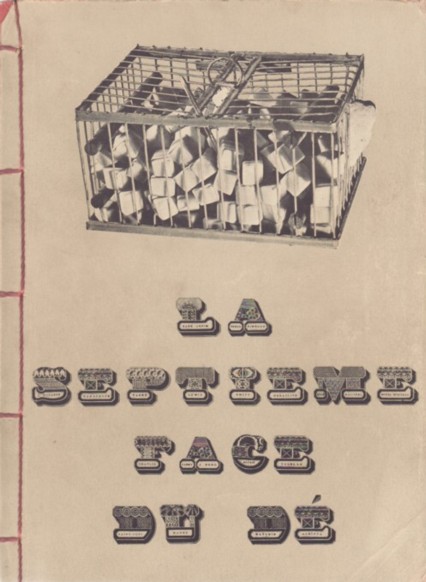
Marcel Duchamp’s cover for Georges Hugnet’s La septième face du dé, Editions Jeanne Bucher, 1936. Somebody still needs to compile a book of Duchamp’s book designs. (From Arcana Books via A Journey Round My Skull.)
Author Archives: dbv
on the silver globe
(Stills from Andrzej Żuławski ‘s On the Silver Globe, almost all from the immense selection here.)
lucy ives, “anamnesis”
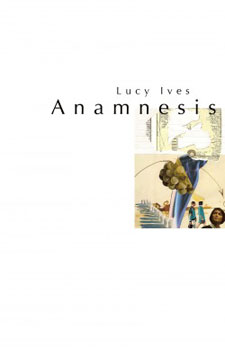
Lucy Ives
Anamnesis
(Slope Editions, 2009)
The premise of this book is laid out in its epigraph, by Vito Acconci: “Sometimes I draw the line on what I have dun.” Deleting the struck-through text, one is left with “o.”: a reminder that the poet can call forth through absence as well as through presence. Anamnesis is a book-length poem about not only writing by also unwriting: not erasure, but crossing out, leaving a record of thought. The book is divided into nine sections by pages that feature only a centered “+”, an interesting device: “+” can be the addition sign, but it might also be a crossed-out vertical line: a negated “I” as appears in the quoted Acconci?
Despite the promise of the epigraph, this is not a book that relies overtly on typographic trickery, though it is deeply engaged in the process of writing, a process that is reenacted in the text. This sounds like the overt premise for a fair amount of electronic writing: from William Gibson’s Agrippa on, it’s been a field fixated on the idea of the ephemerality of digital text. But the premise of good conceptual art is good ideas, not necessarily formal trickery, and it’s the ideas that Ives is interested in. (At the end of the day, “Agrippa” remains a rather bad poem written by William Gibson; while the concept is fine, the text seems incidental.) The way Anamnesis works is evident from its first stanza:
Suppose we write the sentence, “Paul had a very great mind”
Later we can return, strike through the word “mind” and write “brain”
Later we might add, before the word “had,” the words, “the owner of the restaurant”
We might add, “whose sign is the shape of a sleeping deer”
We could strike this sentence out entire
We could write, “Debt has become the watch word”
We’ll write, “Recommended for you”
But we can cross this out
Write, “My family has three members”
Strike through “has,” write “is”
Strike through “members,” write, “both my mother and father, in the apartment right now”
Strike through “right now,” write, ” in the mornings, noon, and in the evenings”
Strike “both” through
Write, “Lucy was saying that”
Strike the whole sentence
Taking the “we” at face value, we could attempt to follow these instructions, to create a sequence that starts like this:
Paul had a very great mind
Paul had a very greatmindbrain
Paul the owner of the restaurant had a very greatmindbrain
Paul the owner of the restaurant had a very greatmindbrain whose sign is the shape of a sleeping deer
but already we have problems: which word does whose modify? The restaurant could have a sign in the shape of a sleeping deer; but it’s the personal noun Paul, rather than the restaurant that can be modified by whose. The whose clause can’t be inserted after Paul because the owner of the restaurant gets lost; it can’t be inserted after restaurant or brain because it would appear to modify those words, which would be ungrammatical. A solution would have to go beyond words themselves: but one notes that this is a book that purposefully doesn’t including periods, in an attempt to construct meanings out of words as words, unaided by that particular form of punctuation.
The commands to write and cross out are repeated through the book. The voice in this stanza is interesting: as something of an introduction, this stanza uses “we” in different tenses: “We write”; “We could write”; “We’ll write”. We seems to include both the speaker and the reader, inviting the reader into the text; but the shifting tenses make the relation of the reader to the speaker unclear. These might be mental exercises, à la Wittgenstein (“Suppose we write”); or they might be future plans (“We’ll write”). By the next stanza, “we” has turned to “you”: “You can write”. Unadorned imperative forms with an implied you become the rule: “Write”; “Cross out”. The reader must make his own space in the text, deciding whether these commands apply to him. There are limits to the reader’s power: following the instructions will only go so far. This is a “writerly text,” as Roland Barthes would have said.
I’m not trying to suggest that the reader is excluded from the book: I don’t think that’s the case at all. Rather, the reader is invited to be a part of the process as something is created by writing and effacing. Another electronic project comes to mind: Brad Paley’s CODeDOC, a program which reflexively visualizes itself while being run. The difference between this and Agrippa might be instructive: there’s an economy of means in CODeDOC, in that the code is the poem, rather than being something separate from (and more interesting than) the poem. Ives’s book contains its own mechanism: everything is done with words.
I feel like I might be unjust to the book by drawing these comparisons to electronic writing; other comparisons could as easily, and perhaps more fruitfully, be drawn. To J. L. Austin, of course, to Barthes and Blanchot, through both of them back to Mallarmé. Marjorie Welish’s recent work – I’m thinking of Word Group and Isle of the Signatories might be another useful point of reference: Welish, with her strong visual sense, is similarly interested in the word on the page and how meanings change without being a concrete poet. And beyond the focus on the process of writing and re-writing, there’s also the problem of how we use writing: as this book moves on, it becomes slowly less imperative and more a consideration of life: of how one does things, thinks about them, records them. This is an important book: I’ll come back to it.
american gothic
noted
- Enrique Vila-Matas appears at the Hispanic Society on March 3 to discuss Dominique Gonzalez-Foerster’s “Chronotopes & Dioramas”.
- Stephen Mitchelmore’s commentary on David Shields’s Reality Hunger is the only intelligent piece on the book that I’ve seen.
- At the Neglected Books site, an appreciation of the great George Leonard Herter, author of many useful books.
the marvelous city of the future
“I hope better of the goodness of God. Perhaps we are approaching the predicted time when science, having completed its cycle of analysis and synthesis, of belief and negation, will be able to purify itself and raise up the marvelous city of the future out of the confused ruins . . . We must not hold human reason so cheap as to believe it gains by complete self-humiliation, for that would be to impeach its divine origin . . . God will no doubt appreciate purity of intention; and what father would like to see his son give up all reason and pride in front of him? The apostle who had to touch to believe was not cursed for his doubt!”
(Gérard de Nerval, “Aurélia,” trans. Geoffrey Wagner, p. 36 in the Exact Change Aurélia & Other Writings.)
naming
“The premium on conciseness and concreteness made proper names a great value – so they came flying at you as if out of a tennis-ball machine: Julia, Juliet, Viola, Violet, Rusty, Lefty, Carl, Carla, Carleton, Mamie, Sharee, Sharon, Rose of Sharon (a Native American), Hassan. Each name betrayed a secret calculation, a weighing of plausibility against precision: On the one hand, the cat called King Spanky; on the other, the cat called Cat. In either case, the result somehow seemed false, contrived – unlike Tolstoy’s double Alexeis, and unlike Chekhov’s characters, many of whom didn’t have names at all. In ‘Lady With Lapdog,’ Gurov’s wife, Anna’s husband, Gurov’s crony at the club, even the lapdog, are all nameless. No contemporary American short-story writer would have had the stamina not to name that lapdog. They were too caught up in trying to bootstrap from a proper name to a meaningful individual essence – like the ‘compassionate’ TV doctor who informs her colleagues: ‘She has a name.&rlquo; ”
(Elif Batuman, from “Confessions of an Accidental Literary Scholar”.)
february 16–20
Books
- Lucy Ives, Anamnesis
Films
- Dont Look Back, directed by D. A. Pennebaker
- The Tenant, dir. Roman Polanski
- Tierische Liebe (Animal Love), dir. Ulrich Seidl
- Cronos, dir. Guillermo del Toro
- La niña santa (The Holy Girl), dir. Lucrecia Martel
- Na srebrnym globie (On the Silver Globe), dir. Andrzej Żuławski
Exhibits
- “Banks Violette,” Barbara Gladstone
- “Markus Schinwald,” Yvon Lambert
- “Koo Jeong-a: Koo Jeong A ~ Z,” Yvon Lambert
february 11–february 15
Books
- Chris Diken, Some People
- Stan Mir, Flight Patterns
- Geoff Dyer, Yoga for People Who Can’t Be Bothered to Do It
Exhibits
- “Dalla tradizione gotica al primo Rinascimento,” Moretti Art Gallery
- “Félix Vallotton: Paintings,” Michael Werner Gallery
- “Demons and Devotion: The Hours of Catherine of Cleves,” Morgan Library
- “Rome After Raphael,” Morgan Library
- “Alias Man Ray: The Art of Reinvention,” Jewish Museum
geoff dyer, “yoga for people who can’t be bothered to do it”
Geoff Dyer
Yoga for People Who Can’t Be Bothered to Do It
(Vintage, 2003)
There are plenty of reasons that I should not like this book by Geoff Dyer: the name of this book, for one; the horrifying blurb on the back suggesting that it was a combination of “Hunter S. Thompson, Roland Barthes, Paul Theroux and Sylvia Plath”; the promise of reading anything about Burning Man. The horrible grunge-y display type used inside for chapter openers, presumably reused from the poorly designed hardcover edition. The copyright page promises that an excerpt from Auden’s “September 1, 1939” is used in a book published in 2003. The prospect of British people writing about the United States. And worst of all, the marketing designation “Travel/Memoir” on the same back cover: a stint in the travel writing business still keeps me filled with horror at the thought of most travel writing and the people associated with it, and it doesn’t need to be said that no one needs another memoir.
And yet I make an exception for Geoff Dyer: somehow, I allow him to get away with things that I find deeply objectionable in most other writers. Part of this is context: I picked this book up at the bookstore in Fort Greene after a disheartening show at BAM, in need of something to pick me up for the subway home. Dyer’s writing works for me in that way as few others can reliably. (Also in this category, off the top of my head: Gertrude Stein, Ashbery’s Three Poems, some of Donald Barthelme, The Man without Qualities. Others exist, I’m sure, but it’s a vanishingly small group.) A lot of this has to do with style: Dyer’s a good enough writer that he can entertainingly talk about nothing will giving off the impression of effortlessness. Closer scrutiny, however, reveals that it’s an effortlessness that’s taken a great deal of work: everything functions. In this book, as in Out of Sheer Rage, Geoff Dyer has the flâneur down to perfection: he pretends to be doing nothing, but there’s a great deal of thought involved in that doing nothing. It helps as well that there’s a sense that Dyer’s using writers to think through the world: Auden and Rilke come up repeatedly in this book (“September 1, 1939,” for what it’s worth, does not come up with respect to 9/11) as do Brodsky and Henry James; epigraphs from the Goncourts and Nietzsche lead off the book. The way he’s using these writers is interesting: not so much name-dropping or academic reference so much as finding people whose thought can be usefully applied to his life. There’s the feeling you’re in the hands of someone who can be trusted, a trust that comes because of these shared points of recognition.
This is a book that’s ostensibly a collection of travel essays: eleven essays about particular places. The copyright page suggests that it’s a compilation, as much of the material has previously been published. It is, to a certain extent; but when read closely, one notes threads connecting the various pieces in the book. A pair of Tevas is bought in the first essay, on New Orleans; these Tevas thread their way through the later essays, just as Rilke and Auden do and a concern with the idea of a “Zone,” found first in Apollinaire and later in Tarkovsky. It’s difficult, however, to ascribe a chronology to these pieces: there are a handful of dates which suggest that these essays take place across the 1990s, but it’s difficult to order them. Girlfriends come and go; there are occasional references to things that came before. One has the sense of a writer who’s constantly traveling: but one can’t sense an overriding narrative in the traveling, the frequent problem with travel writing. (Kenneth Gangemi’s The Volcanoes from Puebla, one of the handful of travel books I like, also escapes the temptation of a narrative arc by the formal device of presenting its short essays in alphabetically.) An introduction to the last essay in the book suggests that it was written in 2000 and describing events of the year before, a decade after the first 1991; however, one is hard-pressed to find a clear sense of growth. Rather, one finds a document of a period in time: how Dyer lived in the 1990s, and how, in a sense, travel worked in that decade. While intended as a document of places, it’s become a document of a time. Travel doesn’t function in quite the same way any more.
Dyer wanders the world: he presents himself as an aimless wanderer, but this is something of a ruse: in the decade he covers, he published at least six books. These books aren’t really mentioned here: the reader familiar with Out of Sheer Rage will be able to place his Roman adventures within that context, and one suspects that his essay on New Orleans has something to do with his book on jazz. Dyer presents himself to the people he meets as a writer: but because he doesn’t mention his books in the text, he seems willing to come across as being without portfolio. Dyer’s presentation of himself contains a weird mix of humility and artifice: he presents his flaws and his frequent disinterest – there’s a certain sense in which this book is an apologia for an extended youth – but there’s the sense that he’s holding something back. We know what he likes and doesn’t like, but the reader is left with a certain sense of distance after finishing the book: there’s a certain lack of autobiography. We’re not over-familiar. I like this.
The essays themselves vary. The pieces on Detroit, Miami, and New Orleans are better than one might expect, as they don’t overreach. Dyer isn’t trying to draw grand conclusions about American civilization from a city; rather, he records specific interactions and impressions. His descriptions of south-east Asian travels make him out to be one of those terrible tourists that one meets on the road, uninterested in anything around them but the next party: but again, one suspects this isn’t quite the case. The final essay, on Burning Man, shows its age: written at the height of San Francisco Internet boom hubris, there’s talk of Hakim Bey, who seems to have mostly been forgotten now, for better or for worse. Descriptions of drug experiences are almost invariably uninteresting. Here, though, he integrates it into larger experience: telescoping out from his local context to past experiences of travel, to Freud’s discussion of the ruins of Rome as metaphor for the mind in Civilization and Its Discontents, to Francesca Woodman’s photography, to Stalker. It works, though it shouldn’t.