- Interviews with Ross McElwee and Werner Herzog (among many others) in Vice‘s film issue.
- And an interview with Alastair Brotchie of Atlas Press about Norman Douglas (with reference to Fr. Rolfe).
- Martin Riker of the Dalkey Archive is interviewed at Poets & Writers.
- A translation of Carl Seelig’s Wandering with Robert Walser by Bob Skinner (via Golden Rule Jones).
- Finnegans Wake links from Ron Silliman.
- Matt Sullivan’s oboe-playing on YouTube.
- Rousseliana: Andrew Hugill’s online version of New Impressions of Africa; William Clark’s introduction, “A Lovely Curiosity”; Alan Ramón Simon’s Raymond Roussel’s Self Help Notes (A Commentary On Bob Perelman’s “Chronic Meanings”) in Glossator.
Author Archives: dbv
paul dirac, 1907
(from here.)
september 7–september 11
Books
- Marcel Duchamp, Manual of Instructions: Étant donnés: 1° la chute d’eau, 2° le gaz d’éclairage . . . (ed. Anne d’Harnoncourt & Michael R. Taylor)
- Julio Corázar, Around the Day in Eighty Worlds (trans. Thomas Christensen)
- Gianfranco Baruchello & Henry Martin, How to Imagine: A Narrative on Art and Agriculture
- Julio Cortázar & Carol Dunham, Autonauts of the Cosmoroute (trans. Anne McLean)
Films
- Jeanne Dielman, 23 Quai du Commerce, 1080 Bruxelles, directed by Chantal Akerman
- Tout la mémoire du monde, dir. Alain Resnais
- Cortázar (Celestial Clockwork), dir. Tristán Bauer
Exhibits
- Carol Bove with Janine Lariviere, “Plants & Mammals,” The Horticultural Society of America
- “Milton Glaser’s SVA: A Legacy of Graphic Design,” Visual Arts Gallery, SVA
- “Ken Friedman: 99 Events,” Maya Stendhal Gallery
the very same culture that had destroyed all reason for going from one place to another
“That’s an attitude too that you often find in the kinds of artists who are content to call themselves ‘cultural operators’ and who get involved with the idea that art has to be revolutionized and made scientific, but they’re getting it all ass-backwards that way. They’re trapped in an illusion that our whole society agrees upon, jet planes were invented because of the developments of science, all of our technology comes out of science, and we’re all drugged on technology and on the idea that I can take this jet and be in America in six hours. But why should it make a difference to me that I can get to American in six hours, maybe I don’t want to go to America at all, and maybe it’s all the same if I get there in six days, or six weeks, I could take a clipper ship and clipper ships were certainly more pleasant than airplanes and maybe just as safe. A friend once told me about an airplane trip where he began to realize that the culture that had made it possible to get from one place to another on all of these fantastic means of transport was the very same culture that had destroyed all reason for going from one place to another. Travelling doesn’t mean anything any more. One of the things technology does to people is to rob them of motivations, you push buttons and you open cans and life becomes much poorer than it ever was before, it’s enriched only by a greater degree of boredom. It creates these huge empty spaces in our lives and then fills them up with itself again, you wash the dishes in a machine and while you wash them you have to look at the television. People who are most alive when they’re active, people who need the feel of being effective and useful in all of the things that go into their daily living are people for whom technology doesn’t mean anything at all, or at least anything positive.”
Gianfranco Baruchello & Henry Martin, How to Imagine: A Narrative on Art and Agriculture, pp. 151–2.)
porcini mushrooms
noted
- William Gass on the St. Louis Arch.
- Joshua Beckman reviews Gabriel Josipovici’s After & Making Mistakes at the Jewish Chronicle (via This Space).
- Joel Brouwer on poetry books with conceptual hooks at Harriet.
- Georges Perec’s “Statement of Intent” (from Thoughts of Sorts) at the David R. Godine blog.
- Marion Boyars goes under.
red poppies
(Emil Nolde, Red Poppies (Roter Mohn), ca. 1920, Philadelphia Museum of Art.)
eggplants and pears
(Charles Demuth, Eggplants and Pears, 1925. Museum of Fine Arts, Boston.)
the real victims
“The most notable literary response to last year’s financial crisis was not to turn to the obvious genre – books about Wall Street shenanigans in the 1920s – but to skip several historical stages and to go straight to Ayn Rand’s 1957 novel Atlas Shrugged, in which heroic titans of industry are persecuted by a meddling government. The book’s sales skyrocketed in early 2009, proving that when bankers puff asset bubbles and wreck the world, a large part of the public can be counted on to learn from that experience that bankers are the real victims of society, presumably deserving even more tax cuts and deregulation.”
(Tom Frank, “The Red Scare Returns”.)
roussel / duchamp / cortázar / fassio
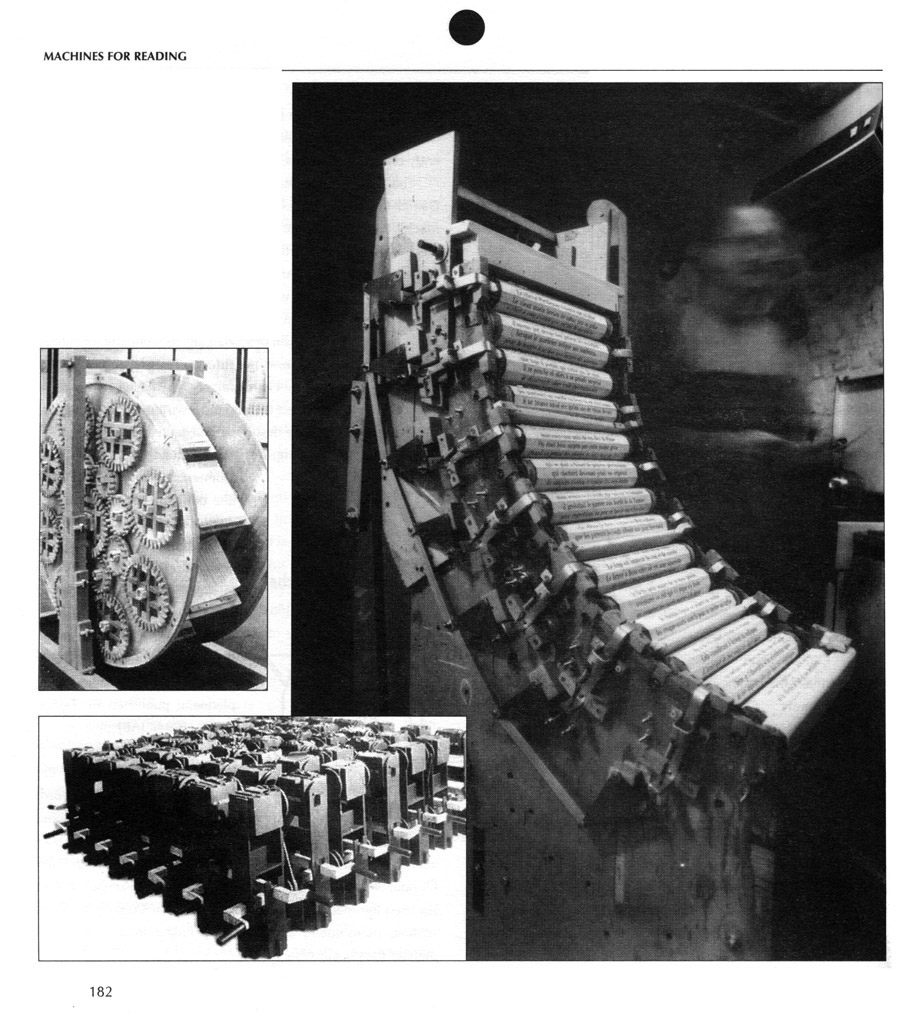
“Serious critics, of course, know that none of this is possible: in the first place, the Lyncée is an imaginary ship; secondly, Duchamp and Roussel never met. (Duchamp relates that he saw Roussel only once, in the Café La Régence, the one in the poem by César Vallejo, and that the author of Locus Solus was playing chess with a friend. ‘I am afraid I neglected to introduce myself,’ adds Duchamp.) But others do not allow these physical difficulties to obscure the truth of a more worthy reality. Not only did Duchamp and Roussel make the journey to [Buenos Aires] but they also met an echo from the future there, linked to them in ways that serious critics would likewise fail to credit. Juan Esteben Fassio prepared the ground by inventing in the heart of Buenos Aires a machine for reading the New Impressions of Africa during the same period when I, without knowing him, wrote Persio’s first monologues in The Winners, using a system of phonetic analogies inspired by Roussel; years later, Fassio attempted to fashion a new machine for reading Hopscotch, unaware that my most obsessive work during those years in Paris was with the obscure texts of Duchamp and the works of Roussel. A double impulse gradually converged upon the austral vertex where Roussel and Duchamp would meet once again in Buenos Aires, when an inventor and a writer – who perhaps years earlier had also watched each other across a cafe in the heart of the city, neglecting to introduce themselves – would meet through a machine conceived by the first to facilitate the reading of the second. If the Lyncée navigated the coasts of Africa, still some of its passengers reached our American shores, and the proof is in what follows, a short of joke designed to lead astray those who search for treasure with solemn faces.”
(Julio Cortázar, from “Of Another Bachelor Machine,” pp. 53–4 in Around the Day in Eighty Worlds.)