two trees by george maciunas
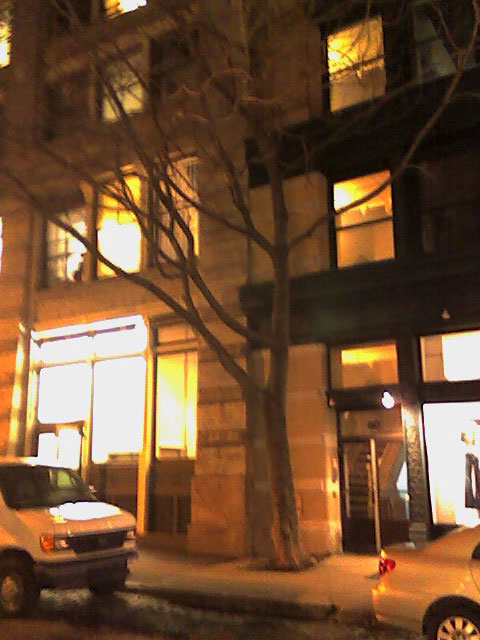
One night I was sleeping in the basement of 80 Wooster Street. I think it was the late Fall of 1967. George comes in, says, “Come help. I got these trees here, I have to plant them.”
“What, at this hour of night?” I hate to get up at night. But I did, and yes, he had these shabby trees lying on the sidewalk.
“I stole them from the parking lot on West Broadway,” he told me proudly, laughing. “They were digging up the whole place, with tractors, and I asked them to give me a couple of the trees, and they said no! So I waited until the night, and I took them, you see? We have to plant them now, it’s against the law to plant trees in SoHo.
The next day, or a day later, some city officials showed up. “No trees are permitted here,” they told me. “You’ll have to get rid of them.”
I go down to the basement, to George. He was making his Fluxus boxes or something, and he says, “Tell them if they don’t like our trees they can pull them out.” So I go back to the city officials, and I say: “No, George is not going to do it. He says you have to do it. And he wants me to take some pictures when you do it.”
The city people looked at me, then at each other, turned around, and we never saw them again.
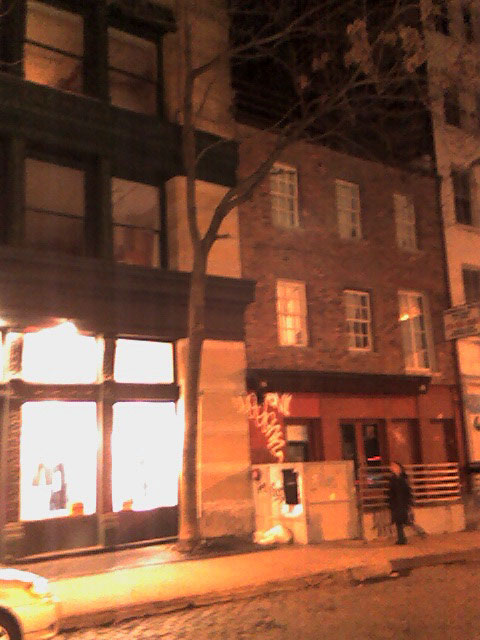
But the trees grew and prospered. Big, big trees they are now, happy trees, the only trees on Wooster Street.
(Jonas Mekas, letter to Emmett Williams, 1993, in Mr. Fluxus: a collective portrait of George Maciunas 1931–1978)
statues of liberty
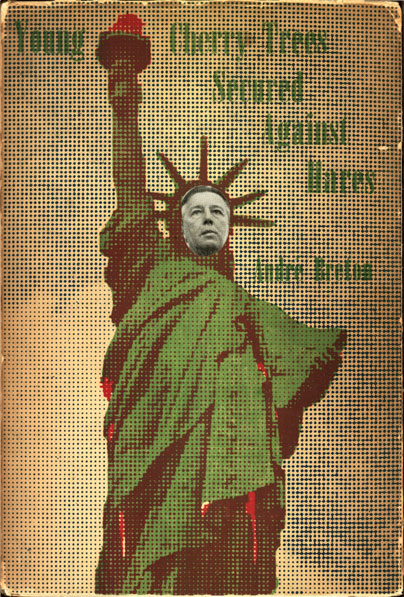
Marcel Duchamp’s cover for André Breton’s Young Cherry Trees Secured Against Hares (1946):
The cover of the first American edition of Michel Butor’s Mobile (1963), designed by Janet Halverson:
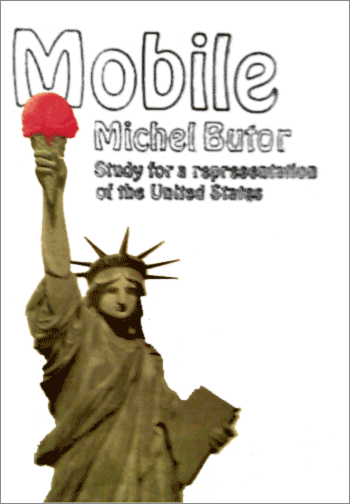
(I would have a better image of that, but there doesn’t seem to be one on the Internet and thieves stole the scanner cable, so the phone & Photoshop will have to do. Alas.)
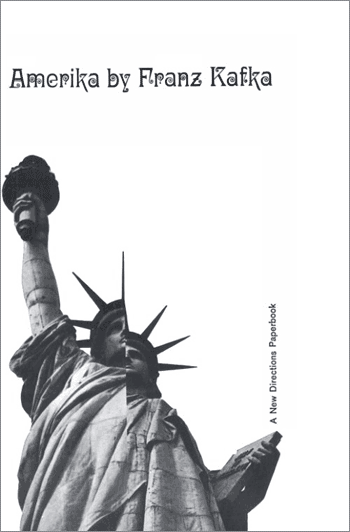
One would imagine that someone would have similarly made a splendid cover for Kafka’s Amerika of the Statue of Liberty holding a sword aloft, but the closest one I can find is the New Directions cover by Gilda Kuhlman:
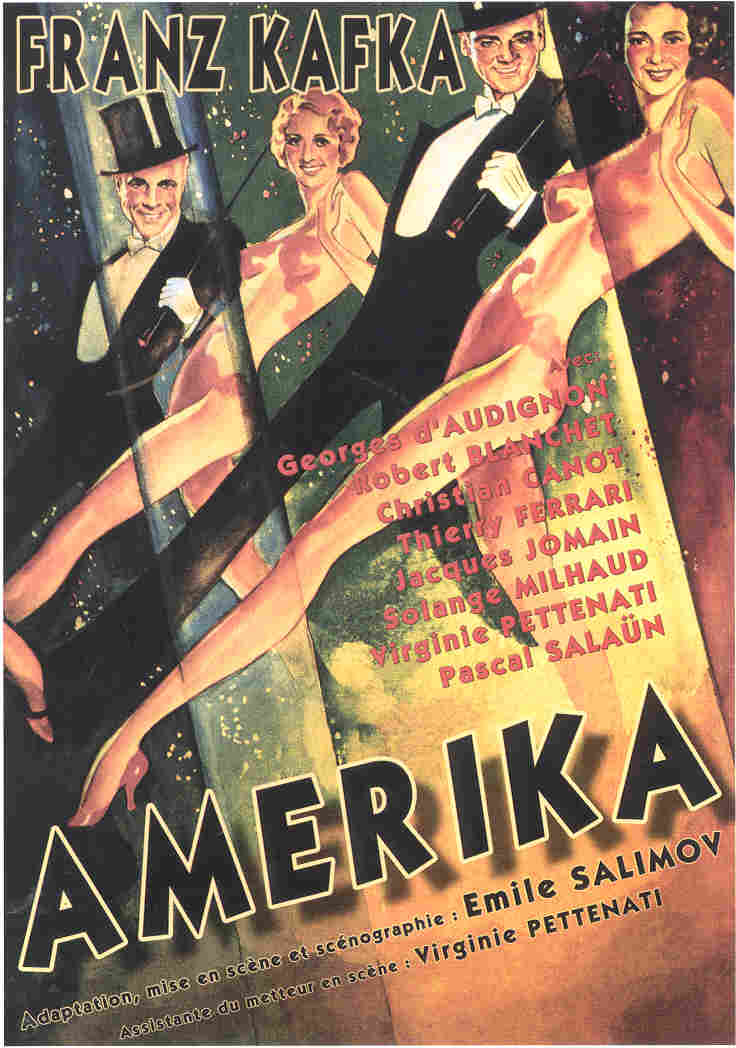
But the best cover for Amerika that I could find is the poster for this French theatrical version of the novel, which captures more of the novel’s spirit:
working, two theories
I’ve never worked for a living. I consider working for a living slightly imbecilic from an economic point of view. I hope that some day we’ll be able to live without being obliged to work.
(Marcel Duchamp, interview with Pierre Cabanne, 1966)
In answer to your question – Fluxus way of life is 9 a.m. to 5 p.m. doing socially constructive and useful work – earning your own living, 5 p.m. to 10 p.m. spending time on propagandizing your way of life among other idle artists & art collectors and fighting them, 12 p.m. to 8 a.m. sleeping (8 hours is enough).
(George Maciunas, letter to Tomas Schmit, January 1964)
forward w/ capitalism!
Voila, the Locus Solus Industries cafépress store. Go buy things. Or rather, go buy the one thing that’s there, this fine t-shirt:

Suitable, I am sure, for many occasions.
randomly
- Skynoise tribute to Nam June Paik (noted by Jace Clayton).
- Thomas Jones on shipping containers at the LRB (also Theo Tait on Houellebecq).
- George Legrady on Daniel Spoerri (among other things), and a partial image-map version of Spoerri’s Anecdoted Topography of Chance (looks to be based on the Atlas Press edition).
(also)
- Aviva Shemesh on Manderlay.
two bad posts on if:book
the impossible bed
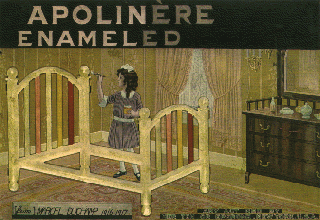
Marcel Duchamp’s Apolinère Enameled, 1916–1917
Rhonda Roland Sherer’s “Marcel Duchamp’s Impossible Bed and Other ‘Not’ Readymade Objects: A Possible Route of Influence From Art To Science”
“the poem is not completely diverting, but appears sometimes odd.”
With the end you are tired of this old world

Shepherdess ô Eiffel Tower the herd of the bridges bleats this morning

You have enough of it to live in Greek and Roman antiquity

Here even the cars seem to be old
The religion alone remained very new the religion
Remained simple like the hangars of Port-Aviation

Only in Europe you are not ancient ô Christianisme
European most modern it is you Black and white Pape X
And you that the windows observe shame retains you
To enter daN a church and of you to confess this morning to it
You read the leaflets the catalogues the posters which sing high
Here is poetry this morning and for prose there are the newspapers
There are the deliveries with 25 centimes full with adventure police
Portraits of the great men and thousand titles various

I saw this morning a pretty street of which I forgot the name
New and clean of the sun it was the bugle
Directors workmen and beautiful shorthand typists
Monday morning at Saturday evening four times per day pass there
The morning by three times the siren groans there
A rageuse bell barks there about midday
Inscriptions of the signs and the walls
The plates the opinions the made-to-order of the parrots criaillent
I like the grace of this industrial street
Located in Paris enters the street Aumont-Thieville and the avenue of the Terns
(Google translation of the start of Guillaume Apollinaire’s “Zone”, from here, complete in French here, and an anonymous translation – not that of LeRoy C. Breunig, Donald Revell, or Samuel Beckett –into English here.)
(Perhaps related: bpNichol’s Translating Translating Apollinaire.)
the problem with blogs / nam june paik
A quick post on if:book on why blogs are terrible things.
Rest in peace, Nam June Paik.