nero/frogs

“From which I later concluded that if there is one thing as noisy as suffering it is pleasure, especially when there is added to it – failing the fear of having children, which could not be the case here, in spite of the far-from-convincing example in the Golden Legend – an immediate concern with cleanliness.”

(Proust, Sodom and Gomorrah, trans. John Sturrock, p.11)

*  *  *  *  *

“Then said he, ‘Make me with child, and after to be delivered, that I may know what pain my mother suffered.’ Which by craft they gave to him a young frog to drink, and grew in his belly, and then he said, ‘But unless ye make me to be delivered I shall slay you all.’ And so they gave him such a drink that he had a vomit and cast out the frog, and bare him on hand that because that he abode not his time it was misshapen, which yet he made to be kept.

Then for his pleasure he set Rome afire, which burned seven days and seven nights, and was in a high tower and enjoyed him to see so great a flame of fire, and sang merrily.

He slew the senators of Rome to see what sorrow and lamentation their wives would make.

He wedded a man for his wife. He fished with nets of gold thread, and the garment that he had worn one day he would never wear it nor see it after.

Then the Romans seeing his woodness, assailed him and pursued him unto without the city, and when he saw he might not escape them, he took a stake and sharped it with his teeth, and therewith stuck himself through the body and so slew himself. In another place it is read that he was devoured of wolves. Then the Romans returned and found the frog, and threw it out of the city and there burnt it.”

(The Golden Legend, the life of Saint Peter)

*  *  *  *  *

“Many writers allude to it in Naaman’s case; that Constantine the head of the whole earth had leprosy no one mentioned; at least none of his fellow citizens, but perhaps some foreigner or other, to be given no more credence than that other fellow who wrote about wasps building their nest in Vespasian’s nostrils, and about the frog taken from Nero at birth, whence they say the place was called the Lateran, for the frog (rana) is concealed (latere) there in its grave. Such stuff neither the wasps themselves, nor frogs, if they could speak, would have uttered! [I pass over the statement that boys’ blood is a remedy for leprosy, which medical science does not admit;] unless they attribute this to the Capitoline gods, as though they were wont to talk and had ordered this to be done!”

Lorenzo Valla, Discourse on the Forgery of the Alleged Donation of Constantine, trans. Christopher B. Coleman, pp.153–155)

<

p align=”center”>        *
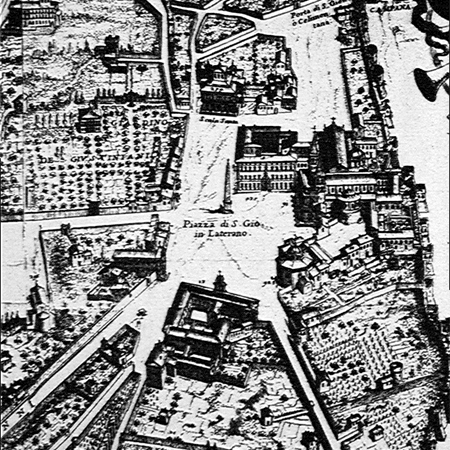
pianta di roma di g. b. falda

(G. B. Falda, Pianta di Roma (detail), 1676)

*  *  *  *  *
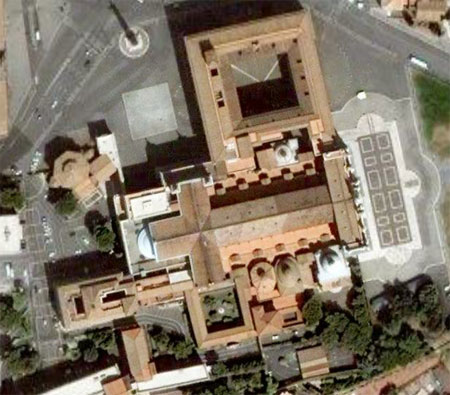
google earth view of san giovanni in laterano

(Google Earth of the same)

wyatt mason in nytimes book review

“When I read Michael Cunningham’s Pulitzer Prize-winning novel, The Hours, I admired it as a thoughtful, delicately considered engagement with the literary past and a sensitive articulation of various kinds of loss. Curiously, though, when I sat in a dark theater and watched the movie version, I sobbed and moaned as though I were being viciously beaten. And although my cinematic reaction was physically extreme whereas my literary response was emotionally mild, I would say it is Cunningham’s novel, and not the film it spawned, that is of greater value. I have had any number of interesting conversations about the book, and phrases from it stay with me (‘without her there is no world at all’), but of the movie I can now remember precious little beyond its having left me sobbing.”

(Wyatt Mason, review of Colin McGinn’s The Power of Movies: how screen and mind interact. Why don’t they give him more space?)

the rose has teeth in the mouth of a beast

“ ‘A new-born child has no teeth.’ — ‘A goose has no teeth.’ — ‘A rose has no teeth.’ — This last at any rate — one would like to say — is obviously true! It is even surer than that a goose has none. — And yet it is none so clear. For where should a rose’s teeth have been? The goose has none in its jaw. And neither, of course, has it any in its wings; but no one means that when he says it has no teeth. — Why, suppose one were to say: the cow chews its food and then dungs the rose with it, so the rose has teeth in the mouth of a beast. This would not be absurd, because one has no notion in advance where to look for teeth in a rose.”

(Ludwig Wittgenstein, Philosophical Investigations, pp. 221–222)

(cf. the interpretation of Matmos)

fabre’s humility

“We all have our own talents, our special gifts. Sometimes these gifts seem to come to us from our forefathers, but more often it is difficult to trace their origin.

A goatherd, perhaps, amuses himself by counting little pebbles and doing sums with them. He becomes an astoundingly quick reckoner, and in the end is a professor of mathematics. Another boy, as an age when most of us care only for play, leaves his schoolfellows at their games and listens to the imaginary sounds of an organ, a secret concert heard by him alone. He has a genius for music. A third – so small, perhaps, that he cannot eat his bread and jam without smearing his face – takes a keen delight in fashioning clay into little figures that are amazingly lifelike. If he be fortunate he will some day be a famous sculptor.

To talk about oneself is hateful, I know, but perhaps I may be allowed to do so for a moment, in order to introduce myself and my studies.”

(Jean Henri Fabre, introduction to Fabre’s Book of Insects, adapted, whatever that means, from Souvenirs Entomologiques)

(see also)

vanishing points

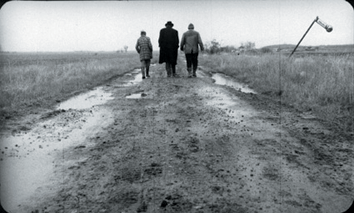
sátántangó still

(representative still from Béla Tarr’s Sátántangó)

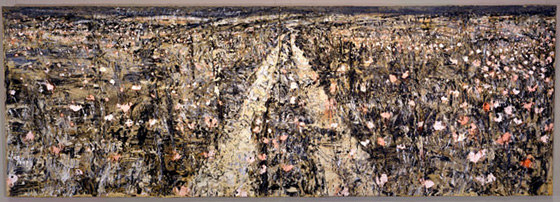
bohemia lies by the sea

(Anselm Kiefer’s Böhmen liegt am Meer)

“Bohemia Lies by the Sea”

Are these houses green, I once more enter a house.
Are these bridges safe, to walk I have good ground.
All loving effort lost for ever, I lose it happily.
lf not I myself then someone else as good as I.
lf here a word adjoins to me, I let it join.
If Bohemia lies still on the sea, I believe the seas.
And if I believe in the sea, I still can hope for land.
lf it’s I myself it’s everyone just as much as I.
I have no wishes any more. I wish to run aground.
Aground – towards the sea, to find Bohemia.
Wrecked, I wake up peacefully.
I have grounded my belief and shall be lost no longer.
Come here, you from Bohemia, sailors, whores, and ships
without a staying. Won’t you be Bohemians, you Illyrians, Veronese
Venetians. Play those comedies to make us laugh

Before we cry. Go wrong a hundred times
as I went wrong and always failed examinations,
yet I passed them all, each and every time.

Passed them like Bohemia which one fine day
was relieved down to the sea and now lies on the shore.

Still I adjoin to a word and to another country,
and ever more adjoin to all there is however slightly,
Come from Bohemia here, a vagrant, who has nothing, whom nothing keeps,
gifted with vision to see from the sea-struggle land of my choice.

(Ingeborg Bachmann, trans. Peter Filkins)

haneke on freedom

“Haneke’s obsessions converge in Caché‘s final scene, a chilling long take that’s the most enigmatic conclusion in recent movie memory. ‘Using a fixed shot means there’s one less form of manipulation – the manipulation of time,’ Haneke says. ‘I’ve always wanted to create the freedom one has when reading a book, where one has all the possibilities because you create all the images in your head.’ Resolutely cryptic, he refuses to decode the scene’s meaning: ‘About half the viewers see something and the other half don’t, and it works both ways.’ He adds, invoking his protagonist’s own mental journey, ‘We always fill the screen with our own experiences. Ultimately, what we see comes from inside us.’ ”

(David Ng interview of Michael Haneke)