two midwestern lists

“What far from average people have walked these streets, in old time! An angel like a hermaphrodite butterfly, a butterfly catcher, a Daniel Boone of the infinite, a finite Elijah, a herb doctor, Lot’s wife, many pastorals, many mechanics, clouded dreamers, a celibate breeder of horses, poor Yahoos, the Spirit of Nature, rational man, irrational man, patriarchs, undertakers. Nor does this list, inclusive as it seems, exhaust the possibilities of nineteenth-century salvationism, as expressed by two Utopias – the first, forerunner of a New Moral World, to encompass all nations and all governments. Two Utopias comprehended, within a half-mile square surrounded by a vast wilderness, past, present, and future, however abstrusely – the burning of Rome, city planning, explosion of stars, a new calendar, anarchy, a New Jerusalem, repression, expansion, moneyless Eden, exaltation of pearls, a three-hour working day, exaltation of horses, infinite regress, the united nations of earth, the many, the few, Lucifer, lotus-eaters, the falling of autumn leaves, the myths of Narcissus, good dentistry, many fictions. So that such perfectionist orders, which would have excluded much of mistaken life itself, with all its infinite variety.”

(Marguerite Young, Angel in the Forest: A Fairy Tale of Two Utopias, p. 3.)

april 21–april 30

Books

Films

  • Never Let Me Go, directed by Mark Romanek
  • Grand Hotel, dir. Edmund Goulding
  • Easy A, dir. Will Gluck

Exhibits

  • “On Becoming an Artist: Isamu Noguchi and His Contemporaries, 1922–1960,” Noguchi Museum
  • “German Expressionism: The Graphic Impulse,” MoMA
  • “Joseph Kosuth: ‘Texts (Waiting for-) for Nothing’ Samuel Beckett, in play,” Sean Kelly Gallery
  • “Chris Marker: Passengers,” Peter Blum Chelsea

looking

Once when I read the funnies
I took my little magnifying glass
and looked too close.

Forms became colors and colors
were just arrays of dots
and between the dots I saw the rough bleak
storyless legend of the pulp paper
empty as the winter moon

and dreaded it.
I had looked right through,
when I wanted a universe
that sustains
looker and looking and the seen
forever, detail after detail
never ending. And all I had found
was between. But between
had its own song:
Find it in the space between—

it is just as empty as it seems
but this blankness is your mother.

(Robert Kelly, from Under Words.)

the truth about the opium lady

YOUNG

I knew an opium lady while I was a student at the University of Chicago, and with whom I spent much time, reading aloud the works of Shakespeare. That is how I worked my way through school.

INTERVIEWER

Who was she?

YOUNG

She had been under opium for about fifteen or twenty years and had not walked for at least ten years. She was one of the original patronesses of Poetry: A Magazine of Verse, and of Jane Addams’s Hull-House. She was also a friend of Thornton Wilder, Harriet Monroe, and many of the other intellectuals of that day. I was with her during her opium dreams. I was with her when the golden bird, who was the spirit of Heroclitus, perched upon the bedpost. I was literally with her when she had a long conversation with the head of John the Baptist.

INTERVIEWER

After decapitation?

YOUNG

After decapitation. I was also there when she spoke with a little rabbit. I was with her when she entertained an imaginary elephant, and when blue fish would be floating over her bed. I began to write my novel quite unexpectedly. I had planned to write a biography of Toulouse L’Ouverture [sic], the Haitian rebel, but my publisher wanted me to write a novel . . . she was the most fabulous, single person I had ever known. I was interested in her for her dreams and her beautiful personality and surroundings.

INTERVIEWER

And the problems of opium addiction?

YOUNG

No. The doctors in her household were always rushing about with Elizabeth Barrett Browning letters to try to explain this beautiful opium lady who was their patient. She was like an Elizabeth Barrett Browning, whom, of course, I had read, along with DeQuincey’s Confessions of an English Opium Eater. I had read Coleridge, too.

INTERVIEWER

So that you would understand her?

YOUNG

No. All this was in my background before I ever arrived. Her house was just right for a young poet. There couldn’t have been a better place. I was offered opium every evening. But I always said, “No, thanks,” and for that reason, she used to call me the “prosaic sprite,” because I didn’t need drugs to dream. I stayed with her most of the time. I was offered the bed in which Edna St. Vincent Millay had slept, when she was a visitor in Chicago, and the idea of sleeping in Millay’s bed—it would mean nothing to me now, but at that age . . . it seemed to be the most marvelous thing that could ever happen to any young person. On the opium lady’s bedside was a silver drinking cup which had belonged to John Keats, a little mosaic Persian letter set, and a beautiful bird with a sea shell. I have these things at my bedside now. Her daughter gave them to me when she died.

INTERVIEWER

You did not enter the opium lady’s dreams?

YOUNG

I do not think she dreamed about people. She dreamed about mandarins and human-sized blackbirds standing in the hallways, or invisible elephants. Adlai Stevenson—he may have known her, by the way—talked about the invisible elephant when he was running for office. I don’t know if he ever got a letter I wrote him, telling him about the invisible elephant in the opium lady’s dreams. He had the same idea: that the thing you think is not there may be there.

(Marguerite Young interviewed by Charles Ruas, Paris Review, “The Art of Fiction No. 66”.)

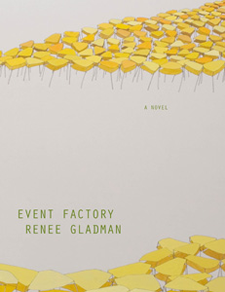
renee gladman, “event factory”

Renee Gladman
Event Factory
(Dorothy, a publishing project, 2010)


It’s hard to know what to make of Event Factory, a short novel that’s the first offering from Danielle Dutton’s Dororthy, a publishing project. The book starts off with an epigraph from Samuel Beckett’s posthumous narrative “The Calmative,” which might offer a clue where Renee Gladman is coming from. Another clue comes in the thanks at the end of the book, which end “and most especially to Samuel R. Delany, for Dhalgren.” Event Factory might be seen as somewhere between Beckett and Delany (the later Delany, of Dhalgren and the Nevèrÿon books).

While Gladman’s book might be read as science fiction, there are none of the usual signifiers of science fiction: no novelties, no space ships, everything taking place in a universe that seems to be our own. Except that it’s not: the first sentence announces “From the sky there was no sign of Ravicka.” Ravicka is, we’ll learn, a city: the reader knows of no city named Ravicka, but might suspend disbelief even for fiction that is not science fiction – has any city ever been more prosaic than Sinclair Lewis’s Zenith in the state of Winnemac? But a sentence later we find this:

The city was large, yellow, and tender.

City refers, presumably, to Ravicka – although three sentences into the book, this isn’t entirely clear to the reader: “Ravicka” could have been any geographical object that can be seen from the sky. Attaching a proper name to it that isn’t a proper name that we know signals that we are outside of our usual space: but how far outside? A city can easily be large: there’s no problem there. Yellow gives pause: this isn’t one of the colors that a city is usually described at. It’s easy to imagine a gray city. A yellow city could conceivably be some sort of tourist destination – walls painted yellow in the way that Marrakech is sometimes called a red city. But the word yellow is functioning differently than large: we’ve stepped, to some degree, into the metaphorical, because, presumably, the city is not entirely yellow, only parts of it is. Or maybe it is: an emerald city suggests fantasy. In science fiction, Delany notes somewhere, there’s a looseness of language: what’s usually seen as metaphor could conceivably be entirely descriptive inside the mode of science fiction. Tender, the third adjective, pushes us in this direction. Even if a city can be yellow, how can it be tender? This adjective, of course, points us to Gertrude Stein, whose Tender Buttons pointed out the possibilities of using words in ways they weren’t intended. (Certainly someone must have by now suggested a science fictional reading of that book?)

Science fiction is inevitably disappointing to me because you often get an opening paragraph like this: one where you can’t understand how the words fit together, which is then defused: over the course of the narrative, you learn exactly what those words mean and why they’re being used in the sense that they are. A second reading is inevitably very different from the first, because the reader has already learned how to read the book. (Perhaps this is why one finds so many trilogies in science fiction?) Event Factory does not work this way. By a second time through – I have now read this book three times, which isn’t that much of an accomplishment, as it’s not very long – this paragraph does not make any more sense. Estrangement is continual in this book. While the proper nouns at the start seem recognizable – there are characters named Simon and Mrs. Madeline Savoy and Timothy; there’s a 32 bus; Simon sings from the Gospels, which could conceivably be the Gospels we know – but soon we find characters named Zàoter Limici, Ulchi Managua, and Dar which might almost be recognizable. (Diacritical marks, as in Delany’s Nevèrÿon, function as a signifier of difference: we look at a name on the page like “Zàoter” and realize that we have no idea how it might be spoken aloud, only that its a is almost certainly not our a.) As the book progresses, recognizable proper nouns almost disappear entirely. It comes as almost physical relief when Kecia Washington reappears toward the end of the book.

What does happen in this book? The narrator, a linguist, goes to the city of Ravicka for reasons left unclear. The air of the city appears to be yellow, though it’s hard to be sure about this, and what exactly this means: perhaps its only smog, maybe its something more fantastical. People seem to be leaving or to have left the city, though why and where they’ve gone is left unclear. The narrator speaks Ravic, the language of the city; she seems to understand the gestural components of communication in Ravicka, which are many. But she still seems to be on the outside of something, mirroring the position of the reader with the book. Because there are the signifiers of science fiction, we keep expecting that something might be explained that will make everything snap into place or to explicate what the ground rules are; perhaps the narrator is expecting the same thing, but it never does. The effect is of taking a long trip in a country that you don’t understand as well as you’d hoped. Again and again there’s the sense of linguistic breakdown:

The woman interrupted, “Yes. We know all of that,” and nodded compassionately. Then continued, more upbeat, “My name is (then gave a puff of air). Will you come with me?”
     And that was what I had feared: she was not Ravickian and, what was worse, she used air instead of hard sound for speech. (pp. 56–7)

There’s more than a hint of metafiction scattered through this book (on the next page, they eat what seems to be “shredded paper, which seemed to have been stewed in various dark and spicy sauces”): one wonders if “hard sound” could mean written or printed letters, since we already know that the air of Ravicka is not quite the same as the air we know. Or we might read this passage as the narrator having become estranged from language: that spoken language turns into only “a puff of air”. This is left unresolved: perhaps it’s both at once.

This book feels like Dhalgren might if that book were more linguistically turned in on itself. There’s the same sense of inscrutability: I think that’s a lot of why I like Dhalgren, and that largely works here as well. Event Factory is supposed to be the first book of a trilogy; I’ll be interested to see where Renee Gladman goes.

the problem of new york

“More disturbing than the well-known situation of commercial publishing is the possibility that the cost of living in New York discourages resident novelists from risking lengthy, time-consuming projects. The future of intellectually and aesthetically ambitious fiction is a huge and complex subject involving conglomerate publishing, new media, text technology, literary education, and literacy itself. That future is global, but I’ve come to believe that New York may well be the representative leading – and double – edge. New York nourishes home-grown writers such as Lethem and Whitehead, attracts writers from abroad such as O’Neill and McCann, and honors its elder, DeLillo. New York offers the eight million stories of the naked city and makes a few writers millions, but I fear that New York also tamps down novelists’ aesthetic ambitions, turns them into careerists of modest, consumable art – not minimalism or maximalism but medianism – that will allow them to continue publishing in and maybe living in Cosmopolis.”

(Tom LeClair, “Going Up, Falling Down”, EBR)

april 11–april 20

Books

Films

  • Tales from the Gimli Hospital, directed by Guy Maddin
  • The Dead Father, dir. Guy Maddin
  • Even – As You and I, dir. Roger Barlow, Harry Hay & LeRoy Robbins
  • Canyon Passage, dir. Jacques Tourneur
  • Fashions of 1934, dir. William Dieterle
  • Roman Scandals, dir. Frank Tuttle
  • The Kid from Spain, dir. Leo McCarey

Exhibits

  • “Martin Kippenberger: Eggman II,” Skarstedt Gallery
  • “Günther Uecker: The Early Years,” L & M Arts
  • “Friedrich Schröder-Sonnenstern: From Barefoot Profit to Avant-Garde Artist,” Michael Werner Gallery
  • “Malevich and the American Legacy,” Gagosian
  • “Touched: A Space of Relations,” Bitforms Gallery
  • “Chris Marker: Passengers,” Peter Blum Soho
  • “Cosima von Bonin: The Juxtaposition of Nothings,” Friedrich Petzel
  • “Hermann Nitsch: Die Apotheke/The Pharmacy,” Leo Koenig
  • “Rirkrit Tiravanija: Fear Eats the Soul,” Gavin Brown’s Enterprise

daniel hernandez, “down & delirious in mexico city” / sharifa rhodes-pitts, “harlem is nowhere”

Daniel Hernandez
Down & Delirious in Mexico City: The Aztec Metropolis in the Twenty-First Century
(Scribner, 2011)
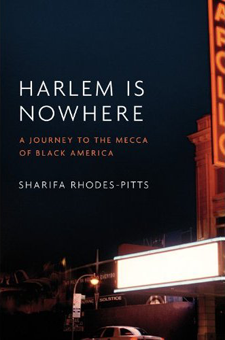
Sharifa Rhodes-Pitts
Harlem Is Nowhere: A Journey to the Mecca of Black America
(Little, Brown, 2011)


Two books this time, one that I’ve taken a very long time to read – I started Harlem Is Nowhere in February if not sooner – and one which just arrived and I read quickly. These books are superficially similar in that they consist of essays about a place – a neighborhood in the case of Harlem Is Nowhere, a nebulously defined city in Down & Delirious in Mexico City – but they’re different in tone and effect. The form is familiar enough, if possibly dangerous: Suketu Mehta’s Maximum City might be a useful example. Reading that book a few years ago, I found myself realizing that I’d find the book immensely fake if it presumed to tell the story of New York rather than of Bombay. The idea of making a city fit into a book is inherently problematic, as tempting as it might seem.

Maybe it’s easiest to talk about Down & Delirious first. Hernandez’s book is both helped and hurt by the existence for David Lida’s First Stop in the New World, from a few years ago; Lida’s book presents a well-written introduction to various facets of Mexico City for an American audience that doesn’t tend to think about Mexico City at all. Lida’s book is cited numerous times in the notes to Down & Delirious; one has the sense that Lida paved the way, and gave Hernandez the freedom to not write about many aspects of the city. Lida’s perspective is perhaps easier for the average reader to related to: he’s an Anglo who moved to Mexico City. Hernandez was born into an assimilated family in San Diego of Mexican descent; though he visits Mexico City for the first time as an adult, it’s easier for him to slide into the youth culture there. This is the real subject of Hernandez’s book: it’s a good one, and he arrives at the right time to chronicle it. The book founders a bit when he tries to draw larger conclusions about Mexico City, simply because it is so vast, and he’s consciously only dealing with a circumscribed part of it. Lida’s book – more considered, running the risk of being impossibly broad – is almost certainly a better introduction to the city for a general audience. 

That said: Hernandez’s book is very pleasant to read. His prose conveys how vibrant the city is right now: for all its flaws, Mexico City seems much more alive, more full of possibility, more creative, than New York does right now. It’s a city full of strange wonders, and Hernandez has a great deal of fun tracking them down. His account of the Mexican emo riots of 2008, or example, carefully and empathetically takes apart what seems to be a ridiculous subject, finding in it a great deal of interest. He backs off, however, when the subject threatens to overflow the essay form: the homophobia he detects at the heart of the story isn’t interrogated at length. 

Maybe that’s a problem with the form of this book. There was a recent piece by Paul Maliszewski that expertly anatomized the problem with magazine-writing as it currently exists in American literary culture. These are problems that bother me; the pieces of this book feel, to me, too much like magazine pieces, and while they’re good at that, I keep feeling like there could be something more made from them. Hernandez bounces from encounter to encounter; each piece more or less stands alone, though there are, of course, some common threads that carry through the book. This makes the book easy to digest; but it almost makes it too easy to digest. The last chapter, in which Hernandez attempts to build up to a resolution, falls flat, in part because his distributed form works against him. 

Harlem Is Nowhere is by contrast a book more turned in on itself. It’s a record not so much of a neighborhood as it is of an encounter with a neighborhood’s extensively documented history. This isn’t to suggest that Hernandez’s book isn’t well-read: a tremendous amount has been written about Mexico City, and his copious notes document his reading. His reading, however, seems instrumental, something to be used as a means to an end; in other words, research. For Rhodes-Pitts, there’s the sense that Harlem exists to end in a book: it always has, but what that book is has changed over time. Where Hernandez talks almost exclusively with young people, Rhodes-Pitts seems to only talk with the old. 

Harlem Is Nowhere makes it clear early on that it doesn’t pretend to be a definitive history: it’s more the record of an engagement with a neighborhood, wrestling with the problem of a sense of place in the manner of Geoff Dyer. It’s a considerably more pessimistic book that Down & Delirious: Rhodes-Pitts is writing about Harlem, buy she might be writing about the terminally bourgeois state of New York City in general. Rhodes-Pitts frames the book with problems of real estate: from present-day developer schemes to gentrify and destroy Harlem to the older black arguments (from Marcus Garvey on) tying cultural autonomy to land ownership. 

Rhodes-Pitts is a cagey presence in her book: born in Texas, she moves to Harlem and looks intently at it, trying to map what she sees to what she’s read. She’s constantly being buttonholed by those who would be her elders, people who have ideas for her and her book, ideas that she questions more often than not. The stories she’s told often don’t hold up when subjected to scrutiny; but the same is often true of the books she reads. 

There’s maybe a quiet echo of Don Quixote to her project: everybody knows that Harlem, like chivalry, is, if not gone, at least in a bad way by the time she gets to them, but maybe her book will get it right. She spends a great deal of time in libraries, attempting to square what’s outside with what’s inside: she moves from the book to the street to the book, sometimes more immediately, as when she is accosted in libraries by old people with their own theories. She’s good at listening; she’s good at digging up stories. 

But this is, finally, an elegiac book, focused squarely on the past, with it’s corollary, how the past informs the present. One wishes the present could do a better job of speaking for itself; but this isn’t Rhodes-Pitts’s fault. She’s made a beautiful book out of it.

april 1–april 10

Books

Films

  • Anatomy of a Murder, directed by Otto Preminger
  • Safety Last!, dir. Fred C. Newmeyer & Sam Taylor
  • Hospital Fragment, dir. Guy Maddin
  • Sweetgrass, dir. Lucien Castaing-Taylor
  • Trick Baby, dir. Larry Yust
  • Homebodies, dir. Larry Yust
  • Месть кинематографического оператора (The Cameraman’s Revenge), dir. Ladislas Starevich 
  • Владислàв Алексàндрович Старèвич (The Insect’s Christmas), dir. Ladislas Starevich 
  • La Voix du rossignol (Voice of the Nightingale), dir. Ladislas Starevich 
  • Les Grenouilles qui demandent un roi (Frogland), dir. Ladislas Starevich 
  • Fétiche Mascotte (The Mascot), dir. Ladislas Starevich 
  • Carrousel Boréal (Winter Carousel), dir. Ladislas Starevich 

Exhibits

  • “Sergej Jensen,” MoMA PS1
  • “Rembrandt and His School: Masterworks from the Frick and Lugt Collections,” Frick
  • “Rooms with a View: The Open Window in the 19th Century,” Met