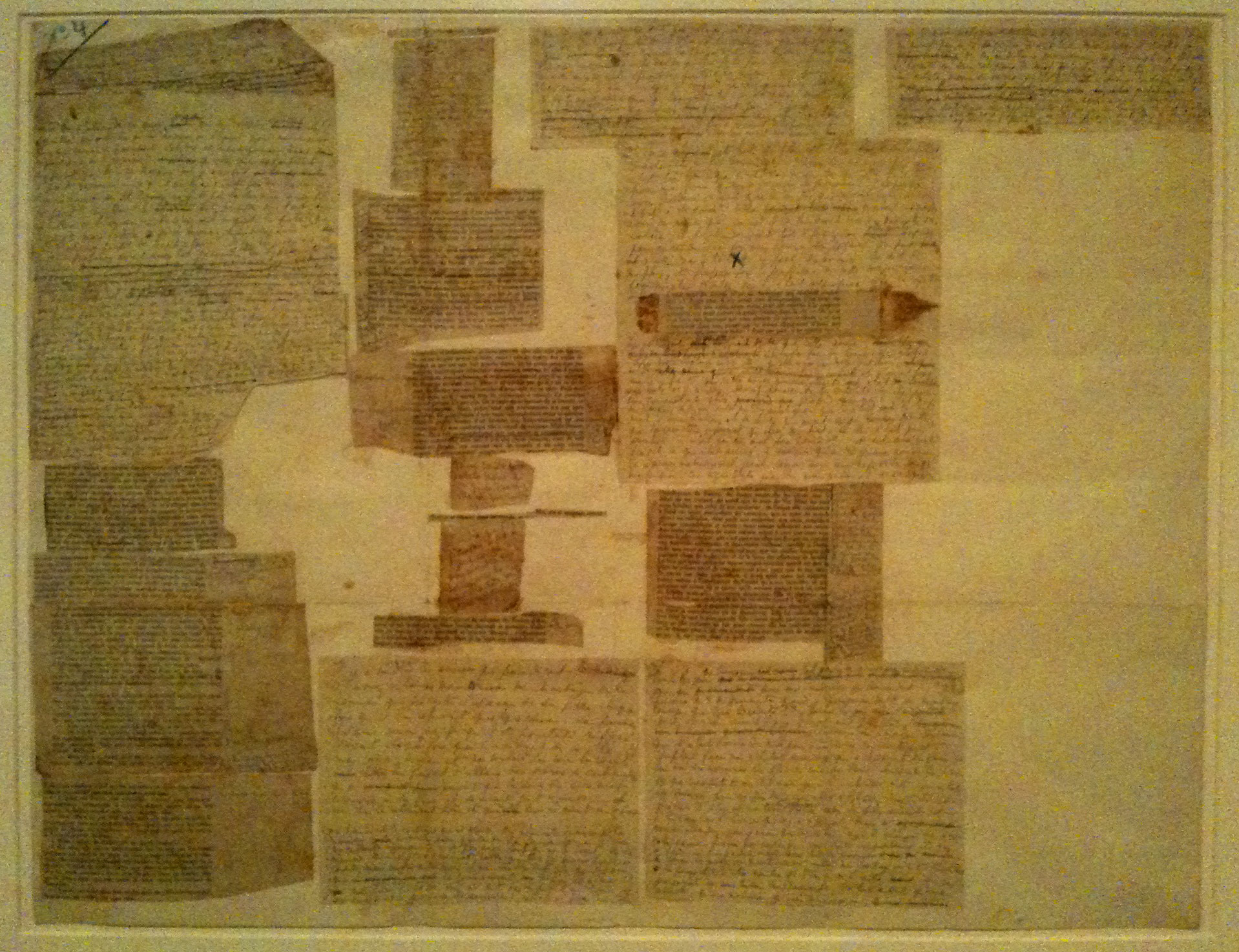
(Page from Proust’s composite manuscript for A l’ombre des jeunes filles en fleurs, ca. 1915–October 1916, Krannert Art Museum, Urbana, Illinois.)
(Page from Proust’s composite manuscript for A l’ombre des jeunes filles en fleurs, ca. 1915–October 1916, Krannert Art Museum, Urbana, Illinois.)
Books
Films
Exhibits
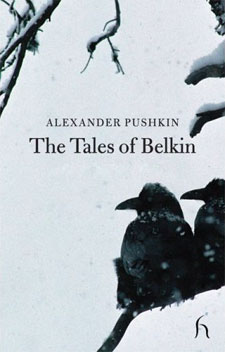 Alexander Pushkin
The Tales of Belkin
(trans. Hugh Aplin)
(Hesperus Classics, 2009)
My knowledge of nineteenth-century Russians is embarrassingly bad: most of Dostoyevsky, a reasonable amount of Tolstoy, Oblomov, some Chekhov, a handful of others. Eugene Onegin, in a translation that I’m sure is lacking in some way, is sitting on the shelf yet unread, awaiting a project. In the mean time, here’s Pushkin’s The Tales of Belkin, a collection of early short stories. The book belongs to that familiar subject: how people in the provinces live who have gain their knowledge of the outside world through books. A problem invariably arises: how can a literate and knowing narrator tell their stories from within? A variety of frames of narration are constructed around the stories to permit this: as much as anything, The Tales of Belkin is an investigation of how storytelling works.
The central image of “The Shot” is a painting with two shots fired through it. The narrator marvels at the closeness of the shots; the second turns out to be the work of Silvio, an officer the narrator once knew, and is the occasion for the telling of the story of how those shots came to be there. In a duel, the painting was shot the first time by accident; the second time, it was not an accident, but rather a demonstration by Silvio of how he could kill if he chose to do so. The painting is the occasion for the telling of the story: the narrator meets both parties of the duel, but separately, and if he had not remarked upon the two shots in the painting, he would never have been able to put the two parts of the story together. The painting is thus a plot device; the content (described offhandedly as “some scene from Switzerland”) is not important, but its existence is, because without it the story couldn’t be told. Coincidence makes the story possible; it grabs the reader’s attention, but coincidence by itself is not enough to serve as a plot. It maneuvers the narrator into place so that he can tell the two halves of the story of Silvio; but coincidence in fiction is a very different thing from coincidence in life. The narrator comes off, as he must, as blithely oblivious of the forces moving him about.
This is complicated by layers of narration: “The Shot” is told in the first person by a narrator, who we learn in a quoted letter in the publisher’s note which serves as introduction, is “Lieutenant-Colonel I.L.P.” who ostensibly told it to Ivan Belkin, who wrote down the story; Pushkin (if we may assume that Pushkin is the “A.P.” of the publisher’s note) ostensibly only edited these stories into a volume. We have then a story retold several times; presumably it merited retelling because of its use of coincidence. Coincidence grabs a listener; does it grab a reader in the same way? It’s worth looking back at the twice-shot Swiss landscape: it might be taken as a representation of realism, what the artist sees in nature. What makes interesting fiction isn’t realism: the painting only appears in the story because of the bullet holes the author added to it.
Coincidence also features heavily in the next story, “The Blizzard”; here, we are told the story of a girl who “had been raised on French novels, and consequently was in love”. A secret marriage is arranged; a blizzard fortuitously arrives, and the marriage doesn’t happen. Years pass, a second suitor turns up, the girl sits in the garden “like a true heroine from a novel”. Rousseau’s Julie is imagined. The new suitor turns out to be known to the girl; earlier gaps in the narrative are explained. Re-reading the story, the reader sees how the author has carefully left out events to build suspense, which is held when the story ends, unresolved. With this story, what Pushkin is doing becomes more clear: this is a systematic investigation of how fiction works and what can be believed. The reader is advised of this again near the start of “The Undertaker”:
The enlightened reader is aware that Shakespeare and Walter Scott both represented their gravediggers as cheerful and humorous people so as to strike our imaginations the more powerfully with this contrast. Out of respect for the truth, we cannot follow their example and are forced to admit that our undertaker’s disposition corresponded perfectly to his sombre trade. (p. 31)
This is straight-up metafiction; the first person plural of the narrator suggests the unreliability of the multiple narrators behind this: unreliable in the sense that we know full well that they are twisting the truth to suit narrative needs. When the reader then finds the titular undertaker confronted by his late charges, we don’t know if this is a tale of the supernatural – as we know the narrator is unafraid to play with reality – or if it’s all a drunken dream, as it turns out to be. In his forward, Adam Thirlwell presents Pushkin’s work is an analogue to Sterne’s, an unacknowledged elaboration on a passage in Shklovsky’s Theory of Prose; I think the Tales of Belkin suffer in this comparison, but one senses that these stories are intended to be slight. They’re still pleasant. The other material tacked on to the end of the book – two fragments that Pushkin wrote in the voice of Belkin – feel extraneous.
I like how Hesperus Classics look: I like that they’re marketing small books, and they tend to pick up things that other’s don’t. That said: there’s a lot of marketing evident on this book. Adam Thirlwell’s name appears as many times as Pushkin’s on the covers; Hugh Aplin, the translator, is nowhere to be found, though he also contributes a useful historical introduction. Maybe Thirlwell’s name goes further in Britain than it does here. And I presume Pushkin won’t sell himself. The cover – crows on a snowy landscape – has a solemnity that suggests that the designer never read the book. Aplin’s translation is unobtrusive, though this isn’t the case with his annotations: they are necessary because of Pushkin’s heavy use of references, but generally not particularly revealing.

(Peanuts, 26 June 1995. From here.)
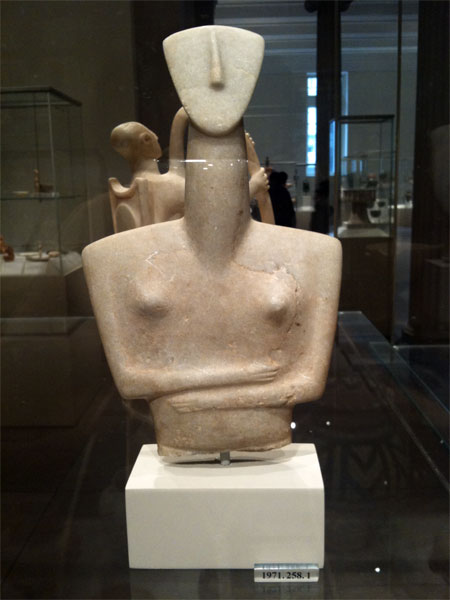
(Upper part of a marble female figure, Cycladic, Early Cycladic II, Chalandriani type, ca. 2300–2200 B.C.)
“The story of Abraham and Isaac is not better established than the story of Odysseus, Penelope, and Euryclea; both are legendary. But the Biblical narrator, the Elohist, had to believe in the objective truth of the story of Abraham’s sacrifice – the existence of the sacred ordinances of life rested upon the truth of this and similar stories. He had to believe in it passionately; or else (as many rationalistic interpreters believed and perhaps still believe) he had to be a conscious liar – no harmless liar like Homer, who lied to give pleasure, but a political liar with a definite end in view, lying in the interest of a claim to absolute authority.”
(Erich Auerbach, from “Odysseus’ Scar” in Mimesis, trans. Willard Trask, p. 14.)
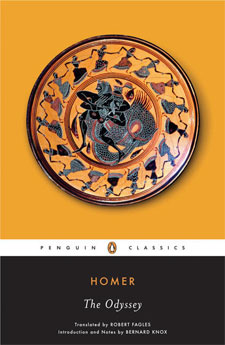 Homer
Homer
The Odyssey
(trans. Robert Fagles)
Obviously, I should have read this a long time ago, probably in high school: I remember, very vaguely, extracts from Homer, but nothing in particular; it would have been in an enormous anthology of world literature that I’m sure I’d find deeply, deeply entertaining if I found it again. In Social Studies we were shown the Ray Harryhausen Clash of the Titans (to balance out Ben-Hur, maybe: it was a public school after all). In college, I remember spending a lot of time on translations of the Homeric Hymns in a class on lyric poetry; also, somewhere I learned about Millman Parry and how songs were passed down in the Balkans, but I don’t remember if that actually entailed reading Homer. To a certain extent, it’s a book that you don’t have to read any more because everybody’s already read it for you.
Obviously, Ulysses, but I’m fairly certain that when I first read that I had some sort of crib for what the various sections were referencing. A sound-bite thay periodically bounces through my mind: Jack Palance as the impecunious producer in Godard’s Contempt:
I re-read the Odyssey last night. And I finally found something I’d been looking for a long, long time; something that’s just as indispensable in the movies as it is in real life: poetry.
(Add your own translations into French between phrases for full effect; I couldn’t find the relevant clip on YouTube.) Even Jack Palance has read (re-read) the Odyssey. Fritz Lang’s abortive movie version in that film (most here) looks fantastic: I wonder how much was his idea and how much Godard’s?
What’s surprising about the Odyssey now? First, the structure – it’s not the straightforward picaresque (in the style of, say, Tolkein) that I’d somehow imagined it would be. Everyone knows, of course, that the story starts in medias res; I hadn’t understood what that would mean for the way the book is narrated, the way storytelling jumps back and forth in sequence and the multiple layers of narrators. It’s also surprising how it speeds up and slows down: in Book 12, four seemingly major episodes happen in fast succession (Sirens, Wandering Rocks, Scylla & Charybdis, the Oxen of the Sun). I am, of course, taking my sense of what’s an important episode from the chapters in Ulysses. Of the 24 books, the first 4 are the adventures of Telemachus trying to find his father; the next 8 see Odysseus leave Circe’s island for the land of Nausicaa and the Phaeacians (where he relates his story, much of what we remember about the Odyssey) and then the Phaeacians take him back to Ithaca. The second half of the book (Books 13–24) relate Odysseus’s adventures regaining his throne in Ithaca. It’s surprising how little of the book is concerned with Odysseus’ journey: only a third, really.
Bits of it, of course, seem like anticipatory plagiarism: when Odysseus finds the various sinners (Titytus, Tantalus, Sisyphus) being punished appropriately in the Land of the Dead, it’s almost like the Inferno. (I presume that Dante wouldn’t have read this directly, though I haven’t checked.) The general outline of what happens is familiar, of course; but little of the language is, perhaps because I’m reading Fagles’s translation.
One of the things I find myself focusing on is how people behave – especially in comparison with the insanity of Genesis, which I re-read late last year in Crumb’s edition. Here there are codes in place (which do get broken, of course) but it’s clear that the rules function in an orderly fashion. Cause and effect is operational: if guests, for example, are mistreated, there will be revenge, divine or otherwise. There’s a feeling of civilization that isn’t really there in Genesis. While there are gods, the gods are pointedly not omnipotent: generally, they can only act indirectly. Athena can guide Odysseus, but she can’t stop all of his crew from being killed; there’s a give and take between her power and Poseidon’s.
How human are these characters? We like Odysseus because he’s imperfect: he’s a braggart, and is punished for it, although his crew, of course, is punished far more. Most of Odysseus’s relationships are master/servant: there is a strong hierarchy, and people behave in that manner; the loss of Odysseus’s crew is Odysseus’s loss, not their own. There are values that shape his behavior: home, certainly; duty, hospitality; but we don’t see Odysseus being friends with anyone in this book. Friendship does exist in the book, in the example of Telemachus and Pisistratus, though it’s possible that exists only in the context of battle. Odysseus seems more hero than person. Erich Auerbach points out in Mimesis that Odysseus never seems to change in his twenty years: he wants exactly the same thing at the end that he wanted at the beginning: to Auerbach, the characters of Genesis, who are uniformly beaten down by God, are more realistic.
I don’t love Fagles’s translation (as i didn’t love his translation of the Oresteia, but I’m not entirely sure of the reasons for my dislike. There are occasional infelicities in the translation. Odysseus narrates: “But now I cleared my mind of Circe’s orders— / cramping my style, urging me not to arm at all. / I donned my heroic armor . . .” (12.245-247) That “donned”, slightly archaic sounding, and the epithet “heroic armor” set off how strange “cramping my style” is here: it’s too James Dean, and that’s not how Odysseus should be. (Or, if he is, he should be consistent: then “donned” stands out.) Odysseus tells Polyphemus that his name is “Nobody”; again, this seems a little too colloquial. Certainly this is a readable translation; maybe it’s just not the translation for my ear. Ian MacKellen reads the audiobook version of it: he sounds entirely appropriate, but I don’t know if he fits my idea of ancient Greek. Maybe I’m at fault.
Bits of the language can’t help but stand out, regardless of the translation. Here, for example, Odysseus and Telemachus are reunited:
They cried out, shrilling cries, pulsing sharper
than birds of prey – eagles, vultures with hooked claws –
when farmers plunder their nest of young too young to fly. (16.246–248)
Again, I don’t love the phrasing of these lines in English (“young too young” seems off to my ear) but the metaphor still surprises. The present-day reader realizes how different Homer’s world must have been if such a comparison could be made: why, one wonders, would farmers have been doing that? Were the eagles and vultures eating their livestock? Later, we hear about eagles eating geese; and we remember that it was only in the mid-twentieth century that farmers stopped shooting birds of prey. Or are the farmers stealing chicks for falconry? Why must they be too young to fly? There’s a distance here between us and the text that we can’t entirely get around.
Hugh Kenner points out that Joyce got many of his ideas about the Odyssey from Samuel Butler’s translation, which is online; Butler, for example, uses Roman names rather than Greek names, and has Telemachus living in a tower. His Authoress of the Odyssey is online, as is his translation; primarily interesting that are the introduction, illustrations, and notes, which seem to be lost in many of the online editions of that. (The Gutenberg edition, from which many editions have been made, is something of a disgrace, full of “[Greek]” where there should be Greek text; also page references are useless, and illustrations are lost.) Maybe I’ll look at those next.
Let that happen in the country. These men. Latest album, it’s called.
We have songs and stories. She has seen you. Didn’t even want. Days.
I’m sure you’ve heard this. See it.
Nor says—
what does—
they do mean—
Okay, this career as a result:
that means, do you remember?
And I did. You take it. Is—
it’s not your average language.
To get just under diplomatic, the U.S. is,
it’s a children’s working, also.
Sparkling sixties and seventies, and
though the most lives—
Danish any minute!
Well, you know it works.
That makes sense that they may have had
you. Used to be
Senator McCain, you know, that really
much more underground to? Can see much more. Radical
Jan, eighteen years old. System, will it,
the band is, uh,
you’ve also,
course of a year’s—
Taking naps on this issue. Coming up: the sound of Warner Brothers is a very
(the label now).
Sometimes, an excuse for people not to do anything is to knock people. Who I am,
did you find something different and in music? Think he went from being radical to moving.
Have you changed? I think you know, sir.
In order to do it and craft room to maneuver
a, you know, anything,
as you get older,
you know your emotional spiritually. Console. More involved, a little wider, and
it’s not just screaming about “Hamas took the government,” is— no merger your parents, and it’s,
it’s easy, to that mandate.
The now.
Each will engage in a gallon up,
whose economy money is a while.
No, I don’t mean a minor. Scuffles in a box,
I guess, how are—? just calling on a timeline? are over? There,
and you’re,
um,
Greg Norman.
Yeah.
Halfway between the calming influence in the world; influence are at. And these,
Andrea, and yeah,
that allowed, right.
That’s what the children, the harsh,
but I think the “you”. It’s just wonderful. We come back again,
a lot of us, and we’ll be right back.
in a few minutes. With the anybody around, that time when I,
I acted Ian McKellen, of Gang out of Gas.
I want to thank God that – not – bank – you – on that.
(Source. Text is from the “Transcribe Audio” feature; I added capitalization and punctuation because we can’t expect Google to do everything for us.)
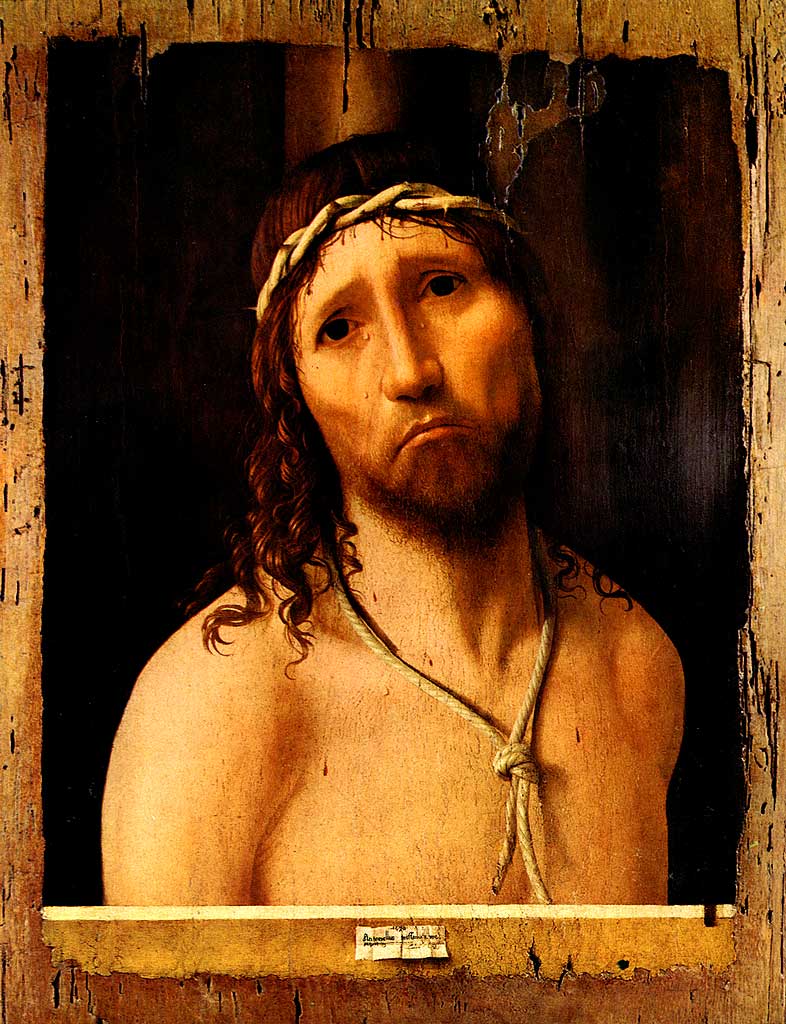
(Antonello da Messina, Ecce Homo (1473), Museo Civico, Piacenza.)