henry green, “back”

Henry Green
Back
(Dalkey Archive; originally 1946)


It’s hard for me to get around how good Henry Green was; one starts every novel expecting that this might be the one to let you down, but it doesn’t happen. Back might be seen as a sequel to Caught, the third of a rough trilogy starting with Pack My Bag, his oblique memoir: besides being the books that don’t have a participle for the name (leaving aside the early Blindness), these are books that document Britain during World War II: they show how things were, not how they are. They’re not as funny as his others, of course; Pack My Bag seems to have been written in a stately panic, while Caught comes out of the claustrophobia of the Blitz. Back seems to follow from the haunting final section of Caught, where Richard Roe has been evacuated to the country and is talking obsessively about what happened to him; but Charley Summers, the protagonist of Caught, seems to be the opposite of Roe: he can’t speak at all about what happened in a German prison camp, though one of his legs is missing.

For all its documentary force, Back is very much a novel – more explicitly so than Caught. There is a clearly constructed situation, with two different triads of children and parents. Charley, before leaving for the war, had an affair with Rose, who was married to James; Rose died while Charley was a POW, but she did have a son, named Ridley, that both Charley and James believe to be their own. (The reader is given no hints as to the parentage of this child; we view this through the lens of Charley, but his judgment is shown to be deeply faulty.) And Rose’s father, Mr. Graves, had another daughter, Nancy, by a different mother. After Charley returns, he visits Rose’s parents; Mr. Graves sends him obliquely to visit Nancy, not mentioning who she is. When Charley finally meets her, he thinks that she is a revenant Rose; there, paternity is the source of identity. With Ridley, who he sees for the first time not knowing who he is, he can reach no conclusions about paternity: 

He was appalled that the first sight of the boy had meant nothing. Because one of the things he had always hung on to was that blood spoke, or called, to blood. (p. 9)

This incident, at the start of the book, sets the rest of the plot in motion. Having met Nancy through Mr. Graves’s machinations, he confuses her with her half-sister; there seems to be no real resemblance between the two women that any one else notices. This is not the first familial confusion in the book: visiting Rose’s parents, her mother, under strain, imagines Charley to be her dead brother. He chalks it up to the war; others, noting his confusion about Nancy/Rose assume the same of him.

What’s most interesting about Back are the odd relationships engendered by the war: Charley is on friendly behavior with the man he ostensibly cuckolded before the war, and on friendly behavior with Rose’s parents. There is no mention of Charley’s own parents; we might assume that they are dead. But it’s worth noting that Charley doesn’t pursue a relationship with Ridley, whom he believes to be his son; once, he makes a sign to the boy, putting his finger to his lips, but this is their only real communication. It’s the substitute family that becomes his: when Mr. Graves has a stroke, he visits often, and is there when Mr. Graves finally dies. This switch isn’t his alone: Mrs. Graves, who knows of the extramarital liaison that produced Nancy, has Charley bring Nancy to her house when Mr. Graves is dying; Nancy moves in and effectively becomes the couple’s daughter. Nancy does have a mother of her own, of course, with whom, she takes care to note, she was the best of friends; but the mother has been evacuated to the country and doesn’t appear. (Nor does James – the son-in-law of the Graveses and father of their grandchild – appear when his father-in-law is dying.) When Nancy and Charley finally decide to get marred, they plan to live with Mrs. Graves: an odd family of elective affinities.

Everything ends happily, or reasonably so, with a marriage on the way: it’s very much a novel in that way. It’s entertaining to watch Charley to bumble his way through his job, his life, and his relationships with women. But Back is a book about trauma; reading it, I found myself thinking again and again of David Cronenberg’s underrated Spider (based on a novel by Patrick McGrath that I haven’t read), another closely-observed story about a damaged man returning home after years spent away. The viewer of Cronenberg’s film doesn’t know what happened to Clegg in the mental hospital, though it can be assumed to be terrible; nor do we know what happened to Charley Summers in Germany. He does make one tiny admission about what happened to him, two sentences, ten pages from the end of the book: these two sentences don’t describe what happened directly to him, just how he was living, and they hit the reader with the blow of a hammer. We realize just how much has been unsaid in this narrative. Moments like this are scattered through the book: when Mrs. Graves admits to Charley that she knows about her husband’s other daughter, for example, and we realize how complex real world relationships can be. Mr. Graves, stricken dumb by his stroke but still conscious, can only watch the reassembly of a family (his wife, Nancy, Charley) which goes on in front of him on his deathbed. There’s little mention of Charley’s missing leg in the book, though it must cause him a great deal of trouble; most characters seem not to notice it, and even a doctor is surprised to hear that he has a missing leg. All these things have been swept under the rug, necessary, one supposes, for survival during wartime. 

jean-philippe toussaint, “self-portrait abroad”

Jean-Philippe Touissant
Self-Portrait Abroad
(trans. John Lambert)
(Dalkey Archive, 2010)


What, precisely, is this book? My copy is a galley; the front cover and the title page say “Self-Portrait Abroad, a novel by Jean-Philippe Toussaint”; on the cover, the category tags it as “fiction”. The info sheet tucked inside this copy says that in the book “our narrator – a Belgian author much like Toussaint himself – travels the globe”. The Library of Congress headings on the copyright page don’t suggest that it’s fiction, rather tagging it travel. To the reader, it doesn’t feel like a novel: this is a small book, a collection of short travel pieces that might have appeared separately in a newspaper, as I thought I heard Toussaint indicate last Friday in his appearance at BookCourt. Were one coming at this book as a tabula rasa, one would probably not tag it a novel.

This book might be thought of as falling between genres in tradition of Butor: his Mobile, while formally much more experimental, takes the same approach to travel. At the end of that book, the reader has an idea of Butor’s sensibility, what interests him; but a sense of Butor as a traveler is entirely lacking, and one wonders whether Butor actually took the trip laid out in the book. Toussaint’s approach is more personal (a bit more like Butor’s later, and more stylistically restrained, The Spirit of Mediterranean Places), but there is the same vagueness: if this is memoir, it’s considerably oblique one. It’s certainly not trying to be travel writing, as that’s usually understood: one can’t learn very much about places from this book. (“Seen from above, at four thousand feet,” the narrator writes in the first paragraph of “Tokyo,” “there isn’t much difference between the Pacific and the Mediterranean.”) Rather, as the title suggests, we learn about the narrator.

The narrator sees not where he is, but where he’s from. On his arrival in Tokyo, a Corsican friend insists on filling him in on what happened there; he is “perfectly indifferent to the surrounding atmosphere,” an indifference that the narrator seems to share: “Although it was pastis time,” the narrator notes, “we contented ourselves with green tea.” The section named “Hobg Kong” describes that city from a bench in its airport and, most notably, from the airplane prior to arriving in the city. The subjectivity of the narrator is paramount:

The silent cabin of my sleepy seven-forty-seven was still convinced of its being night, however, as it flew in perfect stillness toward Tokyo to the hushed drowning of its motors, my watch showing one o’clock in the morning, the other passengers dozing around me in the feeble light, the small plastic blinds on the window carefully lowered, to say nothing of my own fatigue after seven or eight hours of flight, my eyes heavy and closing softly, yes, everything seemed to indicate that it was night – apart from one important detail: it was now broad daylight outside. (p. 13)

There’s an accuracy to this depiction: while a clock declares one time, the passengers understand it to be something else entirely, just as the airplane only appears to be still to those inside with windows closed, so the relative motion of the rest of the world can’t be noticed. The passengers arrive in a city still in the grips of this disjunction, in no state to understand anything. The airport becomes a dreamscape, and we understand the behavior of the narrator earlier in the piece; the airport is anything but an interesting place, but it seems impossible to traverse. One wonders what the great novels of airports are; Brian Eno’s Music for Airports gets at this feeling with its etherial, possibly inhuman, choirs.

One thinks back past Butor to another French traveler, Raymond Roussel, who traveled all over Africa in his specially designed motorhome and famously didn’t bother to look out the window. This is the conspicuous consumption of the idle rich; but Roussel also realized that enough narrative to fill any number of books could be found in anything – the label on a bottle of water, for example – and that the act of looking could be more important that what you actually looked at. (Dalí tried to run with this in his film Impressions de la Haute Mongolie – Hommage à Raymond Roussel – skip to about forty minutes into the bloated film for the big reveal, that the seemingly abstract landscapes of the second half of the film were in fact generated by zooming in on the the ferrule of a pen that Dalí urinated on with an electron microscope.) Robbe-Grillet is also in the background, of course: a number of his novels are set overseas, but one forgets this because Robbe-Grillet is never that interested in his setting: Project for a Revolution in New York could have happened anywhere; a more direct antecedent to Toussaint’s novel, La maison de rendez-vous, another of the later, kind of terrible Robbe-Grillet book, is as inconsequentially set in Hong Kong, taking only chinoiserie from its location.

This is a slight book, tracing out an itinerary across Asia and Europe, dropping south to Sfax, the town in Tunisia that Georges Perec described in Les choses; Japan has the most pages devoted to it, but it’s difficult to work out whether multiple trips are being described or the same trip split into moments. Time is a focus: the individual pieces go back and forth in time. In the last piece in the book, the narrator describes returning to Kyoto (a previous piece has indeed been about Kyoto) and trying to be overcome by emotions; he is not, though the setting is right, and he describes a desolate landscape as straightforwardly as he does in the book. The ending is uncharacteristically emotional, and suggests that the jumps back and forth in time are not verbal acrobatics but an attempt at something else:

This wasn’t the first time I’d seen a place I’d frequented in the past disappear in this way, the transformation of a location I’d known, but seeing this desolate spectacle, this abandoned station out of bounds behind iron bars, this deserted station with its disused platforms, whose tracks had become a craggy rain-soaked wasteland and whose main hall with its ticketing machines was now a junkyard where a rickety turnstile lay askew in the mud, I realized that time had passed since I’d left Kyoto. And if this affected me so deeply on that day, it was not only because my senses, numbed by the prevailing grayness and the alcohol in my blood, naturally put me in a melancholic frame of mind, it was also because I suddenly felt sad and powerless at this brusque testimony to the passage of time. It was hardly the result of conscious reasoning, but rather the concrete and painful, fleeting and physical feeling that I myself was part and parcel of time and its passing. Until then, the feeling of being carreid along by time had always been attenuated by the fact that I wrote – until then, in a way, writing had been a means of resisting the current that bore me along, a way of inscribing myself in time, of setting landmarks in the immateriality of its flow, incisions, scratches. (pp. 83–84.)

The echoes of Proust (and perhaps Leiris) here might be unexpected: the reader is sent back to read the book again, to make sense of this record again.

april 22–may 1

Books

Films

  • 蜘蛛巣城 (Throne of Blood), directed by Akira Kurosawa
  • Night Mayor, dir. Guy Maddin
  • The Thin Man, dir. W. M. Van Dyke

Exhibits

  • “Tracing Proust,” Krannert Art Museum, Urbana, Illinois
  • “Pablo Picasso: Celebrating the Muse: Women in Picasso’s Prints from 1905–1968,” Marlborough Gallery
  • “Franz Erhard Walther,” Peter Freeman, Inc.
  • “Janet Cardiff and George Bures Miller,” Luhring Augustine
  • “Tadanori Yokoo: The Aesthetics of End: Early Silkscreens from 1965–1971,” Friedman Benda
  • “Nina Yuen: White Blindness,” Lombard-Freid Projects 
  • “Emily Dickinson’s Garden: The Poetry of Flowers,” New York Botanical Garden

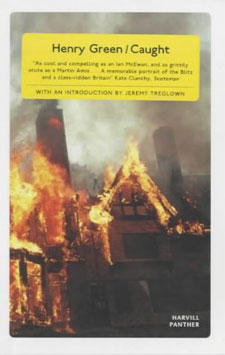
henry green, “caught”

Henry Green
Caught
(Harvill Press, 1943)


Caught seems to be the odd one out of Green’s books: it’s the only one that’s out of print in the United States. Berkley Medallion published a paperback in 1960 available on Amazon for wildly inflated prices; since then, as far as I can tell, potential readers have had to have recourse to the British edition. It’s also, and perhaps relatedly, the only book of Green’s that John Updike didn’t like, as he admits in his introduction to Loving/Living/Party Going. But the strangeness of the book really starts with the title: Caught is a verb, like most of Green’s other titles, but it’s in the past tense, not a gerund. Green’s other books describe how things are; this one describes how things were. Caught depicts a specific point in time – the Blitz in London – and was published soon afterwards (1943). There’s a documentary character to this book that isn’t in Green’s other novels; it feels much more like Pack My Bag, Green’s memoir of his youth than Loving, which followed two years later (and which is also set during World War II). Most of all, it’s not comic: there are comic elements, of course, but this is a much more serious book.

Caught describes the lives of firefighters in London at the start of World War II as they wait for the bombing of London to begin. It’s an exceptional state: no one behaves as they normally would, and no one is quite sure what the new rules are or how long this will last. The characters hang suspended: they are doing what they know is dangerous work; indeed, at the end of the book, a number of them are dead. The lives that they are living are unsustainable; the book ends with a coda where we learn that the central character, Richard Roe, has been sent home:

Some months later, after nine months of air raids on London, Roe was unlucky one morning. A bomb came too close. It knocked him out. He was sent home, superficially uninjured. They called it nervous debility. (p. 173)

The nine months of air raids on London fall into the eight blank lines above the beginning this section: they’re not described directly, though Roe haltingly attempts to describe them to his sister-in-law. But the disaster is not written about directly: preparations for it fill most of the book, and its repercussions finish the book. What happened can’t be described directly; maybe it’s something that can’t be explained. Green, it should be said, was a firefighter in London during the war; like Roe, he would have been upper class and somewhat out of place, but how closely Roe’s life corresponds to his, I don’t know. This is a book written in the middle of WWII; the grand narrative that came out of that war (of good defeating evil) had not yet been constructed, and whether the actions of the firemen in London were brave or delusional hadn’t yet entirely been defined. Roe attempts to explain what happens to his sister-in-law:

“The first night,” he said, “we were ordered to the docks. As we came over Westminster Bridge it was fantastic, the whole of the left side of London seemed to be alight.”
(It had not been like that at all. As they went, not hurrying, but steadily towards the river, the sky in that quarter, which happened to be the east, beginning at the bottom of streets until it spread over the nearest houses, was flooded in a second sunset, orange and rose, turning the pavements pink. Civilians hastened by twos or threes, hushed below the stupendous pall of defeat until, in the business quarter, the streets were deserted.) (p. 177)

Two more paragraphs encircled in parentheses follow, describing what happened from an omniscient point of view. Roe at this point has not entirely regained his language: he struggles to explain something that made an immense impression on him, but largely fails, and his sister-in-law remains uncomprehending. But the omniscient narrator’s point of view is curious and worth scrutinizing. Roe describes what he saw from his perspective (“the left side of London”); the narrator’s description is not so much more objective but more artful. Detachment seems to be necessary to attain this artfulness; a beautiful description, coming from Roe, would seem callow, as he’s describing a situation in which his fellow firefighters – “friends” doesn’t really work, as Green’s books are always attuned to class distinctions – are going to be killed.

These parentheses have appeared before in the book, more mystifyingly, at the beginning. Roe is second-in-command to Pye, an older trade-unionist; Pye lives with his elderly sister, who is not quite right in the head. Pye’s sister, wanting a child, kidnaps Roe’s son Christopher; the situation is soon sorted out, but it necessarily complicates the already fraught relationship between Pye and Roe; Pye’s sister is sent to an asylum, and Christopher is sent to the country. Roe attempts to reconstruct what must have happened, but fails; the two primary participants, a child and an insane woman, can’t explain what happened. Parenthetical paragraphs serve to do this; we are dragged outside of the character’s point of view so that we can understand what happened.

Christopher figures only in the fringes of this book, but he’s especially well done as a character. He’s decidedly not romanticized:

Christopher was like any other child of his age, not very interested or interesting, strident with health. He enjoyed teasing and was careful no one should know what he felt. (1)

This is perfect: when such a description appears on the first page of the book, you know it’s worth reading. It’s not altogether unexpected – but still shocking – when we near the end of the book Christopher has this interaction with his father in the country:

“Look,” his father interrupted, “haven’t you knocked those branches about enough? There’s hardly a bird left in the garden since you’ve been out. You’d do better to put food for them. They starve in this weather you know.”
“They’re Polish people,” Christopher said, “and I’m a German policeman, rootling them about.”
“Well, if that’s so, hadn’t you better carry on the good work where it’s drier? Why not go back to the stables and see if you can’t kill some more mice with a spoon? You could think they were Czechs,” his father said.
“Oh thanks, I say. That’s a lovely idea,” and he ran off, stumbling in the snow, diminutive. (p. 190)

Children are more terrible than they know; but there’s a realism to this description.

This is necessarily a solemn book; and the effect from reading it is different from any of the other books by Green. It’s not my favorite of his work; I wonder if it would be anybody’s, just because his other novels are so powerful. But it’s not the worst of his books: Blindness is clearly juvenilia and suffers in comparison to the rest. 

king kong in literature

“The Auxiliary on guard with him had been in the Navy. Some time ago this man had seen ‘King Kong,’ the film of an outsize in apes that was twenty foot tall. Roe’s explanation was that the experience had had a lasting effect on his adjectives. One in particular, ‘conga,’ he used to cover almost everything.

‘A conga night,’ he said. He called each Rescue man ‘cock.’ He remarked that their whisky was dodgy. He went by the name of ‘Shiner,’ because his surname was Wright.”

(Henry Green, Caught (1943), p. 41.)

homer, “the odyssey” (redux)

Homer
The Odyssey
(trans. Samuel Butler)


While on a visit home, looking for something to read, I picked up the Great Books edition of Homer, volume IV in that series. This edition of the Great Books of the Western World, edited by Robert Maynard Hutchins and published by the Encyclopæedia Britannica in 1952, was my family’s one real pretension to intellectualism. I am not entirely sure how it got into the house; it was never really read, as, my mother explained, the type was too small to read. It was also vexingly incomplete, as some religion-crazed relative had made off with Volume II of Thomas Aquinas; this bothered me as a youth. I don’t think anyone actually read any of these; I’d periodically pick up one volume or another (“Darwin” or “Swift/Sterne”) with intent, but I don’t remember how far I would get. Looking at the list of authors now, it seems decidedly weird: Plotinus gets a whole volume? Is it really worth reading Lavoisier or Fourier or Faraday now? The English-language novelists are the aforementioned Swift & Sterne, followed by Fielding, then a big jump to land on Melville. The ending sequence, volumes 49 through 54, seems particularly ominous: Darwin, Marx & Engels, Tolstoy, Dostoevsky, William James, Freud. Presumably there’s a good history of the Great Books project, though I haven’t seen anything other than Wikipedia’s entry, which points out that ours was the first edition of the em>Great Books of the Western World, and that Sterne and Fielding were dropped in the second.

But picking up Homer, it turned out that the translations are by Samuel Butler, which translation I am interested in because it’s the one Joyce used. It’s a decidedly idiosyncratic translation: most prominently, names are given their Roman rather than Greek version, so Odysseus is Ulysses. It’s also prose. It’s an odd choice for a version to include as one of the Great Books: while it’s eminently readable, Butler’s ideas about Homer and how he should be translated were very much his own, and his introduction and footnotes explain his view that the Odyssey was written by a woman (probably Nausicaa) and point out details in the text that support this view; Butler had first advanced this view in The Authoress of the Odyssey (1897), and came at his translation with an argument, albeit one argued in a way that leaves much to be desired. (This note on III.266 might be taken as typical: “The writer – ever jealous for the honour of women – extenuates Clytemnestra’s guilt as far as possible, and explains it as due to her having been left unprotected, and fallen into the hands of a wicked man.” What’s weirdly interesting about the Great Books edition, however, is that the editors have swept away Butler’s introduction and notes. (An online edition of his translation of the Odyssey is available at the Internet Archive; that edition is undated, but includes the original illustrations.) Not, however, particularly well: consider the start of Book IV, which starts, in Butler’s original, in mid-sentence, the sentence having been started at the end of Book III. While the Great Books Book III ends in a comma (“Now when the sun had set and darkness was over the land,”), Book IV starts, in house style, with a drop-cap, capitalized, of course: “They reached the low lying city of Lacedæmon, where they drove straight to the abode of Menelaus”. The next phrase starts with a bracket: “[and found him in his own house, feasting with his many clansmen”; at the end of the next paragraph, we find the end bracket. No explanation, in the Great Books edition, is given for these brackets; however, turning to the scan in the Internet Archive, we find an interesting note:

The lines which I have enclosed in brackets are evidently an afterthought – added probably by the writer herself – for they evince the same instinctively greater interest in anything that may concern a woman, which is so noticeable throughout the poem. There is no further sign of any special festivities nor of any other guests than Telemachus and Pisistratus . . .

One wonders, really, how many people ever actually read Homer in the Great Books edition: did the editor? (This is also, for what it’s worth, a poorly designed book for reading: so that both the Iliad and the Odyssey can fit in 322 pages, they’re laid out in two columns, and the type is rather small.) Butler’s ghost brackets, for what it’s worth, don’t end in 1952; the online edition at MIT’s Internet Classics Archives also has them and no notes; the Project Gutenberg edition, from 1999, includes Butler’s notes, but in unwieldy fashion (they are numbered, at the end), and, inevitably, a huge number of people have issued cheap print-on-demand & Kindle versions of Butler’s Odyssey; looking inside one revealed it to be lacking notes though it did have brackets, and one assumes that the rest are similar. (My favorite of Amazon’s lot is the nicely titled The Odyssey B utler – one hopes the extra space is significant – a new work by Samuel Butler, unknown, presumably, to him.) One knows, of course, that the people creating these POD and Kindle editions are hacks, if they’re even people at all and not a batch script running on the Gutenberg library; but it’s odd to realize that the editors of the Great Books seem to have also had their hackish tendencies. The reason for the choice of the Butler translation for inclusion is almost certainly not because they thought Butler’s was the best (or because they realized the importance of this translation to Ulysses); rather, Butler’s was probably the most recent translation out of copyright in 1952. I wonder again about the ending sequence of the Great Books: did the Great Books series come to that conclusion because copyright gets in the way? In this edition, Freud is presumably the only author that they would have had to pay for.

What I like about the Butler translation is precisely how idiosyncratic it is: his Nabokovian concern for how Ulysses’ house was laid out led him to include his photographs of houses in Sicily which, he supposed, might be similar to the Greeks’; in his introduction, he apologizes that a man and a dog appear in one of the pictures; this, he says, was “accidental, and was not observed by me till I developed the negative”. Looking at the illustration in question, one notes that there’s also a person in the lower illustration; this person is not apologized for, and one wonders who he might be. But the reader is reassured that they are safely in the hands of a man at least slightly crazy; academic rigor is clearly not what Butler was interested in, which is what makes it more interesting that his would be the translation selected to go into the Great Books. Maybe that’s why Joyce liked him; presumably Butler’s notes had not yet been swept away by the time Joyce read him.

And there is something to be said for Butler’s phrasing, which, while it may not be exact (and may well be distorted) is euphonious, and bits feel familiar to those who know Ulysses. Here, Telemachus explains things to Minerva in Book I:

“My mother,” answered Telemachus, “tells me I am son to Ulysses, but it is a wise child that knows his own father. Would that I were son to one who had grown old upon his own estates, for, since you ask me, there is no more ill-starred man under heaven than he who they tell me is my father.”

No one speaks this way, of course; but it feels right and properly fictional: in Butler’s Odyssey, everyone talks this way. It’s a pre-Raphaelite Homer.

butler’s odyssey

“Then Minerva said, ‘Father, son of Saturn, King of kinds, it served Ægisthus right, and so it would any one else who does as he did; but Ægisthus is neither here nor there; it is for Ulysses that my heart bleeds, when I think of his sufferings in that lonely sea-girt island, far away, poor man, from all his friends. It is an island covered with forest, in the very middle of the sea, and a goddess lives there, daughter of the magician Atlas, who looks after the bottom of the ocean, and carries the great columns that keep heaven and earth asunder. This daughter of Atlas had got hold of poor unhappy Ulysses, and keeps trying by every kind of blandishment to make him forget his home, so that he is tired of life, and thinks of nothing but how he may once more see the smoke of his own chimneys.’ ”

(Homer, The Odyssey, trans. Samuel Butler, book I, lines 44–60.)

people cringe

“For many years I have worked in film production and seen more than once how the directors, during the screenings before public release, said that these were just sketches, something that would have to be reworked in the future.

People cringe when showing something that’s most precious to them.”

(Viktor Shklovsky, Energy of Delusion: A Book on Plot, trans. Shushan Avagyan, p. 7.)

render what is supposed to be a revelation a transaction

“Even the snottiest young artiste, of course, probably isn’t going to beat personal ill will toward writers of trash; just as, while everybody agrees that prostitution is a bad thing for everyone involved, few are apt to blame prostitutes themselves, or wish them harm. If this seems like a non sequitur, I’m going to claim the analogy is all too apt. A prostitute is someone who, in exchange for money, affords someone else the form and sensation of sexual intimacy without any of the complex emotions or responsibilities that make intimacy between two people a valuable or meaningful human enterprise. The prostitute ‘gives,’ but – demanding nothing of comparable value in return – perverts the giving, helps render what is supposed to be a revelation a transaction. The writer of trash fiction, often with admirable craft, affords his customer a narrative structure and movement that engages the reader – titillates, repulses, excites, transports him – without demanding of him any of the intellectual or spiritual or artistic responses that render verbal intercourse between writer and reader an important or even real activity.”

(David Foster Wallace, “Fictional Futures and the Conspicuously Young,” The Review of Contemporary Fiction Fall 1988: Novelist as Critic, p. 45)

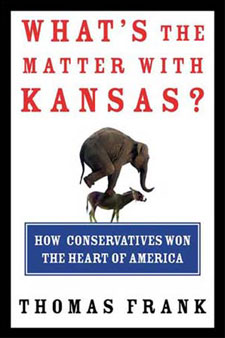
thomas frank, “what’s the matter with kansas?”

Thomas Frank
What’s the Matter with Kansas? How Conservatives Won the Heart of America
(Metropolitan Books, 2004)


Our building has bookshelves down in the laundry room in the basement, and among the books was this one, which I didn’t read when it came out, in no small part because I was deeply depressed by where the country was going – 2004, it doesn’t need to be said, was a bad year – & I was afraid of sinking deeper into that. I was familiar with Frank’s argument, of course, from his writing in The Baffler; he was right, I thought, but to me he’d be preaching to the choir. So I put off reading the book, assuming that a copy would show up sooner or later: now one has. (Similarly, I have assumed for most of the past decade that sooner or later I will wind up staying the weekend in a house with a copy of Jeffrey Eugenides’s Middlesex, upon which point I will read that book; that has not happened yet.)

I am in Champaign-Urbana for work, a place that I have not been, as far as I remember, for fifteen years. One finds, browsing the local paper, that the mayor of Champaign just announced at a Tea Party rally that he doesn’t believe the President was born in this country; local residents write letters for and against. It’s not entirely surprising, as Champaign was never the Madison of Illinois, but it’s still a touch disappointing. Champaign was mildly exciting in my youth; now it seems like a college town, with the same shops and chain-story eateries as any other college town, plus a couple of sad and decrepit non-chains. It’s hard to know if the town’s changed or if I’ve changed: probably both, but I don’t remember things feeling quite so generic the last time I was here. Would I have been excited by a Panera Bread in high school? Caribou Coffees? Probably not, though it’s hard to know. 

This is by way of saying that I do have something of a personal stake in Frank’s book, being very much someone shaped by the middle of the country, anguished and distanced as that relationship might be. The landscape where I grew up in looked almost identical to where I am now (though of course it didn’t have the benefit of a major state university). And there’s a similarity to the Kansas that Frank describes in this book: it’s the same sort of country with the same sort of people, mutatis mutandis.

There are sober, sociological explanations for Kansas’s penchant for martyrdom . . . . I personally prefer the more romantic notion that the extremity of the land itself accounts for the bumper crops of martyrdom-minded folks that Kansas so reliably produces. Most of the state is an empty place, a featureless landscape capable of quickly convincing anyone of their own cosmic insignificance. For this reason it has often been compared to the Holy Land, where a similarly blank vista generated an endless stream of prophets who descended on the cities to preach “world-worthlessness,” as T. E. Lawrence once summarized the creed of the desert: “bareness, renunciation, poverty.” (p. 215)

There’s an odd, if not necessarily surprising, similarity between this book and Harold Bloom’s The American Religion, the book in which Bloom inspects the history of American Christianity – particularly the evangelical movements and Mormonism – and comes to the conclusion that American Christianity is fundamentally gnostic in character, in the sense that it’s fixated on declaring the real world as an error which must be destroyed to achieve the kingdom of God. Gnostics, for Bloom, are revolutionary; he seems chagrined in that he’d like to see himself as likewise being a Gnostic but doesn’t like his bedfellows. This is also the book, written in the early nineties, where Bloom despairs of ever seeing a Democratic president again in his lifetime; reading it in the late nineties, it was easy to sneer at that, but now I wonder if he wasn’t right. 

Frank’s thesis is familiar right now, and it still seems operational. The players have changed slightly in the six years since this book, of course: Ann Coulter’s inanities have been replaced by those of Glenn Beck; George Tiller was murdered, as everyone must have known would happen. Sam Brownback is leaving Washington for Kansas to run for governor. David Brooks is still an idiot. Frank divides Kansan Republicans into “Mods” (the traditional upper class Republicans, now presumably being damned as RINOS à la Charlie Crist) and “Cons” (the conservative rabble-rousers): it’s easy to forget when surveying the doings of the Cons that what the Mods were up to wasn’t, in the end, that much better; with the Democrats moving further and further to the right, we see this playing out on a national scale.

What’s most valuable about Frank’s work, I think, is how he points out that economic arguments have largely been driven out of American political life: we argue endlessly (ceremonially, almost) about taxes, but nobody says anything about class. This is a problem, of course, because class exists whether or not we acknowledge it. At the heart of Frank’s book is a core of autobiography: growing up as a Young Republican in the affluent Kansas City suburbs, he’s generally unaware of class until he arrives at university and is confronted with those much wealthier. It’s a familiar enough story, though not one that’s usually talked about: Frank moved to the left when confronted with the upper class (as did I), though that’s not the usual response. Frank, to his credit, stayed engaged, despite moving to Chicago and then D.C.; I left. Real life happens elsewhere; there’s not a lot of future to be found in the rural Midwest. But Frank can still talk to Kansans, and there’s value in that: he can make sense of those who might be written off as lunatics. But as much of the problem that he’s pointing out is one of discourse: what we talk about and what we don’t talk about.