poetry is [vol. I] from George Quasha on Vimeo.
music is [Vol. I] from George Quasha on Vimeo.
art is [Vol. I] from George Quasha on Vimeo.
art is [Vol. II] from George Quasha on Vimeo.
(via Ron Silliman.)
poetry is [vol. I] from George Quasha on Vimeo.
music is [Vol. I] from George Quasha on Vimeo.
art is [Vol. I] from George Quasha on Vimeo.
art is [Vol. II] from George Quasha on Vimeo.
(via Ron Silliman.)
“INTERVIEWER [Terry Southern]: And yet, as I understand this theory, its success does not depend upon any actual sensory differences between people talking, but rather upon psychological or emotional differences between them as readers, isn’t that so? I’m referring to the serious use of this theory in communicative writing.
GREEN: People strike sparks off each other; that is what I try to note down. But mark well, they only do this when they are talking together. After all, we don’t write letters now, we telephone. And one of these days we are going to have TV sets which lonely people can talk to and get answers back. Then no one will read anymore.”
(Henry Green’s Paris Review interview, from summer 1958.)
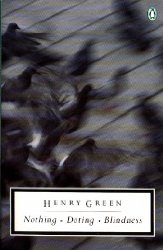 Henry Green
Nothing
(Penguin, 1950)
I went to a reading the other night; the opening readers (and performers, it was that sort of event) were terrible, so I left at an intermission to have dinner with the people I’d come to the reading to see. After dinner, I got on the uptown train to go home; I was reading this book, an omnibus edition of Nothing, Doting, and Blindness. The woman across from me was looking at me strangely, and I may have been looking at her strangely because she looked like one of the people who had been reading that I’d been introduced to in passing; she reached in her bag and pulled out the Dalkey Archive edition of Nothing, and we had a conversation about how fantastic Henry Green is and what a shame it is that nobody seems to read him. She got off at the next stop after we re-introduced ourselves; this saved me the embarrassment of having to explain that I hadn’t actually seen her read, though she was the only one in the line-up that I’d been half interested in hearing. I have been reading books in the trains of New York for a long time, but this is the first time this sort of thing has happened to me, as far as I can remember. Maybe I’m reading the wrong books.
Henry Green is fantastic, of course, even if one isn’t making conversation on trains. I tore through Living, Loving, and Party Going last November while in Mexico, read Blindness, in this volume, on the flight home from Christmas, and Pack My Bag somewhere in between; all the rest save Caught, which is out of print and expensive, are on the shelves waiting to be read. Nothing has taken a little while to get back to: I was reading too fast, I thought, and I needed to slow down. Henry Green seems a bit imposing, I think: like Ronald Firbank, this novel is almost entirely dialogue, and if you’re not reading carefully, a great deal can get lost. Once you’re in, though, it’s hard not to be swept along.
The title is from Shakespeare, of course; Much Ado about Nothing with its pairs of starcrossed lovers is an obvious model for the book. Philip and Mary want to get married; their widowed parents, Jane and John, respectively, were once lovers and are still friends. Dick and Liz are Jane and John’s current lovers, though they’re of little consequence, as are, for what that’s worth Philip and Mary. When it’s followed in this volume by Doting, the title suggests the word’s Elizabethan pronunciation, “noting”; as in the play, there’s a great deal of crossed communication. Here Philip discusses wanting to call off his marriage with his mother:
‘All right my dear,’ she said, ‘But you seem very touchy about this. She’s a nice girl I agree yet I also know she’s not nearly good enough for you. What are we to do about it, that is the question?’
‘To be or not to be Mamma.’
‘Philip don’t dramatize yourself for heaven’s sake. This is no time for Richard II. You just can’t go into marriage in such a frame of mind. Let me simply think!’
(p. 108.) Philip’s response, though he probably doesn’t realize it, is loaded; though the question isn’t “to be or not to be Mamma” but whether his actual father isn’t John, the father of his fiancée, as has been hinted by others. The threat of incest hovers over the book: two-thirds of the way through the book Mary asks her father point-blank if Philip and she are really half-brother and sister, which he strenuously denies. The perceptive reader, however, will have noted that if John is Philip’s father, it’s still entirely possible that John might not be the half-sister of Mary if she is as illegitimate as he is.
As in Much Ado about Nothing, this is a comedy, though there’s a darkness behind it. The subject matter is nothing if not slight; the joy of the book is how perfectly it’s accomplished. The book is almost entirely structured in scenes of dialogue between two characters: they are substituted in and out. The primary exception is the novel’s central scene, a party that Jane has thrown ostensibly for Philip’s twenty-first birthday but actually for herself. Philip and Mary attempt to upstage the action by declaring their engagement, but are deeply disappointed when nobody seems to care as much as they had hoped. This interchange between the two of them is at the center of the novel:
‘I say,’ he said, ‘you do feel better now, you must?’
‘I think so, yes,’
‘Can’t find out yes or no.’
‘But no one can. First something inside says everything is fine,’ she wailed, ‘and the next moment it tells you that something which overshadows everything else is very bad just like an avalanche!’
‘I’m so sorry,’ he said. ‘I truly am.’
They danced again and again until, as the long night went on they had got into a state of unthinking happiness perhaps.
(p. 88.) The way the punctuation is deployed for emotional balance here bears note: in particular, that dangling “perhaps” which doesn’t get a comma and pulls down everything that’s come before it. Mary and Philip aren’t the center of the novel, of course; this is a book about their parents, and Philip comes off as a mooncalf. This is a book about middle age: Mary and Philip are too young to realize what’s going on around them. The reader’s affections lie with John and Jane. In the end, the adults have re-paired, but it’s unclear what will happen to Mary and Philip; they’ll be fine, one suspects.
Edmund White says in his recent memoir that Nothing is the book he’s read the most times. It’s a book that would lend itself to re-reading; the cyclical motion of characters from one scene to the next suggests it. And one wants to inhabit the world of the book, even though if you don’t particularly care about the social manners of the upper class in post-WWII Britain; it’s like Proust, in that regard. But this is also a book that’s tremendously funny: for me it trumps Waugh.
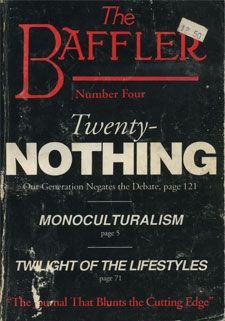 The Baffler #4: Your Lifestyle Sucks!
ed. Thomas Frank
Another Baffler: this one the oldest I’ve ever seen, from 1992. It’s a very young piece of work, self-consciously so: the contributor’s notes at the beginning identifies the ages of everyone involved. (“David Berman (26) and company have a 7” record out on Drag City. Band: Silver Jews. Sound: difficult but rewarding.”) After the contributor’s notes, there’s a piece that “was read at a real-life provocation staged by The Baffer on October 21, 1992 at the Hot House, a Chicago “performance space” and favorite art-lifestyle hangout”. That’s followed by the lead editorial, Tom Frank’s “Art As Lifestyle,” set in bold Helvetica for blunter impact, one supposes. Then there’s “Bafflers Behind Bars” which narrates how the editors where mistakenly arrested for provocation and spent “12 to 18 hours” in jail: at this distance, it’s hard to know if this is a joke or if the editors are legitimately proud of the credibility that comes from going to jail for one’s art. Scattered between these are a couple of poems, a full-page photograph of a sheep, and an “ask a post-structuralist” advice column that isn’t very funny. This issue, then, is something of a mess, though it’s enjoyable. Potshots at postmodernism hearken to a time when critical theory was something that people could be afraid of (and a time when ads from Critical Inquiry could subsidize your publication). One notes obsessions with Thierry Muggler and Prague (both seemingly from afar). Lexicographers should take note of a memo from Quaker Oats, in which they propose using the term “granola” to mean the sandal-wearing set. There’s the pre-mature appearance of the “New Urban Hipster” in a fictional piece by Keith White, also set in Prague.
There’s a lot of fiction in here; there’s also a lot of poetry, and a smattering of art. It might be worth tracking down what happened to most of these writers, as most of them are utterly unknown to me: presumably they were people floating around U. Chicago in the early 90s. But there’s a predominance of non-fiction here: it seems by design, a project to present an alternative to the mainstream. Mat Lebowitz’s “Uncoupling” is a chronicle of yuppy New York of the time in the style of Brett Easton Ellis: perhaps this is what Walter Benn Michaels was calling for in his demand for capitalist realism in the style of The Wire, though I can’t help but find an echo of the criss-crossed generations of Henry Green’s Nothing in it. It is worth looking at how the creative work functions here: a good deal of it (though not all) is pointedly socially engaged, to the general detriment of the poetry. The end of D. M. Mulcahy’s “Libidinal Tourist,” looking at how Prague was being marketed as a bohemian paradise, turns into a manifesto:
There are two worlds, that of those who live life and that of those who purchase lifestyle. Therefore we at The Baffler consider worthwhile only that art which understands these relations. To those artists we despise, we will not say, “Your painting is bad; your music is boring; your writing is trite.” We will say instead, “Your lifestyle sucks.”
The critical side of this is taken up by a pair of pieces about Donna Tartt’s The Secret History, a novel “eclipsed by the event of its publication”. (See, for example, a piece from the New York Times business section.) Maura Mahoney’s “The Packaging of a Literary Persona” is unabashedly snarky; but it’s hard to say that Tartt didn’t deserve it though, when Vanity Fair was evidently gushing about how she had T. S. Eliot reading “The Waste Land” on her answering machine. Mahoney does nail the appeal of the novel: “Young, professional, liberal-arts alumni, nostalgic for the life of the mind while experiencing the harsh truths of the life of the paycheck have been targeted to consume the Tarttian version of their most cherished myth – if it’s elitist, it must be art.” Mahoney’s piece is complemented by a shorter one by Richard F. Kolbusz, Jr., examining the novel’s dust jackets – by Chip Kidd, before he was a household name.
What I like most about this issue is how unabashedly amateur it is: from the typography, which systematically marches through all the native Mac fonts from 1992, to the fiction and poetry clearly written by their friends. (Particularly “Honey,” a soppy love poem written by “A.P.,” identified only by initials: maybe this is an inside joke?) The origin of the odd layout of later Bafflers, where shorter articles snaked down the margins of longer articles for spread after spread, can be seen here; here, though, the inside and outside articles tend to be on the same subject, revealing it to be typographic experimentation: somebody clearly had seen a copy of Derrida’s Glas. There’s a scan of a draft of “The Libidinal Tourist” signed by Mike Ditka; there’s a fashion shoot featuring the editors. The final section, “Twenty-Nothing” turns into a Gen-X manifesto, written at a moment when the mass media was busy codifying grunge. There’s an entertaining prediction of the future:
More disturbing is the thought of these products being sold in the form of nostalgia years from now. We can doubtless look forward to television shows like “Slammin’,” chronicling the adventures of a group of alienated Washington D.C. teenagers who use peculiar dance rituals to express their misunderstandings with the parents. “This Old Garage,” will peek in on the coming of age of a homosexual vegetarian brother and his feminist sister as they clash and come together on the fringes of the Seattle rock world. More important than the shows will be the products sold along with them. As teens today sport the tie-dyed shirts of the sixties and the bell-bottoms of the seventies, so will our children model Doc Martens, special hair-griming formulas, and knee-exposing jeans in the year 2005.
“Twenty-Nothing” is more impassioned than reasoned; it doesn’t stand up very well, like most manifestos, or, for that matter, most writing by the young and excited:
Our youthful vision of the world was influenced more by Minor Threat (‘who’s that?‘ you wonder) than by the Partridge Family.
In retrospect, one might say that two roads diverge here, like when hardcore punk spawned emo and straight-edge. The Gen X self-consciousness points the way to Dave Eggers’s Might, where politics was rejected in favor of cultural whimsy – The Real World even comes in for generational scrutiny here. (Shiny Adidas Tracksuits and the Death of Camp, read five years ago, didn’t hold up very well at all.) Deeper political engagement leads to the later Baffler, the one that’s remembered, as well as Thomas Frank’s career. There’s not as much recourse to arguments from American history here as there would be later: while the history of American populism is tentatively brought out towards the end, it’s not as fully deployed as it later would be, perhaps for fear of seeming overly academic.
“ ‘And then eloping’s out of date, it went out with horses.’
‘Oh dear now they’re all eaten poor things.’
‘Too many people on this island keep carnivorous pets Mary,’ he replied. ‘The waste is fearful.’ ”
(Henry Green, Nothing, p. 87.)
“Not that Mr Pomfret appeared to pay heed. A pale smile was stuck across his face while he looked about as though to receive tribute. But the attention of almost everyone in that room was still fixed on the awkward happy couple, and Elaine Winder smacked their backs and generally behaved as if she were in at a kill.”
(Henry Green, Nothing, p. 78.)
 The Baffler #8: The Cultural Miracle
ed. Thomas Frank
I don’t think that I ever actually had a copy of this issue of The Baffler, #8 from early 1996, though pieces are familiar from their appearance in Commodify Your Dissent (my copy of which is, as far as I know, still in a warehouse about a rug factory in north Somerville). The arrival of Baffler 18 seemed like a good excuse to pick up old issues that I was missing – most show up on Amazon used for not much – & this was the first to arrive in the mail. At sixteen years old, this is an old issue, almost a pre-Internet Baffler: there are a couple of web addresses in the ads for Sub Pop and Dusty Groove, but those are the only acknowledgments that the web existed. The (first) Internet Boom hadn’t happened; Monica Lewinsky hadn’t happened yet, and Newt Gingrich was ascendent. There’s an ad for The For Carnation on the inside back cover; most of the full-page ads seem to be connected to Sub Pop in some way or another. Both poems (“Cantos for James Michener”) and drawings by David Berman feature prominently. Okay Soda is mentioned not in nostalgia but as a present horror; the marketing of Red Dog beer, which I’d completely forgotten about, appears more than once.
That said: it’s strange how contemporary so much of this feels. Maybe that’s this moment speaking, when the Supreme Court has decided that as legal people, corporations deserve to have free speech, real health care reform has been taken off the table again, and when the Democrats can’t even hang on to Teddy Kennedy’s seat. I don’t think we’ve been in a holding pattern for the past fourteen years; but reading this, you get the sense that we might have arrived back in the same place. Frank’s opening piece, “Gold Diggers of 1996,” which posits that the present has returned to the turbulent 1930s, ready to explode, could be followed, in true Busby Berkeley style, by a “Gold Diggers of 2010”. Some pieces may have been ahead of their time: the Mike Neuwirth short story that closes the issue, about a bartender in East Hampton, seems vastly more appropriate to 2006 than 1996. A piece by Negativland explains how record companies exploited consumer ignorance to artificially raise the price of CDs after decades of attempts to sell different formats; it ends:
So what’s next? How can they get you to buy another copy of your favorite Pearl Jam release when you already have it on CD? Don’t worry, they’ll come up with an answer for you soon.
(p. 31.) That particular story has finished itself; but, as ever, nonconformity is still used to market conformity. Robert Schuller’s Orange County Crystal Cathedral, visited by Tom Vanderbilt, had been superseded by megachurches; Pat Robertson remains. Owen Hatteras’s “Pelf and Powder Blue,” about the public taste for blockbuster shows (Monet & Caillebotte at that time) and America’s lasting taste for the Impressionists feels like a prelude to the popular success of Thomas Kinkade, which A. S. Hamrah took apart in the most recent issue of the magazine. Robert Nedelkoff’s fictional interview with a campaign manager feeling out a Senate run for Steven Seagal is McSweeney’s before the letter.
What’s most striking about this issue – especially when compared to McSweeney’s and what’s followed – is how angry it is. Most of what they were angry about is still worth being angry about. Right-wing “populism” is still a threat to civil society. But I think it’s been hard to sustain outrage in the face of so much that’s happened since: witness, for example. the general indifference to Scott Horton’s report in Harper’s demonstrating that our government has been torturing and killing prisoners and disguising this as suicides; or the military’s seeming need to command & control Haiti before bothering to aid the people. There’s a sense of burn-out on the left presently: the thrill of the Obama win aside, it’s hard to imagine serious change actually happening, and at best the Democrats stand as a bulwark against further right-wing indignities. Here there’s the idea that maybe if people understood these things, they’d wake up. Now one worries that people understand but can’t care.
The indie aspect still looks weird: now the focus on post-punk seems more parochial than anything else, an attempt to graft a politics onto an aesthetic. But in this issue, at least, that mostly comes through the ads, which suggest a certain sort of readership, a readership who were primarily interested in books and Chicago-style post-rock. There’s a lot of Hunter Kennedy (of Drag City/The Minus Times, which seems to still be going) in here; in the TOC, it’s art. Zines will be zines; the roots show through on the ads and art, some of which appear to have been made with scissors, tape, and a photocopier. A Gary Groth piece castigates Quentin Tarantino, then culturally ubiquitous; it’s paired with a piece by Ray Carnie, slamming middlebrow taste in film (then being adopted by emergent media studies programs) in favor of John Cassavetes, at that time impossible to find on video; both of these would be argued differently today when media has become less of an either/or choice.
The most beguiling piece in the issue, for me, is Aaron Cohen’s reclamation of Artie Shaw for the left (online here), which follows an excerpt from Shaw’s Sideman, which was to be a “92-chapter autobiographical novel which, in Dostoevskian fashion, he intends to be the first part of a trilogy”. As far as I can tell, none of these ever appeared; nor did Good Enough Isn’t Good Enough, a multi-disc set of his own work that Shaw was compiling. But the voice of Shaw makes you wonder why you haven’t heard it before. The piece ends with this account of surviving McCarthyism:
I’m convinced that the thing that saved me, the one thing that kept me going, through it all, was sheer downright orneriness, the fact that I was just too damned mulish to lie down and oblige a pack of righteous idiots who believed they cornered the market on truth. Besides, I was curious to see what might happen next. Who knows? (I kept thinking) there may be a sudden outbreak of mass sanity. Hey, don’t laugh. It may happen yet. Listen, anything is possible.
Films
Exhibits
“It’s a curse of our culture, this addiction to smartness and knowingness. It’s not just Tarantino. Look at MTV. Look at Spy magazine. Look at the ads in The Sunday Times Magazine. What’s so great about being so knowing, so smug, so cocky? Why do we want to be cool and ironic? Why are we so afraid of emotions? It’s an American disease. Our emotions can help us out of traps. Emotions are the way of truth. We need works of art that defeat our intellectual and emotional habits, that force us to see and feel freshly. We need an education in emotion. That’s why we have artists. They can be our teacher, if we are willing to let them.”
(Ray Carney, “Pulp Affliction: The Sorry State of Contemporary Film,” p. 49 in The Baffler #8, 1996)