the baffler, vol. 2, no. 1: margin call

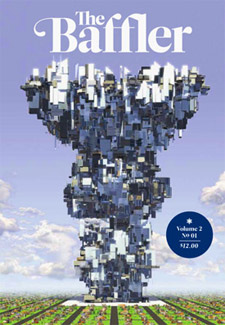
The Baffler Vol. 2, No. 1: Margin Call
ed. Thomas Frank


A new issue of The Baffler (number 18) arrived yesterday & I’ve already made my way through it. There aren’t a lot of magazines that I reliably read through on arrival any more: I’ve fallen down on Dot Dot Dot, which was carrying me for a while, though I do generally make it through new issues of Fantastic Man. Everything else piles up. The past decade has been bad for magazines: wandering the magazine stores, it’s hard to find anything that looks necessary. I still miss Nest. Did I miss the Baffler? It never really folded per se, though it did seem like it faded out across the 2000s: the major lights had gone on to better things, and though four issues were released after Bush came into power, offering intelligent critique seemed beside the point in a world so impervious to reason. One can only say “I told you so” for so long.

The media world changed too: though the Baffler had done a superb job of covering the idiocies of the first Internet boom (Tom Frank’s One Market Under God is probably worth re-reading), it seems like they were taken aback with how radically the media landscape had changed. This new issue finds them taking stock: a quick piece by the editors leads off the issue by surveying the unexpected death of established media and the all-too-expected life of Wall Street. Chris Anderson & Wired come in for some old-time bashing. Focus stays on the Internet & the changing media world in the essay section, starting with Christine Smallwood (the problems of thinking about the Internet) and documentarian Astra Taylor (the problem of the artist in a world where everything can be pirated). Naomi Klein looks back at No Logo, examining the assumptions of 1999 (the same piece just appeared in The Guardian: presumably it’s an introduction to a tenth anniversary edition). Michael Lind finds oligarchs in America: at about this point it becomes clear we’re safely back in Baffler territory.

A. S. Hamrah’s piece on Thomas Kinkade and flipping houses is vintage Baffler: maybe my favorite piece in the issue. Yves Smith takes on the excesses of the finance industry. Walter Benn Michaels reprises a piece from Bookforum where he accuses the recent American novel of a lack of engagement with class issues; the piece has been reworked since its last appearance and is stronger for it, though I’m still not sure that championing American Psycho is the right way to do this. Moe Tkacik’s piece on the business writing of the recent bubble is good, though it pales against the memory of Tom Frank’s obvious love for the language of American business. Will Boisvert looks at Detroit; Ryan Ruby surveys the cultural devastation levied on New York by Mike Bloomberg; Jim McNeil looks at housing in DC. Will Schmenner’s piece on movies using the compilation soundtrack as a shortcut to emotion isn’t bad, but it could appear in any number of places; and the essay section is rounded out with the resurrection of an old conservative (Henry Fairlie) to serve as a voice for the progressive.

The magazine looks nicer than it did – though the “fi” ligature in the font they’re using draws an unseemly amount of attention to itself, as does the way they smallcap all abbreviations. There’s a blue bookmark, and the binding is good. The photos, in full color, are beautiful; a graphic section by Angie Walker isn’t particularly strong and feels like it belongs in Harper’s. The back of the book is lighter: a Dan Kelly piece starts with a list of authors drawn from a Facebook meme and explains how they’d do in a fight. Chris Lehmann takes apart revisionist histories of the New Deal; Mike Newirth reconsiders Nelson Algren; Matt Taibbi enjoys Rod Blagojevich’s book as much as anyone can, almost a return to his writing at the eXile. Two fiction pieces, by Paul Maliszewski and Lydia Millet provide a soft ending. There’s no Robert Nedelkoff, which is too bad, but he’ll turn up, I’m sure. It’s a solid issue: it feels revitalized after a long absence: maybe a good place to start volume 2.

*     *     *     *     *

In a way, it’s as hard for me to think critically about The Baffler as it is for many to think about Salinger, as it’s one of those things that I found at exactly the right time: the late 90s, the height of the first dot-com boom, at a college that was a charm school for the upper class, where day-trading was taking place over breakfast in the dining halls, everyone had a start-up based on some ridiculous idea which were, astonishingly, getting funded. The Baffler, then, was a necessary corrective: proof that somebody, somewhere was thinking sensibly, and that meant a lot. Coming across old issues on the shelves of used bookstores since then still provides a shock of recognition: it’s tied up with how I constructed myself at a certain point in time.

The magazine seemed to lose its footing after the Bush inauguration: in an era where blatant disregard of facts was the official order of the day, informed criticism felt besides the point. And of course, attention was elsewhere: Thomas Frank’s been doing solid work since then – in-house leftist on the Wall Street Journal‘s opinion page seems a good fit – as have most of the other people involved: Paul Maliszewski’s book on fakery last year, for example, deserved much more press than it received. Maybe the problem is the place of the literary journal right now: a piece by Ted Genoways, editor of the VQR in Mother Jones, suggests that while everyone’s busy submitting to literary magazines, nobody’s actually reading them. (The MFA industry is as readymade a Baffler story as can be imagined.) Attention’s moved: I don’t know that it’s moved elsewhere so much as it’s lost duration. Nobody needs to hear this again. But it’s nice to see the Baffler back.

(Worth noting: a handful of old issues – 11, 16, and 17 – can be downloaded in PDF format by clicking on the individual issues. These seem to be scans of the images)

the popularity of bolaño

“Tom Disch, the late poet and novelist, once gave me a piece of advice: if I wanted to write a best-selling novel, I should write a novel about a poet. All literate Americans, he said, love poets, even though they don’t much care for modern poetry, or read a lot of it. I followed his advice, and though the resulting book fell well short of the best-seller list, I saw the fictional advantages of such a character. A poet in a novel is in touch with a realm of words more potent than the prose fiction in which he or she is embedded, and thus gains a numinous intensity of feeling from the start. It is not even necessary to supply your poet with great poems: he merely has to ponder the possibility of them.”

(John Crowley on Nicholson Baker in the Boston Review.)

stanley crawford, “mayordomo”

Stanley Crawford
Mayordomo: Chronicle of an Acequia in Northern New Mexico
(University of New Mexico Press, 1988)


I came to Stanley Crawford through his fiction – Log of the S. S. The Mrs. Unguentine got a reissue from Dalkey Archive a few years back with an afterward by Ben Marcus, and there was a bit of attention. It’s an easy book to read, though one that will require re-reading; from there, I quickly went through Some Instructions, Gascoyne, and Travel Notes; his most recent, Petroleum Man is on a stack of things to be read. Gascoyne and Travel Notes feel like juvenilia compared to his later books; stylistically, they feel like Pynchon and Robert Kelly’s Cities, a writer trying out forms. In Log and Some Instructions, the novelist has found his subject: the relations between people. Though formally very different, both are about marriage and the unknowability of others. Crawford doesn’t present this as an endpoint, but as a position from which to think about the ethics of our interactions with others.

From this, it’s a small jump to his non-fiction: A Garlic Testament is his account of growing garlic in New Mexico, which seems to be his primary occupation; it is about growing garlic, and can be judged as such, but it’s also about the problem of how we live our lives. There’s a similarity to the two books that Gianfranco Baruchello and Henry Martin put out (How to Imagine and Why Duchamp) about Baruchello’s attempts to use Duchamp’s thoughts to run a farm: like Crawford’s books, these are meditations on the place of work in our lives, a subject that’s more and more interesting to me. Mayordomo: Chronicle of an Acequia in Northern New Mexico precedes A Garlic Testament. It’s a book about his time as the mayordomo of an irrigation ditch used by himself and the neighboring farmers in New Mexico. The givens are simple: there’s a certain amount of water in the ditch, which everyone needs; water use must thus be rationed, especially during the dry season. The ditch is community property: it must be maintained, which may require a fair amount of labor, which must be apportioned. The mayordomo is paid to keep the ditch in order. Not knowing a great deal about water law, I’m not sure if ditch councils are still in existence: writing in 1988, Crawford speculates that water rights adjudication is likely to massively overhaul how water is administered in the area. Probably western droughts and the massive influx of population into the Southwest has also changed things. But the value in this book isn’t so much in its documentary quality (though I’m sure some readers might find it important for that) or how it functions as a memoir (though it does that). Rather, it’s a study of how people organize and relate to each other, their work, and the world they share. 

There’s a focus on the interactions of communities in this book: Crawford’s ditch shares water from a river with several other ditches, and in dry seasons negotiations with representatives of other ditches are necessary. These are associations of people rather than corporate bodies: those who share the water are small-time farmers, with a few acres of crops. It’s very much a version of the American dream, but one that’s not so blind to believe in self-sufficiency. The amount of water is limited; it needs to be shared. Ditch-sharing agreements, Crawford points out, extend well before New Mexico became a state; the acequia system of management came from Spain, a remnant of an earlier time:

There are few other civic institutions left in this country in which members have as much control over an important aspect of their lives; relatively autonomous, in theory democratic, the thousand acequias of New Mexico form a cultural web of almost microscopic strands and filaments that have held a culture and a landscape in place for hundreds of years.

(p. 176.) In its extended treatment of a subject that might not initially seem interesting, this is a book that forces the reader to slow down. Here, for example, Crawford talks about horses, which he’s just admitted that he doesn’t particularly care for:

There are a few old farmers still using horses up in the higher valleys where the internal combustion engine arrived a decade later than here. The horse has its advantages. Like you it tires with work, needs rest, food, water: your rhythms are similar. A tractor, a machine, invites you to work at a pace unnatural to the body, and while the machine does the work faster and better in some ways it is also designed with complex needs that seem like deep ulterior purposes to connect you to international fossil fuel and manufacturing conglomerates, banks, insurance companies; and its waste products, unlike a horse’s, are toxic and useless.

(p. 95.) When stated this way, Crawford’s point about rhythms of the horse and the machine seems obvious; and painfully applicable to our own lives. A rural Midwestern upbringing is more than enough to inoculate one against romanticizing agrarianism; but there’s something here that’s hard for me to ignore. Maybe it’s the cultural moment we’re in, where it’s hard to look forward to anything substantially improving; maybe it’s New York in a recessionary winter. Watching Paris Is Burning – filmed here while Crawford was minding his ditch in New Mexico – the other night suggested how much the city has changed in the past twenty years: there’s so much more wealth now, but people seem less alive, less attuned to each other. We spend more time in front of computers than we do in front of other people; I won’t argue that’s entirely bad, but one does wonder about how one ought to be living.

Technological mediation seems inescapable right now: correspondingly, maintaining a ditch seems much more interesting than it might have. Crawford, it should be pointed out, was not born to his ditch: born in California, he went to U. Chicago and the Sorbonne before spending time in Greece and moving to New Mexico; he’s acutely aware that he’s a latecomer to the land, but it’s his perspective as an outsider that finds the interest of the story. It’s strange, really, how little notice has been given to his work: no mention of him can be found in the Harper’s database, where one might think he’d fit. A longer piece by Verlyn Klinkenborg appeared in the New Yorker (21 September 1995, p. 125) on the occasion of the publication of A Garlic Testament. There have been a handful of appearances in the New York Times (most notably a generally disapproving review of Travel Notes by Stanley Elkin), but not since 1992. Maybe this lack of attention will change as the increasing importance of water as a social issue has been receiving a fair amount of careful attention recently: Joseph McElroy considers water and writing (his treatment of Crawford is probably the most thoughtful this book has received); and William Vollmann’s Imperial, a book that seems to have awakened reserves of resentment in the nation’s book reviewers, is deeply concerned with the ways in which water use affects communities, amidst the myriad other forces that shape the California-Mexico border. Both McElroy and Vollmann could be read profitably against Crawford.

mcelroy on crawford

“. . . . What little I know about acequias in that general area – including the Rocky Mountain high-altitude meadow system now threatened by climate change – I know from Stanley Crawford.

If it seems indelible and deep – active – what is it but a few visits over almost a generation? Governed as memory works by a continuity that may even give form to the little I know about the right livelihood he and his wife Rose Mary built for themselves over the past 30 years farming garlic in a small Hispanic valley south of Taos, New Mexico. For a year Stan, an Anglo many years a parciante, or member shareholder in the ditch, was the ditch manager, the Mayordomo. This is the title of one of his books, which covers roughly that year (March 1985 to March 1986) in the life of his acequia. This organization, this democracy, that “taught” them to feed themselves, connected them with 30 families, “prods us to remember . . . that if we use our own labor to do so and the labor of our friends and neighbors, we are far more efficient in energy terms than the largest agribusiness farms in the world.” 

Tangible work on the land and on the page. That difficult double career never seeming (at least to me) at Stan’s apparent pace egregiously difficult or impeded, so much as continuing and contained and unscreened by word or delusion. This “over-educated novel-writing truck farmer…caught between two eras like a [Turgenev] character” who has put into his non-fiction book the “veins and capillaries” of this land, the work of maintaining the ditch among other things in every inch of effort and knowledge shared with the fortunate reader, the sometimes bewildering interruptions of uncontrollable weather, the “human constrictions and diversions the mayordomo” must take charge of who is “the pump, the heart that moves the vital fluid down the artery to the little plots of land of each of the cells, the parciantes.” (In Outwater and elsewhere we hear the metaphor of blood circulating, which anciently is a correspondence not metaphorical at all. Crawford is somewhere in between, though not in the following remark.) “Water relationships would be simple and linear were they not complicated by all those other ways that human beings are connected with and divided from each other: blood, race, religion, education, politics, money.” Rights likely to be most nearly reliable locally as here, a precinct of water democracy I imagine.

Walking the ditch, Stan and I come upon a crossing where the beavers have messed things up, two chewed saplings are down across the steep-banks, maybe not even a dam-in-progress. The everyday passingness must be more than passing, though he might shrug off this thought (or that water “rights” [my “quaint,” he calls it, archaic contribution] have anything to do with where you live, considering major diversions of water just about everywhere in the world though the New Mexico basically usufruct – “ownership” custom is archaic. Maybe a luxury of my experience of his life and that I will come back (as he himself will go to market every week in season) and that I will reread him and believe that some metaphors are more than comparisons. Is Stan’s writing what will last?

Though a few years later he has a multi-year grant from the Ford Foundation to study farmers markets in New Mexico. His knowledge is priceless. It takes him away from full time farming. (He’s discovered that State Engineer records of well-drilling in his neighborhood are complete garbage; he and his neighbors rarely have anything to do with the overlapping jurisdictions, typical perhaps of water resources once thought so abundant that rights definitions seemed unnecessary.) His own farming? Perhaps the time itself is ripe, as for more attention to be given to his writing though truthfully he has managed to write fiction and non-fiction of quality during these many years growing garlic and commuting in season twice a week many miles to market in Santa Fe and Los Alamos. What is it to revisit a person? What happens to occur to me, or I happened to be reading something.”

In these remarks of mine, I come back to several figures.

Second thoughts? Odd, this revisiting. “Accretions” the title of Chapter 17 of A Garlic Testament and typical of Stan’s method: “what people do to make things grow . . . consists of . . . eliminating everything else that gets in the way.” My own writing is weeding since I’m always experimentally planting (maybe weeds like nutritious amaranth) just to see, and maybe this analogy stretches things. Revisiting is clearer, though: rereading a person, seeing what I didn’t see before. Facts, however: Stan doesn’t know how much longer the current generation of ditch commissioners and mayordomos can handle drought years, before saying the hell with it – like so many small farmers.

Yes, a walk in the woods or along the river; finishing a table top, making a floor; repairing a bark canoe with pitch or pine gum. Reading, though, as Experience: the book as distillation (I don’t mean, into desalinated water vapor): the book as . . . revision. What Homer even in translation means to a reader of twenty or twenty-one: “. . . a new planet swims into his ken.” Some of my experience, like Keats’, is through books. (Isn’t yours?) Some? Novelists more than they like to admit. A line, a sentence, a scene, an impression of a whole book continuing for years.”

(Joseph McElroy, “If It Could Be Wrapped”, an excerpt from Water Writing – an essay, as yet unpublished.)