Books
- Stephen Wright, M31: A Family Romance
- Stacy Szymaszek, Emptied of All Ships
- Joseph McElroy, Ancient History: A Paraphase
- Julio Cortázar, 62: A Model Kit (trans. Gregory Rabassa)
Films
- Standard Operating Procedure, directed by Errol Morris
Books
Films
Detected little things: a peach-pit
basket watch-chain charm, an ivory
cross wound with ivory ivy, a natural
cross. The Tatoosh Mountains, opaque
crater lakes, a knickerbockered boy
who, drowned, smiles for a seeming ever
on ice skates on ice-skate-scratched
ice, an enlarged scratched snapshot.
Taken, taken. Mad charges corrupt to
madness their sane nurses. Virginia
creeper, Loose Tooth tanned black snake-
skins, shot crows for crow wings for
a black servant’s hat, lapped hot milk,
flung mud in a Bible reader’s crotch:
“You shouldn’t read the Bible nekkid!”
Family opals, selfishness changes hands.
Tatoosh Mountains, opaque crater lakes,
find me the fish skeleton enclosed in
a fish skeleton (fish ate fish) he had.
Fellow compositors
and pressworkers!
I, Chief Printer
Frank Steinman,
having worked fifty-
seven years at my trade,
and served five years
as president
of the Holliston
Printer’s Council,
being of sound mind
though near death,
leave this testimonial
concerning the nature
of printers’ errors.
First: I hold that all books
and all printed
matter have
errors, obvious or no,
and that these are their
most significant moments,
not to be tampered with
by the vanity and folly
of ignorant, academic
textual editors.
Second: I hold that there are
three types of errors, in ascending
order of importance:
One: chance errors
of the printer’s trembling hand
not to be corrected incautiously
by foolish professors
and other such rabble
because trembling is part
of divine creation itself.
Two: silent, cool sabotage
by the printer,
the manual laborer
whose protests
have at times taken this
historical form,
covert interferences
not to be corrected
censoriously by the hand
of the second and far
more ignorant saboteur,
the textual editor.
Three: errors
from the touch of God,
divine and often
obscure corrections
of whole books by
nearly unnoticed changes
of single letters
sometimes meaningful but
about which the less said
by preemptive commentary
the better.
Third: I hold that all three
sorts of error,
errors by chance,
errors by workers’ protest,
and errors by
God’s touch,
are in practice the
same and indistinguishable.
Therefore I,
Frank Steinman,
typographer
for thirty-seven years,
and cooperative Master
of the Holliston Guild
eight years,
being of sound mind and body
though near death
urge the abolition
of all editorial work
whatsoever
and manumission
from all textual editing
to leave what was
as it was, and
as it became,
except insofar as editing
is itself an error, and
therefore also divine.
(Aaron Fogel. Via Tom Christensen’s rightreading.)
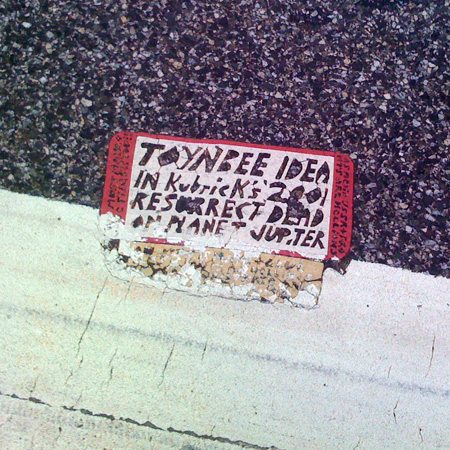
Books
Films
Exhibits
“An illustrious bell-caster, with a long beard and unconditionally an atheist, one day received a visit from two clients. They were dressed in black, and very serious, and showed a swelling on their shoulders, which made it cross the atheist’s mind that that was where their wings might be, as are said to be found on angels; but he paid this thought no attention, since it didn’t align with his convictions. The two gentlemen commissioned a bell of great dimensions – the master had never before made anything similar – and they wanted it cast in an alloy he had never before employed. They explained that the bell would emit a special sound, utterly different from the sound of any other bell. At the moment of departing, the two gentlemen explained, not without a trace of embarrassment, that the bell was to serve for Judgment Day, which by now was imminent. The master bell-maker laughed a friendly laugh, and said that there would never be a Judgment Day, but that all the same he would make the bell as indicated, and within the established time. The two gentlemen paid him a visit every two or three weeks to see how the work was proceeding. They were two gloomy gentlemen, and, despite their admiration for the master’s work, seemed secretly dissatisfied. Then, for a time, they didn’t return. Meanwhile, the master bell-caster had brought to completion the largest bell of his life, and recognized that he was proud of it; and in the secret place of his dreams he could see himself desire that so beautiful a bell, unique throughout the world, be used on the occasion of Judgment Day. When the bell had been finished, and mounted on a great wooden trestle, the two gentlemen reappeared; they looked upon the bell with admiration, and at the very same time with profound despondency. They sighed. Finally, the one who seemed more authoritative turned to the bell-caster and confessed in a low voice, ‘You were right, dear master; there will never be, neither now nor ever, any Judgment Day. There has been a terrible mistake.’ The master bell-maker regarded the two gentlemen, he too with a melancholy air, but his melancholy was happy and benevolent. ‘I’m afraid it’s too late, gentlemen,’ he said with a quiet, steady voice. He pulled the cord, and the great bell swung and sounded, loud and strong, and, as it had to be, the Heavens opened.”
(Giorgio Manganelli, from Centuria: 100 Ouroboric Novels, trans. Henry Martin, pp. 135–6.)
“210 West 14th Street, New York City 6 Feb. 1950
My dear Carrouges,
Long after your letter I received the text, which I’ve read over several times.
It is true I am indebted to Raymond Roussel for having enabled me, from 1912 on, to think of something else instead of retinal painting (André Breton will enlighten you as to this term, because we have discussed it together), but I must declare that I have not read In the Penal Colony, and only read the Metamorphosis a number of years ago.
Just to let you know the circumstantial events which led me to the Mariée.
So I was astonished at the parallelism which you have so clearly established.
The conclusions you have come to in the sphere of ‘inner significance’ interest me deeply even though I do not subscribe to them (except as far as the glass is concerned).
My intentions as a painter, which have nothing to do with the deep result, of which I cannot be conscious, were aimed at the problems of ‘aesthetic validity’ obtained principally through the abandonment of visual phenomena, both from the retinal and the anecdotal point of view.
As for the rest, I can tell you that the introduction of a ground theme explaining or provoking certain ‘acts’ of the Mariée and the bachelors, never came into my mind – but it is likely that my ancestors made me ‘speak’, like them, of what my grandchildren will also say.
Celibately yours, Marcel Duchamp”
(Quoted on p. 49 of Le macchine celibi/The Bachelor Machines, ed. Jean Clair & Harald Szeemann, following the contribution by Michel Carrouges. This letter appears to have been translated from French to Italian before being put into English.)
Books
Films
Exhibits
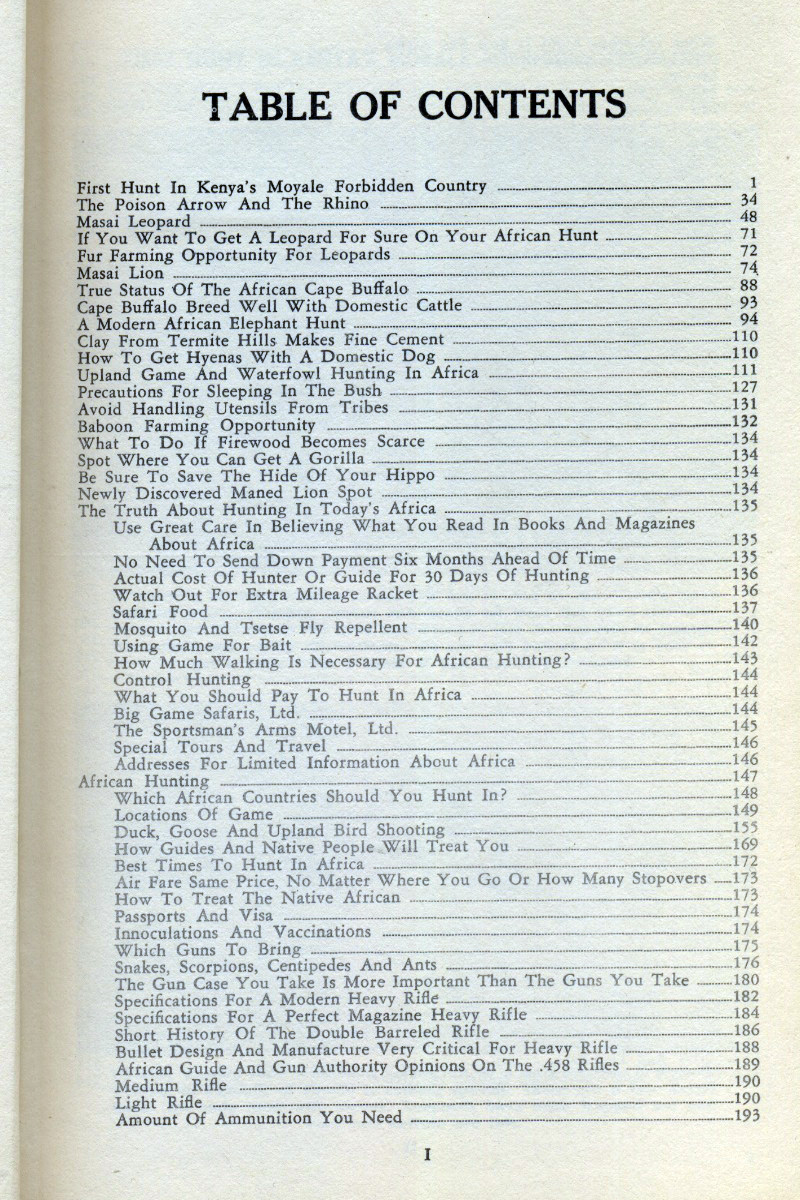
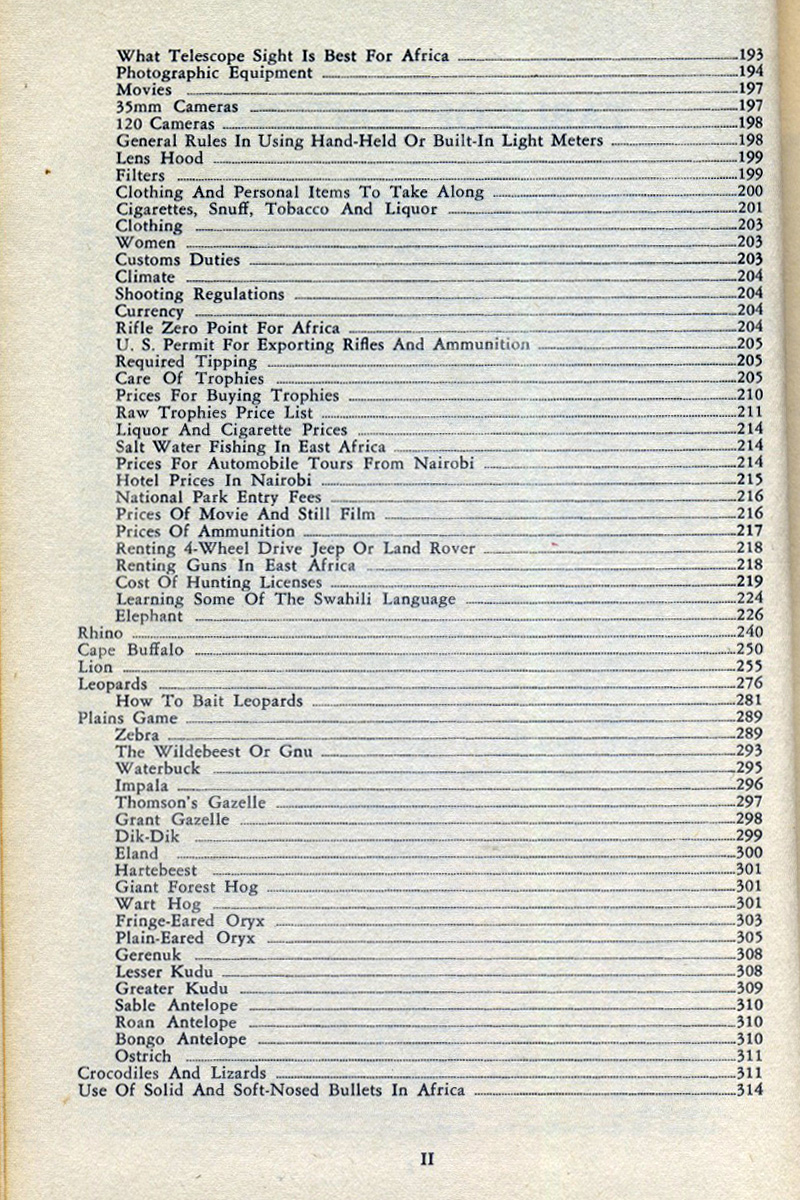
(from The Truth about Hunting in Today’s Africa and How to Go on Safari for $690.00 by George Leonard Herter and Jacques P. Herter, 1963.)