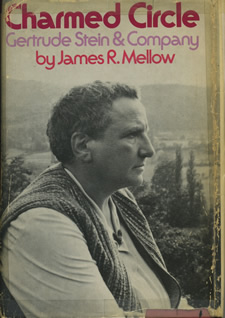
james r. mellow, “a charmed circle”

James R. Mellow
Charmed Circle: Gertrude Stein & Company
(Praeger, 1974)


I dug this book out of the basement of the Strand where the literary criticism now lives; I felt like maybe a proper bio of Gertrude Stein was in order, and everyone seemed to like this one. It’s a pleasant book: it’s hard for me not to like reading about Gertrude Stein & the old familiar story of how Modernism happened. Having just spent time with the later David Markson books, it’s entertaining to find a number of his anecdotes about Stein in very similar wording here: there’s always a frisson at the feeling of walking in another’s footsteps. Markson doesn’t seem to have liked Stein for whatever reason; I do, though I wonder how much her life gets in the way of her work. Going to the biography isn’t the best response to that, but maybe it’s a way in.

Mellow’s reading of her work is almost entirely biographical: figures and events in her life that can be mapped to her work are. Conversely, more abstract texts seem to largely not figure in Mellow’s reading; this book is first and foremost a biography, not an overview of her work. The Making of Americans, for example, gets short shrift, except in how it can be read as a Stein family history. Mellow can be most usefully read against her autobiographies: he finds and notes inconsistencies with the historical record. One starts to wonder then why Stein had her start as a fiction writer: was it simply that fiction was the easiest way into being “literary”? That poetry could be too easily ignored? Stein would seem to be read far more often as poetry than as fiction now; but here she is most often cast as a cryptic autobiographer. 

As familiar as her life is, there are still occasional surprises: her plan to co-author a biography of Ulysses S. Grant with Sherwood Anderson, for example. The Autobiography of Alice B. Toklas was evidently translated into Italian by Cesare Pavese, who also translated Moby-Dick: is it possible that Pavese was so little known in this country in 1977 that his name should be misspelled twice? (My copy is the original hard cover edition; presumably this was corrected in reprintings.) And it’s odd to think of Matisse visiting New York, though I must have known that he had been in this country to install his murals at the Barnes Foundation. Buckminster Fuller, it appears, showed up to the premiere of Four Saints in Three Acts in his Dymaxion car. Carl Van Vechten proposed a film version of the Autobiography.

But beyond trivia, Gertrude and Alice are, of course, fantastic characters; that accounts for a great deal of my interest in reading about them. This could almost be lifted straight from Two Serious Ladies if the names were changed:

Gertrude was to display certain peculiarities as a driver; she could go forward admirably, but she shunned reverse. This necessitated an uncompromising attitude in the matter of parking – which frequently meant directly in the path of other parked vehicles. It was on the question of parking and refusing to back up that Gertrude and Alice had their only violent arguments on the subject of driving. There were those, however, who maintained that even Gertrude’s forward driving could present certain hazards. She had the habit of conversation, and to her passengers it often seemed Gertrude did not pay sufficient attention to the road. This frequently made riding with her invigorating; her brisk turns could sometimes be hair-raising. She did not like to drive at night but often was obliged to because she did not always believe in road signs and thought road maps and predesigned routes hampering to her freedom of action. She preferred trust to instinct. (p. 228)

Most of the characters in this book are fairly familiar: first, from Stein’s accounts, which in style make the biographer’s task more difficult, but also from Malcolm Cowley in Exile’s Return, Robert McAlmon & Kay Boyle’s Being Geniuses Together, William Carlos William’s autobiography, Samuel Putnam’s Paris Was Our Mistress, Hemingway’s thing. I still haven’t gotten around to Matthew Josephson’s memoirs, though I probably should. There are more, of course. American ex-pats in Paris have been covered exhaustively. We know how Gertrude and Alice behaved. It’s the character of Leo Stein here who’s most weirdly intriguing; Leo Stein is so ignored that his poorly-edited Wikipedia entry makes it sound like he was living, and then had a “romance-induced conflict” with his cousin Fred. He’s also distinguished there from “Leo Stein (writer)“, which would smart were he still alive. Leo seems roughly analogous to the figure of Harry Crosby at the end of Exile’s Return, the figure with enormous potential who couldn’t settle on one thing long enough to make a mark, always thought of as smart but jealous of his little sister’s success. One doesn’t feel sorry for him particularly; but it’s a chastening narrative. After Gertrude makes it with her Autobiography, he becomes a heel: “Practically everything that she says of our activities before 1911 . . . is false in fact and implication, but one of her radical complexes, of which I believe you [Mabel Weeks] know something, made it necessary practically to eliminate me.” (p. 356) After that, no more is heard from until he dies. 

A puzzling question that isn’t directly addressed by this book is exactly what happened to Gertrude Stein later in life: how her taste seems to falter late in life. Her right-wing politics before World War II maybe aren’t that surprising : but it’s still astonishing to see the New York Times interview from May 6, 1934 where she explains that Hitler should have been awarded the Nobel Peace Prize. Her lasting friendship with Bernard Faÿ, who would become a collaborationist, also puzzles: what exactly was the appeal of the man? His introduction to the abridged Making of Americans sells her short; it’s odd that she kept him on, especially when she was breaking with so many other friends. Her later taste in artists confuses as well; some of this can be seen from reading Everybody’s Autobiography against Alice B. Toklas. Thornton Wilder isn’t quite Hemingway or Fitzgerald. She starts liking Francis Picabia precisely at the point where most people stop liking him; she takes up, and drops, Pavel Tchelitchev and the Neo-Romantics, who are probably in need of a critical reappraisal anyway. Why in the world did she like Francis Rose? Here he’s only introduced after the first Autobiography; evidently he wrote a memoir of his own, which might be worth looking into, but why Gertrude Stein, seemingly alone in the world, should like Francis Rose’s paintings is entirely unclear. Her later writing doesn’t drop off, at least to my mind; but there is something odd about this, perhaps the subject for another book; maybe Leo Stein comes into that book, though probably not.
now give me one on the jaw!

“Moreover, she seems to have had some worries about her health. After Leo’s departure, Gertrude moved to another house, on East Eager Street in Baltimore. Emma Lootz, a classmate at Johns Hopkins and a mutual friend of Mabel Weeks, had a room directly below Gertrude’s large living room. She recalled that Gertrude ‘got alarmed’ about the state of her own health, feeling that there was something wrong with her blood. Gertrude prescribed an unusual treatment for herself; she hired a welterweight to box with her. ‘The chandelier in my room used to swing,’ Emma Lootz remembered, ‘and the house echoed with shouts of ‘Now give me one on the jaw! Now give me one in the kidney!’ ”

(James R. Mellow, Charmed Circle: Gertrude Stein & Company, pp. 44–45.)

september 11–september 20

Films

  • Das Wachsfigurenkabinett (Waxworks), directed by Paul Leni
  • Rebus Film Nr. 1, dir. Paul Leni
  • Orlacs Hände (The Hands of Orlac), dir. Robert Wiene
  • Speak Easily, dir. Edward Sedgwick
  • The Lead Shoes, dir. Sidney Peterson
  • Greed, dir. Erich von Stroheim
  • King Kong, dir. Merian C. Cooper & Ernest B. Schoedsack
  • Fantômas – à l’ombre de la guillotine (Fantômas: In the Shadow of the Guillotine), dir. Louis Feuillade
  • Juve contre Fantômas (Juve against Fantômas), dir. Louis Feuillade
  • The Scarlet Empress, dir. Josef von Sternberg

Exhibits

  • “Rivane Neuenschwander: A Day Like Any Other,” New Museum
  • “Brion Gysin: Dream Machine,” New Museum
  • “Marcel Broodthaers: Major Works,” Michael Werner
  • “David Lieske: Imperium in Imperio,” Alex Zachary
  • “Gerhard Richter: Lines which do not exist,” The Drawing Center
  • “Claudia Wieser: Poems of the Right Angle,” The Drawing Center

inside/outside

“The thing is like this, it is all the question of identity. It is all a question of the outside being outside and the inside being inside. As long as the outside does not put a value on you it remain outside but when it does put a value on you then it gets inside or rather if the outside puts a value on you then all your inside gets to be outside. I used to tell all the men who were being successful young how bad this was for them and then I who was no longer young was having it happen. “

(Gertrude Stein, Everybody’s Autobiography, p. 48)

both are torsoes

“But as the most mutilated torsoes of the perfections of antiquity are not unworthy the student’s attention, neither are the most bungling modern incompletenessess: for both are torsoes; one of perished perfections in the past; the other, by anticipation, of yet unfulfilled perfections in the future.”

(Melville, Pierre, or the Ambiguities, Book XXVI, “A Walk and a Foreign Portrait,” p. 350.) 

the problem with novels

“By infallible presentiment he saw, that now always doth life’s beginning gloom conclude in gladness; that wedding-bells peal not ever in the last scene of life’s fifth act; that while the countless tribes of common novels laboriously spin vails of mystery, only to complacently clear them up at last; and while the countless tribes of common dramas do but repeat the same; yet the profounder emanations of the human mind, intended to illustrate all that can be humanly known of human life; these never unravel their own intricacies, and have no proper endings; but in imperfect, unanticipated, and disappointing sequels (as mutilated stumps), hurry to abrupt intermergings with the eternal tides of time and fate.”

(Melville, Pierre, or the Ambiguities, Book VII, “Between Pierre’s Interviews with Isabel,” p. 141.) 

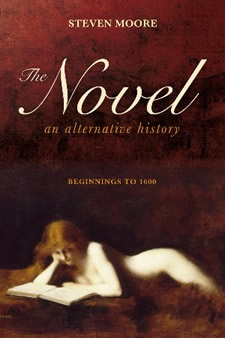
steven moore, “the novel: an alternative history”, 1

Steven Moore
The Novel: An Alternative History
(Continuum, 2010)


Moore’s introduction to this book is offputting. Part of the problem with Moore’s approach is that he’s treating what he’s terming “the novel” almost as if they were a set of artifacts devoid of cultural context: when you wrap this text in a book and set it next to this text in a book, you can find similarities, even if they’re separated by 2000 years. (A similarly maddening, if perhaps more fashionable, version of this might be John D’Agata’s project of describing many things as “lyric essays”. For D’Agata, almost everything is a lyric essay, even if the authors weren’t smart enough to understand this; for Moore, many of the same texts are novels.) The problem with Moore’s taxonomy is that it’s Linnean, based largely on morphology and how similar things look, rather than an evolutionary one; to Moore, a novel seems to mean a fictional narrative, though both of those words are similarly fuzzy.

An analogy might be drawn to the Metropolitan Museum, which contains a great many things (coffins, desks, jewelry, clothing, twentieth-century paintings) under the guise of “art.” The creator of a Mayan death mask, or the members of the society in which it was created, almost certainly did not see that object the same way that a Cezanne painting would have been seen by Cezanne or his contemporaries, or by the way we see that painting now. Certainly commonalities can be drawn – workmanship, originality, for example – but the reason that both of those objects appear in the same museum is historical contingency as much as anything: audiences saw that Cezanne was beautiful, and then realized that the Mayan mask was as well; in the nineteenth century, the Mayan mask would have been in the natural history museum. The art museum as it currently exists is a historical construct. 

To go back to taxonomy: Moore is a lumper rather than a splitter. If something looks like a novel to him, it is; even if Nathaniel Hawthorne labeled some of his books “romances,” they’re still novels (p. 5), while Gertrude Stein’s self-labeled “novels” are also novels (p. 32). This is partially a problem of his belief that while the word “novel” is unwieldy, it can be given a single definition if that definition is his. But there’s a weirdness to his use of terminology: consider his note at the bottom of p. 32:

The “antinovel” is associated with postwar French novelists – Sartre used to describe a novel by Nathalie Sarraute – but the term was actually coined by the experimental novelist Charles Sorel in 1633.

Both Sartre and Sorel would have spoken of “l’anti-roman”; but what they would have mean by it is almost certainly different. Sartre’s introduction to Portrait of a Man Unknown uses the word with reference to Nabokov, Waugh, and Gide. This is glossed over: for Moore, all anti-novels seem to be the same anti-novel, and the possibility that the same word could be used to mean different (or contradictory) things doesn’t seem to bother him.

A larger problem with Moore’s introduction is his us-vs-them argument. “Us” is the progressive novel with a long history; “them” is the Dickensian novel. “Them” is more specifically B. R. Myers, Dale Peck (for his review of Rick Moody), and Jonathan Franzen (primarily for his terrible Gaddis piece in the New Yorker) who wish that modern novels would stop being so modern. There’s an anti-academic slant as well, as if the academics had been hiding a secret history from the masses; but it seems like what Moore is doing is trying to simply change the places of the elites and the preterite. The problem with their canon seems to be that it isn’t his canon. John Ashbery is denigrated twice for being not with it enough to like the Velvet Underground; certainly Ashbery was from an older generation (presumably Gaddis didn’t like the Velvet Underground either), but casting him as an enemy of the progressive novel doesn’t actually make sense: Ashbery championed Roussel and Kenneth Koch’s The Red Robins among plenty of other notable instances of the avant-garde novel. Unfortunately, this makes a mess: I don’t know that battle lines are that carefully drawn. 

A major problem with his book is his neglect of how the market shapes our perception of which fiction is entertainment and which is avant-garde: the common history of the English novel rising with Richardson and Defoe is directly tied to the availability of mass-market editions of their work; until the mid-twentieth century, the novel was a major cultural force, at which point it was supplanted by film, television, and the Internet. The cultural function of the novel changes when other media arise; it probably isn’t coincidence that cries for a return to the values of Dickens in fiction started appearing soon after the Internet rose to prominence in American life. When the novel moves away from the cultural center, the way it’s used changes (becoming more than ever a signifier of the high-brow, or the old high-brow); similarly, long-form narrative before Gutenberg would have functioned entirely differently than a novel would have. 

There’s a sense in which this maybe the argument in this book is perhaps from another time. Does it still make sense to argue about what constitutes the canon in an age when so many books are instantly available? It doesn’t seem impossible to like Ashbery, Gaddis, and the Velvet Underground all at once; however, just because Rick Moody once wrote interesting books (which seems a very long time ago now) doesn’t mean that he’s always worth defending, especially when there may be more interesting work out there. The failure to acknowledge the market hamstrings the argument as well: right now, there are plenty of self-described “avant-garde” fiction being written by MFA writers primarily for an audience of other MFA writers; the avant-garde risks becoming just another marketing genre. How avant-garde these writers might actually be is certainly up for debate; but they certainly don’t align with the lines Moore is trying to draw: being an artist in the age of accreditation is a different sort of beast. Probably there are more avant-garde novels being written now; certainly, there are more bad avant-garde novels being written now. Given this present, returning to the canon starts to seem more desirable. What’s wanted more than ever is discernment: but that’s not Moore’s project here.

september 1–september 10

Books

Films

  • Conte d’hiver (A Winter’s Tale), directed by Éric Rohmer
  • Guernica, dir. Robert Hessens & Alain Resnais
  • The Cameraman, dir. Edward Sedgwick
  • The Docks of New York, dir. Josef von Sternberg
  • Design for Living, dir. Ernst Lubitsch
  • Disco Dancer, dir. Babbar Subhash
  • The American, dir. Anton Corbijn
  • Free and Easy, dir. Edward Sedgwick

Exhibits

  • “Charles Burchfield: Fifty Years as a Painter,” D. C. Moore Gallery
  • “Toledo/Borges: Fantastic Zoology,” Instituto Cervantes
  • “Lee Bontecou: All Freedom in Every Sense,” MoMA

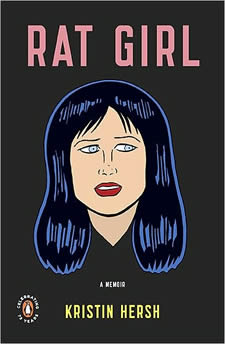
kristin hersh, “rat girl”

Kristin Hersh
Rat Girl: A Memoir
(Penguin, 2010)


The first time I would have heard Kristin Hersh’s music would have been sitting in a station wagon in a dark parking lot somewhere in rural Illinois waiting to pick someone up. Occasionally in the car you could pick up the modern rock stations from Chicago, and what they played was more interesting that the omnipresent classic rock stations, with their monotonous diet of Led Zeppelin, Pink Floyd, Bad Company, Rush, occasionally mixed in with whatever new music might be masculine enough to fit in (Candlebox, maybe Pearl Jam). NPR was occasionally interesting, but not predictable; all in all, it was a frustrating state to be in when it was clear from whatever media did seep in that things were happening elsewhere, happening without you. It’s a state that wouldn’t exist a year later, when I went east to college & the Internet came along; but that’s how things were in 1994, near the end of something though I didn’t know it at the time. That was the environment in which I first heard Throwing Muses’ “Bright Yellow Gun,” the single off University: the song and then the record sounded like a transmission from another world. Faux-surrealism was stock in trade for rock lyrics at that point in time; but Kristin Hersh sounded more like she meant it than most: there was an awkwardness that wasn’t contrived, and the imagery couldn’t easily be resolved into standard adolescent concerns: something else seemed like it was happening.

Early artistic impressions can be hard to shake off; most of what one accords value when young is embarrassing in hindsight, especially when growing up in an environment of cultural deprivation. Throwing Muses were, as it turned out, one of the first bands I saw after arriving at college, a free show on the Esplanade in Boston in front of a crowd of drunken fratboys who clearly didn’t like them, validation in my eyes. It was easy, around that time if you were a certain sort of young person concerned with pop music, to get bogged down in Baudrillard and interminable arguments about fake authenticity; but Throwing Muses seemed to somehow be outside that argument. 

Writing about pop music is almost invariably awful, and this is only intended as background to my reading of this book. I don’t love memoirs; it’s a form that too often lends itself bad writing because of too easy recourse to the truth: the truth about most people’s lives is not art, even if it may be diverting. The rock memoir promises to be the worst of all possible books. But there are exceptions; and this might be one of them. Rat Girl is a memoir of Hersh’s 18th year, when her band was playing regularly in Providence and Boston, when she was ostensibly attending college, when she was diagnosed as being bipolar, when her band was signed to a British record label and recorded its first album, and when she unexpectedly wound up pregnant. What I like here is how much is left unexplained: the overtly Freudian title, an epithet that Hersh uses to describe herself throughout the book; how the members of the band appear to be living as homeless while Hersh seems to maintain a reasonably close relationship with her parents; how she came to be friends with Betty Hutton; how she came to have a baby in the first place. All the obvious questions that a journalist would like answered about Hersh’s early life are entirely disregarded in this book.

What remains is a record of experience; a note at the front explains that it’s based on a diary of the year, but nothing of that diary remains, and it’s difficult to imagine what might be in it. Hersh and her band seem to live like savages or baby rabbits, crashing in abandoned apartments, falling asleep whenever they stop moving, using a language that seems to be their own. There’s a strangeness here that can’t quite be classified. A sequence early in the book between Hersh and her drummer, who’s just brought in some trash to use as percussion:

Sitting up to admire his garbage, I notice that he’s wearing a coat. I’m stunned. “Dave . . . what the hell?”
     Dave and I always believed that coats were for wimps who couldn’t handle seasons: “coat slaves.” Geez, people, get a grip! Seasons happen! And that vision was for wusses: people who couldn’t hack the rough-hewn, fuzzy life we lived – slaves to their glasses – when we could play entire shows without seeing anything. It was the only thing we were smug about, really, our ability to live blind and cold.
     Then, a few months ago, he showed up at our attic practice space wearing glasses. I felt betrayed, but he was transformed. “Trees have individual leaves, even when they’re far away!” he insisted, his eyes and new lenses shining. (p. 62)

This isn’t the only point in this book where one thinks of Werner Herzog’s The Enigma of Kaspar Hauser. What’s most interesting is Hersh’s relationship with her songs: something that started, she says, when she briefly lived in an apartment she calls the Doghouse:

. . . by the time I raced out the door . . . it was too late. I was branded; tattooed all over with Doghouse songs – each one a musical picture etched into my skin.
     I know that when my band plays these ugly tattoos, people can see them all over me, but I don’t care too much. I mean, shy people are generally not show-offs, but the burning that the songs do, the fact that I’m compelled to play them, makes me think they . . . matter? Maybe that’s not the right word. That they’re vital. And I respect that. I can feel sorry for myself without judging the music. (p. 12)

This is also a memoir of mental illness: hit by a driver while on a bicycle when young, Hersh’s songwriting seems to be related to her bipolarity:

A few days later, lying in my hospital bed, I heard my first song: a metallic whining, like industrial noise, and a wash of ocean waves, layered with humming tones and wind chimes. Intermittent voices talked and sang. I thought it was the TV in the next room. The TV never shut up, though; nobody ever turned it off or even changed the channel. I started to worry that the patient next door had died or slipped into a coma. (p. 76)

Hersh doesn’t valorize her bipolarity as the source of her creativity; it’s simply something that’s there that has to be lived with, much the same attitude she has later when she discovers that she’s pregnant:

I really didn’t mind getting hit by a car, though – it was interesting, and probably my last chance to fly through the air in nonjudgmental fashion. I think if I got hit by a car now, it’d bug me, but before we learn to by whiny about our existence and how comfortable it isn’t, we’re still open to being thrown around, even if we bust our faces when we land. So what if sudden contact with the street makes your teeth fall out, maybe snaps off a foot or two? At least you know what that feels like. (p. 78)

There’s something very likable about this book: it’s not for everyone, and certainly my relation to it is going to be charged by personal experience. But it’s far more interesting than writing about music, than a memoir should be.