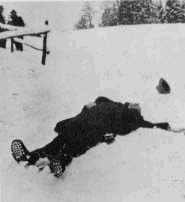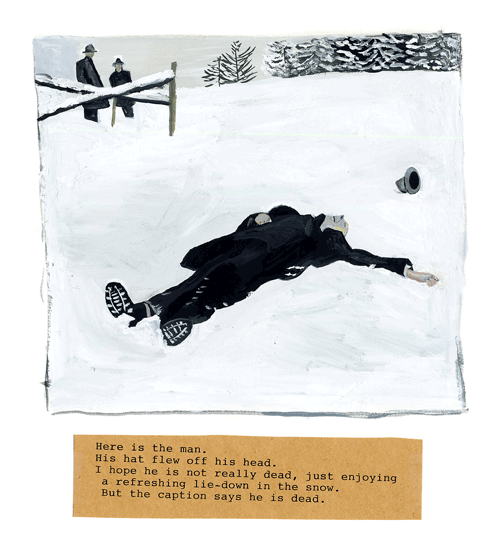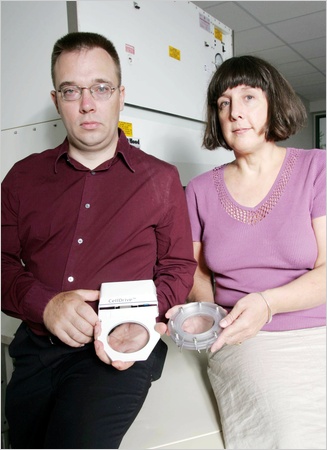


Man Ray, Enough Rope, 1944 (currently on show at the VBH Building on Madison Avenue, with the rest of the photos that Man Ray donated to the Venice Biennale)
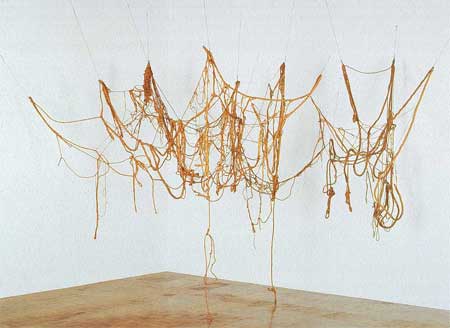
Eva Hesse, Untitled (Rope Piece), 1970 (currently on show at the Jewish Museum)
are these ones from some college:


There’s something about the chains of logic evident in these little narratives that I love: the weird defeatism which reminds me so much of the little stories of Robert Walser, like this one:
The Robber
A pretty woman loved a robber. She was rich, gave parties. Of him it can be supposed that he lived in a hut.
She wore loafers as well as high-heel shoes, and she thought well of him because he was brave, and fair match for hundreds. What an interesting affair.
She had a cage full of lions and tigers and tubs full of snakes. What had he got? Countless sins on his conscience. But at least he wasn’t dull. That decided it.
His overcoat was threadbare enough, it’s true, but she went about with unbelievable chic.
They met partly in the mountains, partly at the railway station. He consigned all his loot to her by bank draft.
Sometimes he’d visit her, and on such occasions he wore an impeccable suit. His behavior was always very polite.
He read Stendhal, she read Nietzsche. This is no place for explanations, even if requests come in for an entire year.
She never permitted intimacies. Their relations remained platonic, and rightly so, for otherwise she’d have lost his spirit of enterprise.
He was a Napoleon! And she? A Catherine the Great, perhaps? Not in the least.
She was the proprietor of a grocery who had three children, and our robber was a decent, reasonable young man, who was in love with the little woman, came into her little shop now and then and chatted with her.
The tigers and lions, the polished bootees, dazzling parties, the impeccable suits, the hundreds he was a fair match for, the relationship full of sacrifice, the whistlings, signals, and shaggy hair, are figures of fantasy.
The person who hatched them now glances at the dial and things it is time to get up from his desk and go for a little walk.
(October 1921: Das Tage-Buch. SW 18.)
(p.32 in Robert Walser, Speaking to the Rose: writings 1912–1932, trans. Christopher Middleton.)
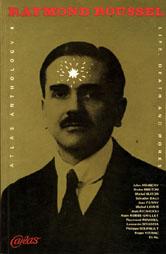
Raymond Roussel, author of L’Étoile au front.

Marcel Duchamp’s tonsure de 1919.
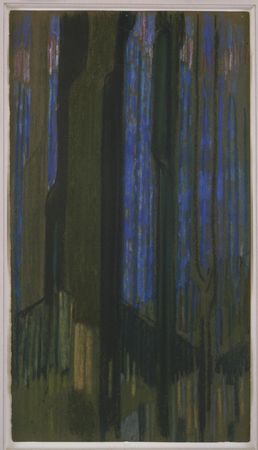
The color’s pretty ferociously botched on this (good job, MoMA): František Kupka’s Study in Verticals (The Cathedral), pastel on colored paper, 1912. In MoMA’s current drawing show.
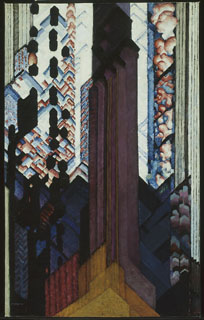
Kukpa, Reminiscence of a Cathedral, oil on canvas, 1922–23. At the diacritically-challenged Art Institute of Chicago, turned up while looking for a better version of the MoMA drawing.
Marcel Duchamp’s cover for André Breton’s Young Cherry Trees Secured Against Hares (1946):

The cover of the first American edition of Michel Butor’s Mobile (1963), designed by Janet Halverson:

(I would have a better image of that, but there doesn’t seem to be one on the Internet and thieves stole the scanner cable, so the phone & Photoshop will have to do. Alas.)
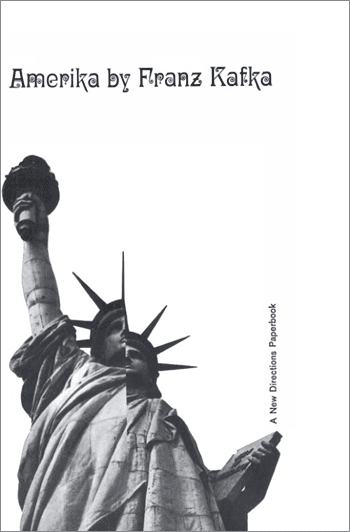
One would imagine that someone would have similarly made a splendid cover for Kafka’s Amerika of the Statue of Liberty holding a sword aloft, but the closest one I can find is the New Directions cover by Gilda Kuhlman:
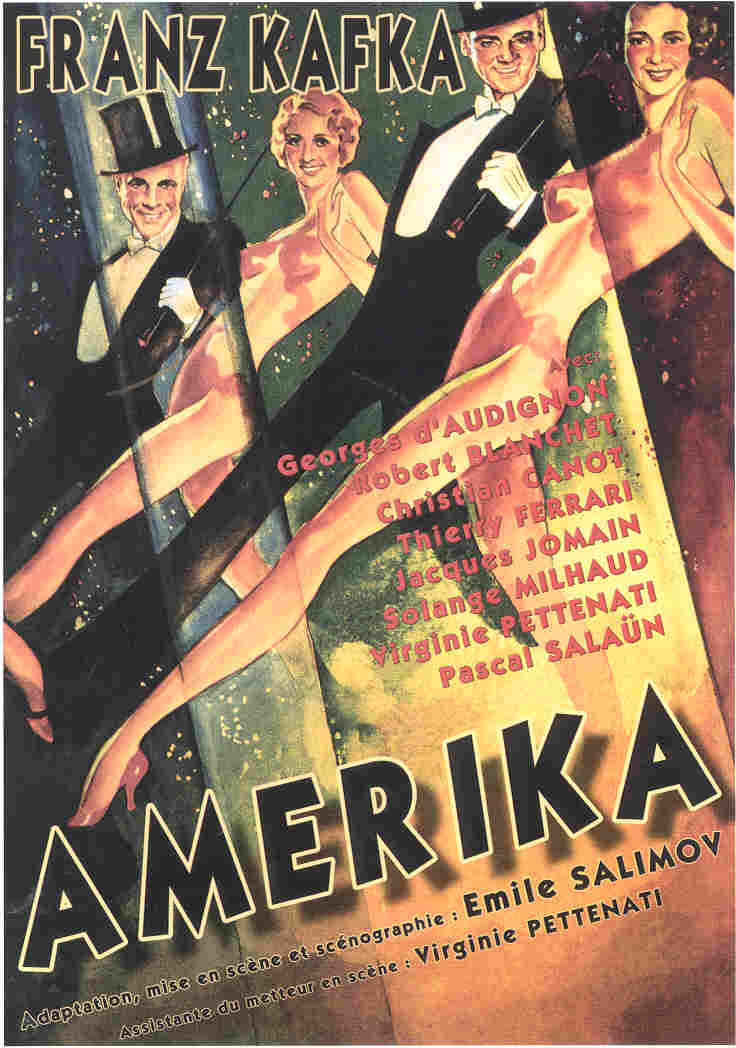
But the best cover for Amerika that I could find is the poster for this French theatrical version of the novel, which captures more of the novel’s spirit:
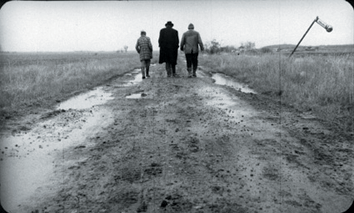
(representative still from Béla Tarr’s Sátántangó)
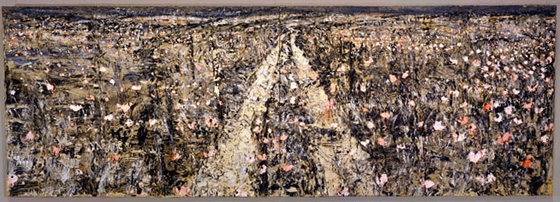
(Anselm Kiefer’s Böhmen liegt am Meer)
“Bohemia Lies by the Sea”
Are these houses green, I once more enter a house.
Are these bridges safe, to walk I have good ground.
All loving effort lost for ever, I lose it happily.
lf not I myself then someone else as good as I.
lf here a word adjoins to me, I let it join.
If Bohemia lies still on the sea, I believe the seas.
And if I believe in the sea, I still can hope for land.
lf it’s I myself it’s everyone just as much as I.
I have no wishes any more. I wish to run aground.
Aground – towards the sea, to find Bohemia.
Wrecked, I wake up peacefully.
I have grounded my belief and shall be lost no longer.
Come here, you from Bohemia, sailors, whores, and ships
without a staying. Won’t you be Bohemians, you Illyrians, Veronese
Venetians. Play those comedies to make us laugh
Before we cry. Go wrong a hundred times
as I went wrong and always failed examinations,
yet I passed them all, each and every time.
Passed them like Bohemia which one fine day
was relieved down to the sea and now lies on the shore.
Still I adjoin to a word and to another country,
and ever more adjoin to all there is however slightly,
Come from Bohemia here, a vagrant, who has nothing, whom nothing keeps,
gifted with vision to see from the sea-struggle land of my choice.
(Ingeborg Bachmann, trans. Peter Filkins)
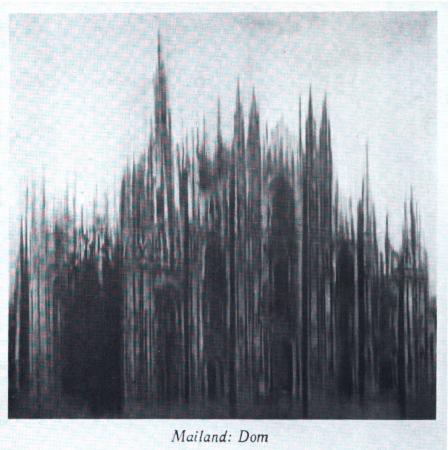
(Gerhard Richter, Mailand: Dom, 1964)
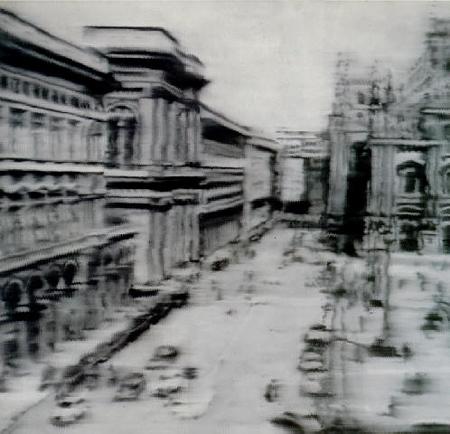
(Gerhard Richter, Domplatz – Mailand, 1968)
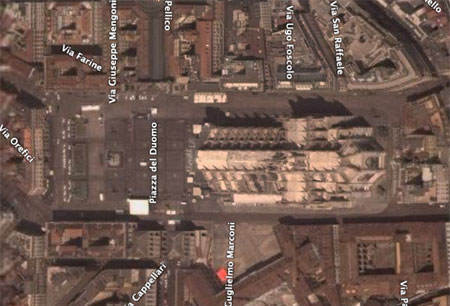
(from Google Earth)
requisite poem:
“Milan Cathedral”
Through light green haze, a rolling sea
Over gardens where redundance flows,
The fat old plain of Lombardy,
The White Cathedral shows.
Of Art the miracles
Its tribe of pinnacles
Gleam like to ice-peaks snowed; and higher,
Erect upon each airy spire
In concourse without end,
Statues of saints over saints ascend
Like multitudinous forks of fire.
What motive was the master-builder’s here?
Why these synodic hierarchies given,
Sublimely ranked in marble sessions clear,
Except to signify the host of heaven.
(Herman Melville, from Timoleon, 1891)
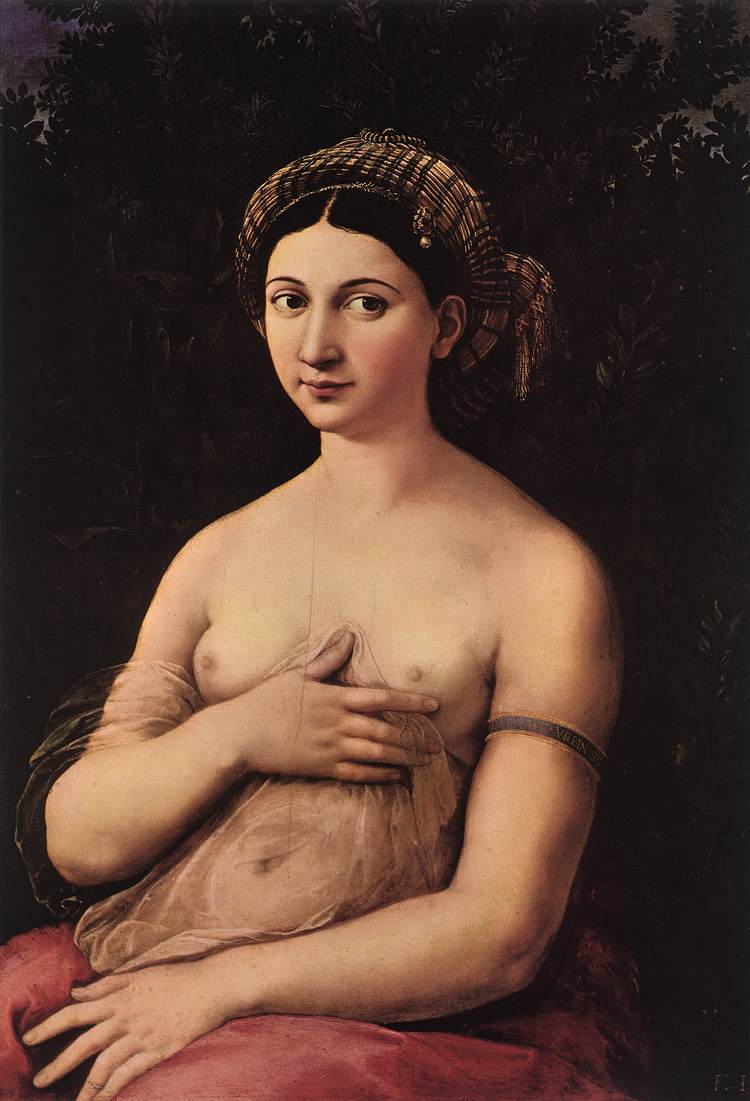
(La Fornarina, Raffaello Sanzio, 1518–1519)

(Portrait of a Young Woman in a Turban (Beatrice Cenci?), Guido Reni(?) ,ca. 1662)