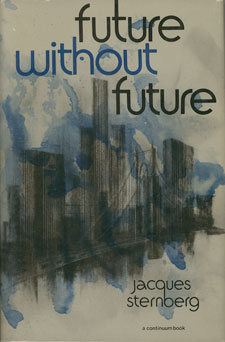
jacques sternberg, “future without future”

Jacques Sternberg
Future Without Future
(trans. Frank Zero) 
(Seabury, 1974)


The Museum of the Moving Image has been having an Alain Resnais retrospective, where I finally saw Je t’aime, je t’aime; the program notes for that film pointed out that it had been written by Jacques Sternberg, “the French Philip K. Dick.” I didn’t remember ever having heard of Sternberg; this book, a 1974 translation of 1971’s Futurs sans avenir seems to be one of two by him available in English (the other being 1967’s Sexualis ’95). Future Without Future appeared as part of Seabury’s Continuum series of foreign science fiction; also listed in the series are works by Stanisław Lem, the Strugatsky brothers, and Stefan Wul, all of whom, like Sternberg, seem to have had their books turned into arty movies. An English Wikipedia page gives some background on Sternberg’s life and work in entertaining prose:

Sternberg, a very apt helmsman, owned a diminutive 12 Ft dinghy (Zef class, excellent for day cruising but slow and utterly unfit for racing) and often undertook arduous coastal treks, even in comparatively bad weather. An anarchist at heart, he rejected organized regatta and racing – Not unlike Bernard Moitessier, the famous ocean vagabond – and wrote a biting satire of yachtsmen, sponsors and yacht clubs, in his erotic-nautical novel Le navigateur published at the peak of Eric Tabarly’s success. Dinghy sailing means living a very close relationship with the sea and it is one of the keys to understand the important place of the sea in Sternberg’s work, specially in what may arguably be his best novel Sophie, la mer et la nuit.

This is not helpful for this book, which contains only passing mention of the sea. The French Wikipedia is a bit more helpful; there we learn that:

Avec 1 089 textes répertoriés à ce jour, J. Sternberg peut se targuer d’être le nouvelliste le plus prolifique du xxe siècle !

Perhaps he will go on being one of the most prolific novelists of the twentieth century; however, he did die in 2006. One learns there that he was part of the Panique group with Fernando Arrabal, Roland Topor, Alejandro Jodorowsky, and Olivier O. Olivier; a fair number of his works still seem to be in print in France despite his general disappearance in English.

Future Without Future collects a novella (“Fin de Siècle”) and four stories. The novella presents a man’s diary for 1999: he lives in a dystopian Paris clogged with cars and soot run by an all-powerful state. Everything is regulated; there are fines and impositions for any misstep (he is sentenced to play tennis two hours a day for a few months), even down to private life (he has a state-mandated mistress and child; the state gives out adultery cards). He spends his day counting punctuation at a state publisher; his job is futile, as all jobs are futile, but there is no escape. Love turns up, predictably enough; but as the story progresses, it becomes clear that the government’s manipulations of time (declaring the Sunday will be skipped) are not in name only, as might be expected, but real; the government’s mismanagement of time causes the universe to collapse. 

The stories show Sternberg to be preoccupied with the world of the bureaucrat: the drudgery of work is very real in these stories. In “Vacation,” a man is forced to go on vacation (which also happens in “Fin de Siècle”); he takes a jaunt by rocketship to the boring world of his childhood, but on his return he is informed that their rocket will need to be parked in orbit for the next year; no worry, because his work will be sent to him. “Very Sincerely Yours” starts out as a report of an absurdist joke (a bored functionary decides to write letters about his own anomie to the people he is supposed to be corresponding with on official business) which turns into a weird fantasia (his correspondent turns out to be an alien living in a parallel world; the alien infects the world with a virus that will eventually cause humanity to shrink to the height of twenty-eight inches, the height of the alien race, so that they might be more easily conquered in a few hundred years). It’s presented in epistolary form; as it begins it might be the response of a latter-day Bartleby so utterly alienated by capitalism that he has no real name (he signs with the name “JR, Director,” though his boss, of course, can’t be bothered with anything as quotidian as answering letters).

Bartlebys take over the world in “Future Without Future,” the last story in the book: in that, the societal revolutions are telescoped forward to a world where the young (“the Fatigued Generation”) refuse to do anything, which stops the Vietnam War and brings about a peaceable planet. Sternberg puts himself in the vanguard of their cultural revolution:

But it is literature, still, which evinces the most spectacular reversals. For two or three years now, the books of Sagan, Druon, Kessel, Troyat, Dutourd, Mallet-Joris, Daninos, or any of the best sellers of the 70’s have not sold a single copy. On the other hand, a vast public of indolent and disgusted readers have flocked to the work of heartsick professionals such as Céline, Beckett, Michaux, Sternberg, Bierce, Kafka, Cavanna, Benchly, and above all Cioran, whose Précis of Decomposition sold five hundred copies between 1949 and 1975, but enjoyed sales of ten million in 1980, and has established itself as the new Bible of modern times. By the same token, no publisher has managed to market a book on management or marketing, those moth-eaten themes of 1970, or any book of poetry, history, politics, sociology, or metaphysics. Those thought-provoking bugbears have finally bored, disgusted, and fatigued the public which still reads. That is to say, the new generation alone. (pp. 193–4)

To Sternberg’s list of familiars, one might add Anna Kavan, whose tone is sometimes very close to this book; I suspect that the argument could probably be made by one more familiar than I that Sternberg presages Houellebecq. Sternberg is not, on the evidence of this book, the French Philip K. Dick: there is no secret meaning to be found in his world, only drudgery, entertainingly presented.
march 1–march 15

Books

Films

  • The Jazz Singer, dir. Alan Crosland
  • Loin du Vietnam (Far from Vietnam), dir. Joris Ivens, William Klein, Claude Lelouch, Agnès Varda, Jean-Luc Godard, Chris Marker & Alain Resnais
  • I Want to Go Home, dir. Alain Resnais
  • Je t’aime, je t’aime, dir. Alain Resnais
  • Le chant du Styrène, dir. Alain Resnais
  • The Naked City, dir. Jules Dassin
  • Night and the City, dir. Jules Dassin
  • Mon oncle d’Amérique, dir. Alain Resnais
  • Mélo, dir. Alain Resnais
  • La Glace à trois faces, dir. Jean Epstein
  • The Kids Are All Right, dir. Lisa Cholodenko
  • Brainscan, dir. John Flynn
  • Little Odessa, dir. James Gray
  • Querelle, dir. Rainer Werner Fassbinder
  • Liebe – kälter als der Tod (Love Is Colder Than Death), dir. Rainer Werner Fassbinder

Exhibits

  • “Stieglitz, Steichen, Strand,” Met
  • “Our Future Is In The Air: Photographs from the 1910s,” Met
  • “Pierre Huyghe: The Host and the Cloud,” Marian Goodman
  • “Tibor de Nagy Gallery Painters & Poets: Celebrating 60 Years,” Tibor de Nagy
  • “David Hammons,” L & M Arts
  • “Stanley Casselman: Evolution-Water,” Chashama Donnell Windows
  • “Hong Seon Jang: Zip City,” Chashama Donnell Windows
  • “Liliana Dirks-Goodman: Color Series #3,” Chashama Donnell Windows
  • “Jose Landoni: The Great Wave,” Chashama Donnell Windows

noted

  • A stage reading of Raymond Roussel’s The Dust of Suns (in the translation of Harry Mathews, under the direction of John Beer) is happening in March at the Charnel House in Chicago.
  • I have a piece in the Review of Contemporary Fiction‘s upcoming “Failure” issue. There’s going to be a reading at PS1 on April 2.
  • Probably the best piece in that issue, Sam Frank’s “The Document” is up at Triple Canopy; new Sergio de la Pava & Joshua Cohen to appear soon in the current issue.

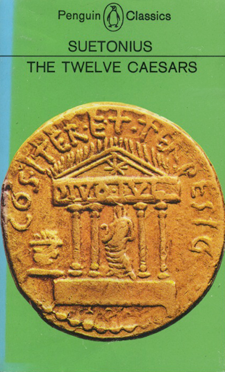
suetonius, “the twelve caesars”

Suetonius
The Twelve Caesars
(trans. Robert Graves, revised Michael Grant) 
(Penguin Classics, 1979)


This book I have something of a history with: in a particularly uncomfortable moment during the year I worked in Rome, I was once called in as a witness to ask someone being fired over a disagreement about the contents of this book, Italian, English, and Latin editions of Suetonius being brandished as proof. Which bit of imperial misbehavior was being argued about I don’t remember anymore – spectators being boiled alive by Caligula in the Circus Maximus, maybe. I picked it up again with the idea that the life of Septimius Severus was described here; it’s not, of course, but I always feel guilty about putting off the classics, and this seemed easily digestible and full of entertaining trivia, in the manner of Petronius or Procopius. My classical history seems to be weighted in that direction; this (along with, of course, my lack of Greek and Latin) is why I’m not a classicist.

Suetonius is pleasant, not least because of what he takes to be his work in writing this book. Most of the long chapters – Galba, Otho, and Vitellius weren’t in power long enough to make much of an impression – are effectively divided in half: the first half presents the notable deeds of the emperor before and after coming to power, while in the second half, Suetonius explains what the emperor was really like. While Suetonius has a grudging respect for at least Julius Caesar and Augustus, and he seems to outright like the short-lived Titus, none of the emperors is exempt from criticism. The lives of the first two emperors are told with quotations from original documents; those don’t generally appear in the later histories, ostensibly because Suetonius was kicked out of the archives. One wonders who this book was intended for; it seems hard to imagine such a scabrous book functioning as a widely-read history. The accuracy is hard to gage; at the very least, there’s a huge amount of second- and third-hand information; at least some is outright imagined. One ends up with something like Voragine’s Golden Legend, mostly nonsensical as history, but entertaining nonetheless. 

It’s hard not to enjoy the details, like the inadvertantly Joycean bit where Caligula calls his “great-grandmother Livia a ‘Ulysses in petticoats'” (p. 164). Most of the Caesars planned on staking out a month in the calendar; Claudius decided that he would improve the alphabet:

Claudius also added three new letters of his own invention to the Latin alphabet maintaining that they were most necessary. He had written a book on the subject before his accession, and afterwards met with no obstacle in getting the letters officially adopted. They may still be found in a number of books, in the Official Gazette, and in inscriptions on public buildings. (p. 210)

Claudius’s letters didn’t take; but they have, in fact, been added to Unicode: they are Ⅎ, Ↄ, and Ⱶ, and whoever added them to Unicode seems to have ahistorically created minuscule versions of them as well. Wikipedia’s story that Claudius was led to add new letters because of his mother’s taunting isn’t in Suetonius; however, Antonia does refer to her son as “a monster: a man whom Nature had not finished but had merely begun.” The young Claudius comes off as rather endearing, almost a young Prince Hal: his “reputation for stupidity was further enhanced by stories of his drunkenness and love of gambling.” He has questionable friends:

Some jokes exercised their wit by putting slippers on his hands as he lay snoring, and then gave him a sudden blow of a whip or cane to wake him, so that he rubbed his face with them. (p. 190)

What’s strange about this book as a whole might be how modern so much of it seems – the struggles for power and succession aren’t immensely different from anything that might be happening today – and yet how unthinkable so much of what’s described as daily life – even aside from the exaggerated excesses – seems to be. A paragraph from early in the story of Vespasian might illustrate this:

In Greece, Vespasian dreamed that he and his family would begin to prosper from the moment when Nero lost a tooth; and on the following day, while he was in the imperial quarters, a dentist entered and showed him one of Nero’s teeth which he had just extracted. (p. 282)

This is not a particularly odd moment in the narrative; indeed, this comes in the midst of a long sequence of auspicious signs that Vespasian noticed prior to becoming emperor. Sequences like this occur again and again in this book. How can we make sense of this? The rationalist approach would say that dreams don’t foretell the future, and that this is an ex post facto dramatization of what happened: Vespasian wanted to be emperor, Vespasian was handed a tooth, Vespasian explains that he dreamt he would be emperor when Nero lost a tooth. Presumably Vespasian is in Greece with Nero, though this is unclear to me. In a more horrific version in the previous paragraph, a stray dog brings a human hand to Vespasian while he’s eating breakfast; this is also a good sign because a hand is an emblem of power. Suetonius doesn’t seems to doubt these signs: he reports them as fact. Vespasian did become emperor, after all. But one feels unimaginably far from a world in which a dog bringing in a hand is regarded as a good thing.

The amount of casual violence is also staggering. Even apart from imperial excess, there’s the sense of life being astonishingly cheap. Regiments of the army are repeatedly decimated; minor crimes are given capital punishment; countless numbers of gladiators and prisoners die in arenas. The family trees of the Claudians and Flavians contain more unnatural deaths than not. Roman life expectancy wasn’t pretty, of course. But it’s almost impossible to imagine what it would have been like to live in a world where death was so inescapable; maybe arbitrary whims of gods make more sense.

the name “galba”

“Why the surname ‘Galba’ was first assumed by a Sulpicius, and where it originated, must remain moot points. One suggestion is that after a tediously protracted siege of some Spanish town the Sulpicius in question set fire to it, using toches smeared with resin (galbanum). Another is that he resred to galbeum, a kind of poultice, during a long illness. Others are that he was very fat, the Gallic word for which is galba; or that, on the contrary, he was very slender – like the galba, a creature which breeds in oak trees.”

(Suetonius, The Twelve Caesars, “Galba” 3, p. 248 in the Robert Graves/Michael Grant translation.)

corrections

Correction: March 3, 2011
An art review on Friday about an exhibition of work by Ree Morton at the Alexander and Bonin gallery in Chelsea referred incorrectly to the exhibition. It is the first solo show of her work at a New York gallery in 10 years, not the first in New York in that time. (There was one at the Drawing Center in 2009.)

Correction: September 29, 2009
An art review on Sept. 18 about “Ree Morton: At the Still Point of the Turning World,” at the Drawing Center in SoHo, misstated the history of exhibitions of Morton’s drawings. Other exhibitions have highlighted her work; this one is not the first.

better days for the arts

“Tiberius also paid Asellius Sabinus 2,000 gold pieces, to show his appreciation of a dialogue in which a mushroom, a fig-picker, an oyster, and a thrush took part in a competition; and established a new office, Comptroller of Pleasures, first held by a knight named Titus Caesonius Priscus.”

(Suetonius, The Twelve Caesars, “Tiberius” 41, p. 135 in the Robert Graves/Michael Grant translation.)

february 6–february 28

Books

Films

  • Gilda, dir. King Vidor
  • The General, dir. Clyde Bruckman & Buster Keaton
  • The Awful Truth, dir. Leo McCarey
  • Network, dir. Sidney Lumet
  • Honeymoon Hotel, dir. Tony Ganz & Rhody Streeter
  • Sincerely, Joe P. Bear, dir. Matt McCormick
  • From Alex to Alex, dir. Alison Kobayashi
  • Eros c’est Lamour, dir. Bradley Eros & Tim Geraghty
  • Synchronized Fountain #2, Dubai, dir. Peggy Ahwesh
  • Valentine for Perfect Strangers, dir. Ben Coonley
  • Tying the Knot, dir. Jacqueline Goss
  • Yard Work Is Hard Work, dir. Jodie Mack
  • People In Order #3: Love, dir. Lenka Clayton & James Price
  • Legend of the Lost, dir. Henry Hathaway
  • Cluny Brown, dir. Ernst Lubitsch
  • Ménilmontant, dir. Dimitri Kirsanoff
  • Lot in Sodom, dir. James Sibley Watson & Melville Webber
  • Überfall, dir. Ernö Metzner
  • Laura, dir. Otto Preminger
  • Vincere, dir. Marco Bellochio
  • The Thin Blue Line, dir. Errol Morris
  • Mr. Death: The Rise and Fall of Fred A. Leuchter, Jr., dir. Errol Morris
  • Manhatta, dir. Charles Sheeler & Paul Strand
  • H2O, dir. Ralph Steiner
  • Exotica, dir. Atom Egoyan

Exhibits

  • “Cézanne’s Card Players,” Met Museum
  • “Picasso: Guitars 1912–1914,” MoMA
  • “Michelle Stuart: Works from the 1960s to the Present,” Salomon Contemporary
  • “112 Greene Street: A Nexus of Ideas in the Early 70s,” Salomon Contemporarly
  • “112 Greene Street: The Early Years (1970–1974),” David Zwirner
  • “Sculpture in So Many Words: Text Pieces 1960–75,” ZieherSmith
  • “Cornelia Parker: Rorschach (Accidental III),” D’Amelio Terras
  • “Alyson Shotz: Wavelength,” Derek Eller Gallery
  • “Ellsworth Kelly: Reliefs 2009–2010,” Matthew Marks Gallery
  • “Heinz Mack: Early Metal Reliefs 1957-1967,” Sperone Westwater
  • “Italian Paintings from the 17th & 18th Centuries,” Sperone Westwater
  • “Lee Lozano: Tools,” Hauser & Wirth
  • “T. R. Ericsson: Étant donnés 2°,” Francis M. Naumann

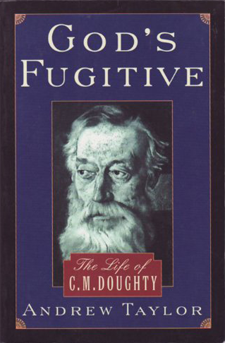
andrew taylor, “god’s fugitive”

Andrew Taylor
God’s Fugitive: The Life of C. M. Doughty
(Dorset Press, 1999)


I’ve acquired, somehow, something of a collection of the work of Charles Montagu Doughty: both the full-length and abridged versions of Travels in Arabia Deserta (which I’ve been dipping in and out of for a while), a print-on-demand facsimile edition of the first volume of his epic The Dawn in Britain, a copy of his verse drama The Cliffs. He’s one of those people who pops up in interesting places: Henry Green, Laura Riding Jackson, and Guy Davenport were all interested in him; The Dawn in Britain in mentioned somewhat dismissively in The Pisan Cantos. I had some idea of Doughty but wanted something more, so I found a copy of this relatively recent biography of him; D. G. Hogarth’s The Life of Charles M. Doughty, which I might yet track down, came out in 1928, but I wanted something a little more recent for perspective. This is a serviceable biography; at three hundred pages, it doesn’t presume to be exhaustive, but it does provide a reasonable introduction to Doughty’s life and work, which is mostly what I wanted.

Doughty (1843–1926) seems to fit nicely into the mould of Victorian eccentric: he started out in geology, the most happening subject when he arrived in Cambridge, though he didn’t get particularly far with that. Doughty’s most endearing traits is his astonishing stubbornness: geology interested him precisely because of its increasing conflict with his Christian faith. Being part of the impoverished gentry, he took up traveling; he wound up in the Middle East with the idea of visiting the lands described in the Bible and found it not at all what he was expecting (shades of Melville’s Clarel) but found himself drawn deeper and deeper into it. He set off into Arabia with vague archeological ideas after being impressed with Petra; he ended up wandering the country for a few years. It is a wonder that he was not killed: his travels are known almost entirely through his own accounts, but it seems likely that the Bedouins he traveled with took him for some sort of holy fool. He refused to pretend to be Muslim, much less convert; at the same time, he didn’t presume to proselytize. 

Returning to England, he found that most people were uninterested in his travels or his discoveries; relatively uncredentialed, he needed a book. He set to writing Arabia Deserta; as his youthful enthusiasm for geology had worn off, he’d been taken with Chaucer and Spencer, whose works he’d read again and again on his travels. The English language, he was convinced, had fallen into decadence since Spencer’s time; his writing, he hoped, might revive it. (Doughty would certainly have nothing to say to Fr. Rolfe, whose life he overlapped; but one might imagine a certain kinship with Rolfe’s project of creating his own dictionary of macaronic Italian with which to write Don Renato.) Doughty’s reforming spirit was lost, of course, on the publishing world, as well as upon, eventually, the reading public; it didn’t help that the original Arabia Deserta was 1200 pages long. Doughty then abandoned the Arab world entirely for poetry, trotting out an immense epic of the British clash with the Romans (the 30,000 line The Dawn in Britain), dramas in verse with subjects both Christian and anti-German (Adam Cast Forth, The Cliffs, The Clouds) and finally, in 1920, Mansoul, another long blank verse epic describing the journey of the Christian soul. Most of these didn’t make it past a first printing. Wanderings in Arabia Deserta, an abridged version of his first book, eventually found him a small, but devoted, audience; he was befriended by the young T. E. Lawrence, who made sure that he didn’t die indigent. 

It’s hard to make sense of Doughty: he seems to have had a quarrel with the world, which makes his life entertaining reading. A reviewer suggested, for example, that The Cliffs might be derivative of Thomas Hardy’s The Dynasts; Doughty wrote to a friend:

The writer knows to his small malicious satisfaction that I had copied something from a book with the strange title Mr Hardy’s Dynasts. Not moving in the Literary World, nor reading the Literary Periodicals, I had never heard of the book or the author, and remain in my ignorance till now, and shall continue to do so . . . (p. 302)

There’s something fantastic about his sheer pigheadedness: his determination that he was right and the world was at fault. An earlier letter to a publisher accompanying the manuscript of The Dawn in Britain explains how he saw the literary world in 1905:

Modern poets’ work has fallen into neglect, and perhaps it may be merito. Where is that sincerity, knowledge, and right inspiration, which is required even in the humblest work of art? Where is that intimate knowledge of language, without which there can be only deciduous handiwork? . . . To speak of the present manuscript. This book is my life’s work, a continuation of Chaucer and of Spenser, such as conceivably they might have written in the present . . . (p. 262)

Doughty’s stubbornness seems to have been a dissatisfaction with the world: unhappy with England, he left for the Europe and then the Middle East; unhappy with the writing of the present, he abandoned it for the past. Though religious to his core, he rarely if ever attended church. Taylor only sketches the personal life of Doughty, but these details further complicate his picture: a bachelor for forty years, he married soon after his return to England, and seems to have led a contented life with his wife and two daughters. It’s hard to blame Taylor for this: Doughty seems to have been thoroughly his own man, inscrutable from outside. One might wish, however, for a little more focus on Doughty’s literary works past Arabia Deserta. Maybe they need their own book.