march 30–april 4

Books

Exhibits

  • “Marina Abramović: The Artist is Present,” MoMA
  • “Ursula von Rydingsvard: Errātus,” Galerie Lelong
  • “Joseph Beuys: Make the Secrets Productive,” Pace Gallery
  • “Bill Albertini: Space Frame Redux,” Martos Gallery
  • “We Between the Lines,” Morgan Lehman Gallery
  • “Donald Judd and 101 Spring Street,” Nicholas Robinson Gallery
  • “Joan Jonas: Reading Dante III,” Yvon Lambert
  • “Stefan Brüggemann: Headlines & Last Line in the Movies,” Yvon Lambert
  • “Allen Ruppersberg,” Greene Naftali
  • “John Bock,” Anton Kern Gallery
  • “Side by Side: Oberlin’s Masterworks at the Met,” Metropolitan Museum
  • “The Mourners: Medieval Tomb Sculptures from the Court of Burgundy,” Metropolitan Museum
  • “Masterpieces of European Painting from Dulwich Picture Gallery,” Frick

Films

  • The Great Train Robbery, directed by Edwin S. Porter
  • Barbe Bleue (Bluebeard), dir. Catherine Breillat
  • Le mystère Koumiko, dir. Chris Marker
  • 2084, dir. Chris Marker
  • Junkopia, dir., Chris Marker, Frank Simeone & John Chapman
  • L’opéra-mouffe, dir. Agnès Varda
  • Réponse de femmes, dir. Agnès Varda
  • Sweet Movie, dir. Dušan Makavejev
  • My Winnipeg, dir. Guy Maddin
  • Time Bandits, dir. Terry Gilliam
  • Shampoo, dir. Hal Ashby

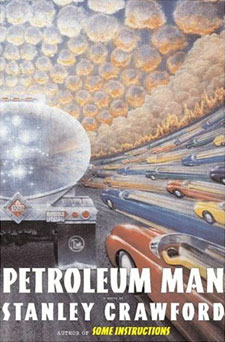
stanley crawford, “petroleum man”

Stanley Crawford
Petroleum Man
(Overlook, 2005)


It’s a truism that most great artists aren’t nice people, in exactly the same way that most great businessmen aren’t nice people, or in the same way that anyone who’s devoted to one thing above all will prove lacking in the rest of life. One starts thinking about this very quickly when considering the work of Stanley Crawford: because he does seem to be that rare example of the artist who seems to understand the problem of living decently. One reaches this conclusion from his non-fiction work, which focuses on agriculture; but one can also arrive there through his fiction. Almost all of it (Gascoyne, Log of the S. S. The Mrs. Unguentine, Some Instructions, this book) focuses sharply on dictatorial male characters who are set on ruining the world, domestically or more broadly construed, in some way. Travel Notes, his second novel, seems to diverge most widely from this plan, but the narrator of that book might be roped into this schema without too much trouble. Though satirical, Crawford’s monomaniacs might be seen as a critical inquiry: what makes people behave this way? And what can be done about them? Crawford’s own response is a life of rural agrarianism in New Mexico, but his continued treatment of these characters in his fiction suggests that he hasn’t finished trying to understand them as a problem.

Petroleum Man, as its title suggests, is his most explicitly political novel. Published in 2005, it can’t help but be read as a novel of the Bush administration. Leon Tuggs, the protagonists, deprecatingly refers to his adversaries with the specific epithet (a Reaganism?) “liberal democrats” (the italics are his); their opposite numbers are “Conservative Republications“. Tuggs is a close personal friend of the President; by his own account, he is the most wealthy businessman in America (and perhaps the world), having achieved this position by selling something named “the Thingie®” which is made out of wood, and the precise function of which is left unclear (a nod, perhaps, to what is made in Woollett in Henry James’s The Ambassadors); it is, he says, an “unchallenged tool used to keep track of the proliferating things of the world.” His “liberal democrat” son-in-law informs him that there is “a glob of Thingies® all stuck together the size of a small iceberg floating off the coast of Southern California and that Thingies® have cause the death of millions of ocean-going fish by getting stuck in their gills and seabirds by getting caught in their throats” (p. 86) – but Tuggs, every inch the industrial villain, has little time for such concerns. Tuggs writes the book while in the air in his private jets; with an eye to his legacy, he has embarked on a program to give his two grandchildren, Fabian and Rowena, a series of scale models of every car (with a few planes, for good measure) that he’s owned; each model comes with explanatory text telling, at least in part, his life story as well as detailing his ongoing struggles with the rest of his family and the broader world.

Despite having a family, Tuggs is much better with things than with people; his fortune, he explains, stems from his General Theory of Industrial Sex, which mostly goes unexplained, but seems to stem from his observation that since sex can be found everywhere in the metaphors of the industrial world (nuts and bolts, plugs and sockets, etc.) there is no need to look for it in the considerably messier world of people. The position of Tuggs is that of Ayn Rand: he sees a rational world in front of him (found though the lens of engineering), and is purposefully blind to everything outside of that world – his family in the throes of collapse around him. His grandchildren, to whom his narrative is ostensibly dedicated, don’t seem to be interested in the slightest in his educational program, being, as they are, scions of a wealthy family above all else. But telling his life story through cars owned is the only way Tuggs can express himself: his world is the world of things. He yearns for the day when human advance will finally overtake the natural world:

This should be not far off, according to the figures I am being supplied concerning the paving over of raw land and the converting of forests into useful industrial products like Thingies® and the plans for processing useless icebergs into drinking water and – of course – into bags of ice to help counter the effects of global warming, which I have always regarded as yet another business opportunity, perhaps the greatest ever in the history of civilization. At the present moment, the main tool is the computer – which appears to work flawlessly, however, only in the movies. (p. 130)

The discordant introduction of the computer here points out how oddly anachronistic Tuggs seems as a figure of the American businessman: while everything, of course, can be made from petroleum, his fixation on the thing (as opposed to the human) seems out of place in an American economy that’s increasingly virtualized. His hated son-in-law, a lawyer for an investment, might point the way forward: like most financiers, Chip (note the name, of course) produces nothing but the abstraction of more wealth. (Fabian and Rowena, the reader assumes, probably will never bother to actually have jobs; they trade away their collection of laboriously constructed metal models of their grandfather’s cars for cheap plastic copies and cash to make up for their lack of an allowance.) There’s something almost laudable in Tuggs’s function as a producer: he is monstrous, but in his ridiculousness he is a comprehensible figure: we can see how he arrived where he is. His position at the end of the book is predictable: though he is more wealthy than ever, his family refuses to speak to him, and his long-suffering wife is suing him for “being the source of a drift onto her organic fields of illegal pesticides or herbicides or other substances not approved for organic production” when thousands of miniature hamburgers dropped from helicopters fail to hit his birthday party, as intended.

It’s always surprising how few American novels are about the mechanisms of capitalism and its effect on the businessman: off the top of my head, there’s The Rise of Silas Lapham, Melville’s “The Paradise of Bachelors and the Tartarus of Maids,” Nathanael West’s A Cool Million, Gaddis’s J R, Richard Powers’s Gain. It’s a big subject: there should be more.

henry green, “doting”

Henry Green
Doting
(Penguin, 1952)


I’ve been slowly working my way through Henry Green – slowly here partly because I want it to last, and partly because I’ve been slowing my reading down this past year. Doting is Green’s last full novel, but the middle of Penguin’s second omnibus, now seemingly out of print. It’s odd that Living / Loving / Party Going seem to be the Green novels that everyone reads; Dalkey Archive keeps most of the rest in print, but they don’t seem to sell nearly as well as the Penguin Classics; there’s an order of magnitude of difference in the Amazon sales rankings. Does a John Updike introduction really get you that far? Blindness is clearly juvenilia, but Nothing and Doting are as funny and well-plotted as anything in Living / Loving / Party Going. Maybe it’s just that American readers are suspicious of small novels.

Doting follows on from Nothing: like that book, it might be described as a romantic comedy composed of a series of scenes set between two characters. It’s a light subject – and it’s a book that can be read quickly – but not without an undercurrent of sadness that comes out from time to time. The book begins with the middle-aged Arthur and Diana Middleton out for a celebratory dinner at a nightclub with their son Peter, who’s home in London on vacation from boarding school, along with Annabel Paynton, a few years older than Peter and the only daughter of friends of the Middletons (who remain only a threat for the duration of the novel). What she’s doing there isn’t entirely clear to the reader: while she’s almost the same age as Peter, she seems much more interested in his parents, and Arthur, though he has known her since she was a child, is suddenly interested in her. 

The stage is set for a rectangle of relationships; but Peter is soon shoved aside, being sent off to Scotland, and replaced by Charles Addinsell, Arthur’s best friend. (The names, it should go without saying, bear inspection: the Middletons are set up as being a very ordinary couple, Ann functions as a pain in their marriage. “Addinsell” suggests math and business; he’s substituted into a zero-sum game.) Arthur falls for Ann, and starts taking her out to lunch; she is happy to have lunch bought for her & tells her friend Claire that she’s interested in older men. Diana catches Arthur and Claire in a compromising situation when she’s supposed to be going to Scotland with Peter; she goes to confide in Charles and begins an affair of her own with him, although nothing is consummated, to the chagrin of Charles. Ann, jealous of Diana’s place, suggests to Arthur that Diana is having an affair with Charles; this does not displace Arthur but draws him back to Diana, who then tries to pass off Ann on Charles. This succeeds; Arthur then finds himself jealous again, as does Diana. Things carry on: Diana tries to split up Charles and Ann by introducing Charles to Ann’s friend Claire. This set-up works: and by the time the novel closes, with the original foursome back at another nightclub for a last dinner before Peter returns to school, the reader has the sense that everything has returned itself to the original state. Except not quite.

As one might expect, there’s a fair amount of lying in this book, which becomes rather convoluted. Here Arthur is trying to find out if Diana has told Charles anything about what she saw when she caught him with Ann:

“. . . . But she hasn’t said a word?”
“She wouldn’t, Diana couldn’t,” his guest lied in a flat voice. “Her loyalty’s like an oyster, and you’d cut yourself if you tried to open it with an opener.”
“Yet there are men who deal with dozens a minute out of a barrel.”
“Oh,” Mr Addinsell objected, “then, I imagine, they’ve all got their cards, are members of the Union. Any pearls they may find have to go to the credit of the Benefit Fund.” (p. 249)

There are several layers at work here: first, of course, Charles is lying in his response to Arthur’s question, because Diana has said something to him: Diana told Charles that she found Arthur in bed with Ann. Arthur previously told Charles what actually happened – Ann was trying to get a coffee stain out of her skirt, though they had been kissing – so Charles knows that one of them must be lying; as he knows them well, he probably knows that it’s Diana. But there’s also indirection in Charles’s answer: he doesn’t give Charles a flat-out yes or no – Arthur’s question, formulated in the negative, resists such an answer – rather, Charles falls back on generalizations about how Diana’s behavior, which he knows to be false. On another level, though, Diana is loyal: for a comedy based on the threat of adultery, no adultery actually takes place, though there’s every opportunity for it. Rather, Arthur and Diana’s marriage appears to be incredibly stable, like Charles’s oyster: they do appear to genuinely love each other.

Have things returned to normal at the end of this book? Charles, who seems like the force most likely to destabilize the Middleton’s marriage, has been taken out of play with the conveniently available Claire. In the final scene, the foursome has become six, joined by Charles and Claire; but there’s the sense of a lack of closure. The object of Ann’s affection may have moved on from Arthur, though it’s unclear that Arthur is entirely over his infatuation with her; and Diana still seems to feel pangs of jealousy watching Charles and Claire. Peter has been promised wrestling at the nightclub; the wrestlers never arrive:

“. . . . Well, you know, Di, I’m wondering if there is to be any tonight, when all’s said and done.”
“Oh no, Arthur! After you promised those wrestlers to Peter?”
“But if they are to show up, they’re being a bit slow about it, surely?”
“In any case, he can’t have anything. Now should he, Charles?” the mother said, using a suddenly bored voice.
“Got to learn to go without,” Mr Addinsell agreed. (p. 332)

And here (a few page later) the book ends: the situation is unresolvable, but it must be resolved; life has to continue.

noted

march 17–march 29

Books

Films

  • All the President’s Men, directed by Alan J. Pakula
  • Louis Lumière, dir. Éric Rohmer

Galleries

  • “Beyond Participation: Hélio Oiticica and Neville D’Almeida in New York ,” Bertha and Karl Leubsdorf Art Gallery at Hunter College
  • “Frederick Kiesler: Endless,” Jason McCoy Gallery
  • “Nicholas Knight/Kat Tomka,” Hewitt Gallery, Marymount College
  • “The Visible Vagina,” Francis M. Naumann Fine Art
  • “Marguerite Duras by Hélène Bamberger,” Cultural Services of the French Embassy
  • “Eva Hesse,” Hauser & Wirth
  • “Julian Montague: Secondary Occupants Collected & Observed,” Black & White Project Space
  • “Star Black: The Collaged Accordian,” Center for Book Arts

monica youn, “ignatz”

Monica Youn
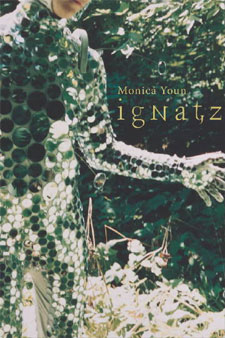
Ignatz
(Four Ways, 2010)


I picked up a copy of this after a performance at the Asian American Writers’ Workshop: word came from their email list that Matmos was going to be performing with Monica Youn. Matmos is one of the few electronic groups that’s reliably entertaining (see, for example, this clip on YouTube, as well as its weirdly civil comment thread), and as I’ve been going to Matmos shows on and off for the past ten years – having first run into them at the Festival Dissonanze in Rome, where they were contact-miking each other and making music out of that – I dutifully went along, knowing very little of Monica Youn, besides having seen her name about before. The company one keeps is important, of course; and I have been to enough poetry readings to know that interesting poetry readings are very much the exception rather than the rule. This was a nice one, in no small part because of how arbitrary it seemed: there’s nothing in Youn’s book that suggests that it needs to be remixed live to make sense, my problem with a lot of mixed-media poetics. (The blurbs on the back of the book – by Cal Bedient, Stephen Burt, and Matthea Harvey, all respectable enough – don’t suggest this either.) Rather the impression was that of listening to David Grubbs and Susan Howe reinterpreting her books live (the CD version of Thiefth and a live version of Souls of the Labadie Tract are now online at PennSound): it’s a different way into the words.

The performance was rather staid as Matmos performances go: a brick was hit with a rock hammer and looped to create a rhythm; drumsticks and, and one point, a rubber duck were thrown in as well. Previously sampled voices reading Youn’s poetry (probably the members of Matmos) mixed with Youn’s own voice. A synthesizer was in there somewhere as well. One had the sense of a sonic Rube Goldberg machine being constructed: the result wasn’t pop by any measure, but it had the playfulness of pop to it. Not knowing the book going into the performance, I don’t know how many poems formed part of the thirty-minute construction; one did have the sense of a character named Ignatz who recurred, and some sections did seem to be prose rather than verse. A particular standout was “Landscape with Ignatz,” a six line poem based on structured repetition, something like Queneau’s Cent mille milliards de poèmes:

The rawhide thighs of the canyon straddling the knobbled blue spine of the sky.

The bone-spurred heels of the canyon prodding the gaunt blue ribs of the sky.

The sunburnt mouth of the canyon biting the swollen blue tongue of the sky.

This does lend itself to an electronic rendition: taking the structure “The — — of the canyon —ing the — blue — of the sky” as a spine, different recorded voices and Youn’s live voice were substituted in for the parts. Not having the poem in front of me while listening, I don’t know how much of this was improvised or whether this was a straightforward performance of the poem.

Reading the book on the subway home, I found a similar sort of obliqueness: as most readers probably will, I started by reading the back cover’s paragraph-long blurbs, then made my way through the poems from the first page to the last. The blurbs inform you of the meaning of the title: Ignatz is a character in George Herriman’s Krazy Kat. I don’t know Krazy Kat, save from references: Wikipedia is helpful, but Wikipedia doesn’t exist on the subway. At the end of the book, we find an appendix with an explanation: 

George Herriman’s Krazy Kat comic strip was published in U.S. newspapers from 1913 to 1944. The strip is set in Coconino County, Arizona, and stars Krazy Kat, a feline of indeterminate gender and mutable patois. Krazy is hopelessly in love with Ignatz Mouse, a rodent of criminal tendencies, who, in turn, despises Krazy and whose greatest pleasure is to bean the lovelorn cat in the head with a brick. Krazy interprets these missiles as tokens of reciprocated affection, and the cat-mouse-brick-love cycle recurs in almost every strip. Ignatz’s repeated assaults upon Krazy incur the righteous wrath of Officer Bull Pupp, the canine sheriff of Coconino County, who is sweet on Krazy and who takes every opportunity to spy out Ignatz’s crimes and to drag the recidivist mouse to jail.

Hence, of course, Matmos’s bricks (and perhaps an antecedent to their involvement can be found in their Rat Relocation Project); from this we can start to make sense of Youn’s poetry. From Youn’s description, one might think of Wile E. Coyote’s unfulfilled desire to catch the Road Runner; but that isn’t actually what the relationship between Krazy Kat and Ignatz is. Krazy wants Ignatz; Ignatz wants to throw bricks at Krazy; but a third member of the triad, Officer Pupp, keeps the law. One realizes that things aren’t quite as they seem from Youn’s notes, which point out what she’s borrowed from Herriman’s work: the epigraph from “The Subject Ignatz,” for example, is from Officer Pupp: “Once more an urge; once more a succumb.” This is the language of desire, but played out in the world: Pupp is describing what he sees, not what Krazy (whose position the speaker in most of these poem appears to take) feels. A handful of poems here (“Ignatz Incarcerated”) lay out words in rectangular matrices, looking at how structures can be used to relate them. In “X as a Function of Distance from Ignatz,” parenthetical phrases constantly intrude in the poem to relate the position of male and female figures. 

And I like the language here: sources aside, this is a satisfying book. Later in “The Subject Ignatz,” we find “Asbestos / interlude: // the rubber / button // replumps itself,” cartoonish, but beautiful in the way the “u” sounds cascade through the stanza. Or “I-40 Ignatz”: “A cop car drowses / in the scrub // cottonwoods. Utmost. // Utmosted. There is / a happy land.” A note suggests that this poem “quotes Krazy”: these might be Herriman’s words rather than Youn’s, but they’re still worth noticing. 

leonard mlodinow, “euclid’s window”

Leonard Mlodinow
Euclid’s Window: The Story of Geometry from Parallel Lines to Hyperspace
(Touchstone, 2001)


This is a book that arrived as a birthday present, along with another book by Mlodniow, from Aunt Chris. I am not entirely why she sent these two particular books: over Christmas, we’d been discussing the problem of math education, and she said she had a couple of books about the problem of math education, but I am not sure that they were actually these ones. But I’m always interested in math, though I don’t know very much about it, due in large part to having grotesquely incompetent math teachers for almost all of my high school education. My geometry teacher was the only competent one; he should have taught calculus senior year, but he’d been elbowed aside for a rookie teacher who was fresh out of college and probably had never learned calculus to begin with. But aside from geometry, all the math I learned was self-taught; this worked out reasonably well, and I probably could have taught myself calculus, but by senior year it didn’t seem to matter any more.

And now I am mathless. That said: I like the idea of math, and I generally like histories of mathematics, though I don’t actively seek them out as often as I should. This book, a history of geometry from the Greeks to the present, reads easily, maybe too easily. But it’s hard for me to like this book. The problems start with the paratext: the book is set in Times New Roman, which is dispiriting: math, of course, is more difficult to typeset than ordinary text, but there are plenty of tools for the job, tools which give much better looking results. These weren’t used here. Early in the book (p. 26), the square root of 2 comes up; this is displayed not with the 2 under the radical sign as it should be:

[latex size=”-2″]\sqrt{2}[/latex]

but rather as the Unicode radical sign, then the 2:

√2

(Looking up the history of the radical sign in Wikipedia does point me to Antonio J. Duran, George Ifrah, and Alberto Manguel’s The Life of Numbers, which looks like the sort of math I’m interested in – one of the books I’ve always wanted is a history of mathematical typography.) But this looseness with typography bothers me mostly because of the lack of attention to detail: it seems cheap, and it makes me wonder about a math writer who doesn’t insist on this kind of precision, in the same way that misspellings make one wonder about the quality of a writer. At one point, we learn that the distance in flat space is the sum of the squares of the differences in x, y, and z: I’m pretty sure that value should be squared, but I could be missing something. Doubt has crept in.

Mlodinow’s style also grates. He’s clearly aiming for the popular audience, but that’s a hard thing to hit. There are a lot of jokes, which aren’t worth mentioning. The writing suffers from plenty of choppy declarative statements: “It sure seemed radical at the time.” (p. 217). Historical characters are given thoughts and dramatic struggles; frequently, we hear about their family life, which seems to serve as a counterpoint to Mlodinow’s own two sons, Nicolai and Alexei, who turn up again and again. They serve both as the protagonists of thought experiments and as the source of minor anecdotes; the former undercut the latter. If Alexei and Nicolai have been floating around in dimensionless space, why does it matter if they dye their hair blue to see what their teacher will say? At a certain point, they move the narrative forward by appearing in their father’s dream; at this point the reader wants to toss the book across the room. The author himself makes appearances toward the end of the book, but never to much obvious purpose; perhaps the author is a serious physicist, but it’s hard to know this from the way he appears in his text.

I critique the book’s style because it’s difficult for me to assess how accurate the book’s presentation of material might be. The book is structured as five great revolutions, as personified by five revolutionaries – Euclid, Decartes, Gauss, Einstein, and Edward Witten. Certainly the book seems to be in a rush to leave pure mathematics behind for physics. This is where the narrative loses interest for me; for whatever reason, I find myself more interested in pure mathematics than the glorious world of string theory. Not unrelated: at the same time, the examples in the book become less comprehensible. It’s hard for me to know how well this sort of focus works: I picked up the book wanting to know more about non-Euclidean geometry, never having properly had an introduction to the subject, but Lobachevsky, Bolyai, and Riemann don’t figure as major players. Klein bottles never appear, which made me sad; nor does topology, except as two paragraphs of background for string theory. Instead, we get personal narratives: a great deal of time is spent on Gauss’s relationship with his father and his teachers. And, of course, the sense that everything is leading to the present, the trap of any historical narrative. Certainly math does build on the past; but I wonder how useful this reductionist view of everything building to the present moment is.

Above all else, this is a book that needed an editor and didn’t have enough of one; it’s also unclear why there weren’t more illustrations, as the ones that do exist are generally helpful. A lengthy review by Robert Langlands tears the book apart from the opening line: “This is a shallow book on deep matters, about which the author knows next to nothing.” But this is an extremely useful review, if perhaps overly stern. “One should not ask about the scientific or mathematical achievements of Pythagoras but of the Pythagoreans, whose relation to him is not immediately evident,” says Langlands; but it’s hard to follow this advice when your project is to make Pythagoras come alive as a person. Langlands’s review is a useful corrective. As mentioned before, I do have a copy of another of Mlodinow’s book, The Drunkard’s Walk; I’ll probably make my way through it, but not without some trepidity. 

noted

against the old establishment

“As this half of the countercultural ideal originated during the 1950s, it is appropriate that the evils of conformity are most conveniently summarized with images of 1950s suburban correctness. You know, that land of church-goers, tailfins, red-scares, smiling white people, lines of commuters, sedate music, sexual repression. An America of uptight patriarchs, friendly cops, buttoned-down collars, B-47s, and deference to authority – the America of such backward-looking creatures as Jerry Falwell. Constantly appearing as a symbol of arch-evil in advertising and movies, it is an image we find easy to evoke. Picking up at random a recent Utne Reader, for example, one finds an article which seeks to question the alternativeness of coffee by reminding the reader of its popularity during that cursed decade: ‘According to history – or sitcome reruns –’ the author writes, the ‘the ’50s were when Dad tanked up first thing in the morning with a pot of java, which set him on his jaunty way to a job that siphoned away his lifeblood in exchange for lifelong employment, a two-car garage, and Mom’s charge card.’ The correct response: What a nightmare! I’ll be sure to get my coffee at a hip place like Starbuck’s.”

(Tom Frank, “Dark Age,” pp. 13–14 in The Baffler no. 6, 1995.)