joshua cohen, “a heaven of others”

Joshua Cohen
A Heaven of Others
(drawings by Michael Hafftka)
(Starcherone Books, 2007)


The premise of this book is carried in its subtitle: “Being the True Account of a Jewish Boy Jonathan Schwarzstein of Tchernichovsky Street, Jerusalem, and his Post-Mortem Adventures in & Reflections on the Muslim Heaven as Said to Me and Said Through Me by an Angel of the One True God, Revealed to Me at Night as if in a Dream.” Like Cadenza for the Schneidermann Violin Concerto it is composed of a long monologue (albeit one with section breaks this time); Jonathan Schwarzstein speaks in the first person, so the “me” of the subtitle might be the author himself: one thinks of how Joseph Smith is given a translation credit on The Book of Mormon.

The book most readily brought to mind by this fictional exploration of Heaven is Stanley Elkin’s The Living End (1979): Ellerbee, Elkin’s virtuous everyman, is sent to Hell after he is killed in a hold-up of his liquor store by a literal-minded God for, among other offenses, keeping his store open on Sundays. God is getting tired, as he explains to Ladlehaus, one of Ellerbee’s killers: 

I’m Himself Himself and I don’t know how I do it. I don’t even remember making this place. There must have been a need for it because everything fits together and I’ve always been a form-follows-function sort of God, but sometimes even I get confused about the details. (p. 54)

He goes on to brag that Ladlehaus would go blind even trying on His contact lenses. While it’s left unclear if Elkin’s characters are Jewish (as was, of course, their author), the afterlife they end up in is the Christian one of popular mythology: St. Peter waits at the gates of Heaven, there’s no Purgatory. It’s clear what sort of universe Elkin’s is: one battered down by neglect and incompetance; it might be run by Communist bureaucrats. (God is once described as having an Iron Curtain around him.) The Living End is, I should make clear, an immensely funny book. Cohen’s, by contrast, starts from the same lack of definition of the Jewish Heaven, but turns into a corporatist nightmare Hugging the young Muslim suicide bomber who kills him, Jonathan ends up in the Muslim heaven; no redress of the mistake is possible. The influences of Beckett (the trilogy) and perhaps even more Kafka (the blind fixation on justice in “In the Penal Colony”) are here, inescapably: while this is a cosmology without meaning, the structures linger on, not unlike Nike co-opting Gary Gilmore’s “Just do it” into advertising for sneakers.

Like Schneidermann, this is an extended monologue; however, this one is less directly indebted to Bernhard. This book is broken into sections; three short poems (“Alef,” “Beit,” and “Alef” again) further subdivide the text. That isn’t to say that the breathless quality of Schneidermann isn’t here: a child is telling this story, and the rhythm varies from short, fragmentary sentences to extended, redoubling ones; the final section, titled “A ‘Metaphor’,” is a single 16-page sentence. Something odd is going on with capitalization: take this, for example, excerpted from a much longer sentence, where Jonathan recalls his father talking about cancer:

. . . he said it was A big black bumpishness that just grew larger or rather filled you largely despite what the doctors would empty, which despite the nail of any needle would never be enough to empty It all – Aba himself never went to doctors, he went to the Queen, by which I mean my first one and only his second – and so this Queen, that former Queen whom I never knew her neither her name even she was blackened as if burned like a bush once consumed . . . (pp. 126–7.)

The words capitalized in the middle of sentence (as “A” and “It” in the example above) recur throughout the book; in the sections with extended sentences they seem to function almost as pauses for breath, or the way linebreaks function in a poem. (The first one in this quotation also has a slightly different function, signaling the opening of a quotation.) This book could probably have worked as a narrative poem: as in Schneidermann, the language is very much oral, and the rhythms of this book demand that it be read aloud. But there is a pronounced bookishness to this, which the capitalized letters bring out: capital letters don’t exist in spoken language, or, for that matter, in Hebrew; they are a part of written language, that of the scribe writing this book. 

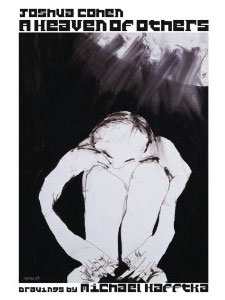
Something should also be said about the form of this book: most prominently, it features spidery, blotchy pen and ink drawings by Michael Hafftka, generally illustrative of what’s happening in the text at that point in time. I don’t love these; but they are of a piece with the tone of the text, and it’s a good match. It’s nice to see an illustrated book, though I don’t know that they add much to the text. I find myself a bit vexed by the book design (also by Hafftka): the body text is set in a slab serif, which complicates reading. Perhaps this was chosen because the darkness of the letterforms look like Hebrew (as is the case with the display type); to me, it gets in the way of the text and seems too showy. 

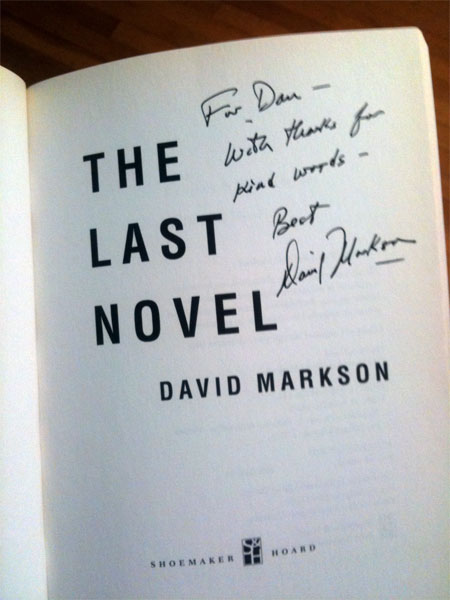
The death of David Markson makes me think of the apocryphal story that Samuel Beckett was a friend of the parents of André the Giant and would drive the young André to school. One wonders what stories Beckett would have entertained a child with; maybe something like this.
june 1–june 5

Books

Films

  • After the Thin Man, directed by W. S. Van Dyke
  • Splice, dir. Vincenzo Natali

Exhibits

  • “Yves Klein: With the Void, Full Power,” Hirshhorn Museum
  • “ColorForms,” Hirshhorn Museum
  • “Helios: Eadweard Muybridge in a Time of Change,” Corcoran Gallery
  • “American Falls: Phil Solomon,” Corcoran Gallery
  • “In the Tower: Mark Rothko,” National Gallery of Art

edmund white, “caracole”

Edmund White
Caracole
(Plume, 1986)


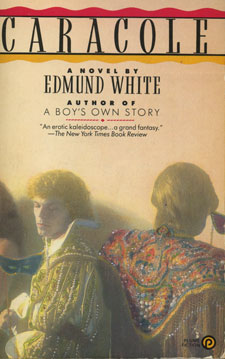
Edmund White’s narrative works might be divided into four categories: first, the obliquely fabulist early novels which are relatively forgotten (Forgetting Elena, Nocturnes for the King of Naples); second, the autobiographical fiction he’s best known for (A Boy’s Own Story on); third, the memoirs (My Lives, City Boy); and fourth, the historical fiction (Fannie: A Fiction, Hotel de Dream). There’s a rough chronological progression across these forms: autobiographical novels lead fairly naturally to memoirs. His biographies might be lumped in that third category; and it’s a small jump to go from writing biography to fictionalizing biography in his historical fiction. This isn’t a straight progression, of course: not everything fits into this rough schema. Caracole came out in 1985, after White had moved into autobiographical fiction; however, it hews much more closely to the mould of his first two novels. After reading White’s other works, however, one finds the autobiographical elements in this book can’t entirely be ignored. In City Boy, for example, White notes that his portrayal of Susan Sontag and her son in this book led to a break with them: reading it now, in the light of White’s subsequent autobiographical work, it’s hard to avoid this element of the book. A cosmopolitan uncle who rescues a nephew from an intractable home situation clearly has parallels in White’s own life in the 1970s; but most of the other characters in this book resist immediate identification.

This is not a roman à clef: this is the straightest of White’s books, and pseudoreality prevails, as it does in Proust’s The Captive and The Fugitive. At the same time, one understands, reading this book, why White would have shared an issue of the Review of Contemporary Fiction with Samuel R. Delany, as this isn’t a world away from the spirit of Delany’s Nevèrÿon fantasies. The setting is a city: White’s description of the book in City Boy suggests that it’s nineteenth-century Venice, but abundant indirection makes it clear that the city is not entirely a resurrected version of that city, though it is marine, does have carnivals, and many of its characters sport Italian names. Bits of Rome’s geography are recognizable, and there’s a distinction between a lazy South and an industrious North. The first chapter begins in a crumbling rural villa, a setting almost Southern gothic; mention of conquerers suggests empire, but not quite a recognizable one. Christianity doesn’t seem to exist, perhaps a nod to Carlo Levi’s “Christ stopped at Eboli”; those outside the city are described as living in tribes, and there are other kingdoms. Courtliness is emphasized inside the city; but the interactions of the characters might be those of New York in the 1970s. This is an imagined world: though one that, like all fiction, takes the outside world with it.

The first chapter depicts the novel’s young protagonist, Gabriel, in his decaying home in the countryside; he lives with his corpulent mother and feral younger siblings, visited occasionally by a distant father. In the woods, he finds a girl, Angelica; he marries her in her tribe’s ceremonies, but is discovered by his father, who, in cahoots with his mistress, confines him in a cage. Angelica summons his powerful uncle in the city to rescue him; Mateo, a senator, brings Gabriel to the city and teaches him the ways of the court. White’s defamiliarization of the world goes down to the level of language. Here, for example, Gabriel’s early playmates (“sons of the old rural gentry”) are described:

One of them had a clay pig, small enough to fit into his pocket; it whistled one dry, low note when blown on the snout. The other knew the names of stones but he was the hardest to understand. Someone’s youngest brother he called “the Least One.” If he doubted a story, he said, “I don’t confidence you.” Windows he called “lights” and their hiding place in an oak bole he spoke of as the “plunder room.” Where the creek fanned out into a hundred rivulets, this child said, “That’s where it turkey-tailed,” and if a grown-up showed him special attention he’d ask later, “Why did he much me?” Both of Gabriel’s companions spoke in doubled nouns (“biscuit-bread,” “ham-meat,” sulfur-match”). Nor did they grasp what Gabriel meant when he said once, “Have a nice weekend.” After a while it turned out their families worked every day and the notion of a weekend was beyond their means. (p. 7)

This linguistic slipperiness carries into the courtly world, where it is carefully cultivated and put to use:

When Mathilda asked Mateo to bring Gabriel to his very first reception at her house, Mateo assumed she was merely being polite out of consideration for him, Mateo. More than once she’d assured him she knew what it was like to be stuck with a child in their nearly childless world of artists and intellectuals; after all she (with Mateo’s distant if affectionate assistance) had raised a child, Daniel, who was now thirty and looked so nearly as though he were her brother that her maternity would have been suspect had not their celebrated, even infamous past together been so well documented. Nevertheless Mathilda was delighted when naïve or provincial people mistook Daniel for her brother or lover, and to increase the confusion she often referred to him coyly as “the darling.” This coyness was so unlike her that people expected to catch a sardonic smile and were shocked to see instead the sort of smile people wear when they speak of their pets. What few people knew was that an older child, a girl, had died when she was four. This loss had poisoned Mathilda’s joy in motherhood at the same time it had intensified her love for – no longer “my son” but “the darling.” (p. 93)

The civilization that White depicts is a mannerist one: this is a book less baroque than rococo. Cultivating relationships is important, but most important is to find a language in which that relationship might be depicted. In the first chapter, Gabriel’s relationship with Angelica jumps from animalic sex to a declaration to his mother that he intends to marry her (whatever that might mean to the two of them) to a marriage in her tribe’s rites, which he does not understand; then he is taken away from Angelica entirely and begins to desire her while building fantasies around an invented woman. On Mateo’s unrequited love for an actress:

Love is a progressive illness, one that starts as self-hallucination, an act of parody, and ends as a wholly real, involuntary malady that kills us or something vital in us. Mateo could never quite understand when or why he’d fallen so terminally in love with Edwige, but he suspected that whereas when could be answered, as least theoretically, why could not. Nevertheless he speculated at such length on his own condition he sometimes imagined that the function of love was to be a point de repère, an enigma so bright it distracted attentions from bigger fears. (p. 84)

The novel proceeds in a spiral fashion, jumping back on itself as it moves between its characters – or more precisely, between the relationships between its characters. Among its other meanings, caracole is “snail” in Spanish and Portuguese; in architecture in English, it may mean a spiral staircase. The most common English meaning is a half-turn on a horse; the OED qualifies this by noting that “Many writers have used the word without any clear notion of its meaning”.

aristocrats

“What Gabriel had to realize was that aristocrats, unlike intellectuals, had no desire to improve or prove themselves. In the world of the salons there was no future, only the present. One looked at a painting, one consumed a lime ice, one played a round of cards, one talked, walked, shopped, rode a horse, cooked up a practical joke. The absence of time was paradisal, if paradise is conceded to be splendid but dull. No one struggled to memorize the names of foreign painters, to question the meaning of money or society, to talk amusingly, to stand at a viewing distance from the moment.”

(Edmund White, Caracole, p. 259.)

may 26–may 31

Books

Films

  • The Human Voice, directed by Ted Kotcheff
  • À propos de Nice, dir. Jean Vigo
  • Zéro de conduite, dir. Jean Vigo
  • Le Train en marche, dir. Chris Marker
  • If . . . ., dir. Lindsay Anderson
  • Cremaster 1, dir. Matthew Barney
  • Cremaster 2, dir. Matthew Barney
  • Cremaster 3, dir. Matthew Barney

Exhibits

  • “Whitney Biennial 2010,” Whitney Museum

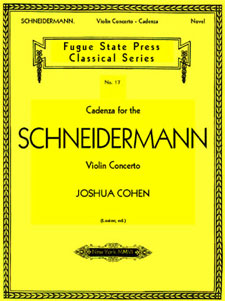
joshua cohen, “cadenza for the schneidermann violin concerto”

cadenza for the schneidermann violin concertoJoshua Cohen
Cadenza for the Schneidermann Violin Concerto
(Fugue State Press, 2007) 


This book is a rant, one that goes on for 380 pages. It’s impossible, when discussing the rant as literature now, to escape the influence of Thomas Bernhard, who looms large in this book. The narrator of a much smaller book, William Gaddis’s Agapē Agape midrant on Bernhard’s Concrete addresses the problem of Bernhard:

Where the tissues, just get cold water on it stop the bleeding, you see? Scrape my wrist against this drawer corner tears the skin open blood all over the place it doesn’t hurt no, skin’s like parchment that’s the prednisone, turns the skin into dry old parchment tear it open with a feather that’s the prednisone, reach for a book reach for anything tear myself to pieces reaching for this book listen, you’ll see what I mean, opening page you’ll see what I mean, “From March to December” he says, “while I was having to take large quantities of prednisolone,” same thing as prednisone, “I assembled every possible book and article written by” you see what I mean? “and visited every possible and impossible library” this whole pile of books and papers here? “preparing myself with the most passionate seriousness for the task, which I had been dreading throughout the preceding winter, of writing” where am I here, yes, “a major work of impeccable scholarship. It had been my intention to devote the most careful study to all these books and articles and only then, having studied them with all the thoroughness the subject deserved, to begin writing my work, which I believed would leave far behind it and far beneath it everything else, both published and unpublished” you see what this is all about? “I had been planning it for ten years and had repeatedly failed to bring it to fruition,” but of course you don’t no, no that’s the whole point of it! It’s my opening page, he’s plagiarized my work right here in front of me before I’ve ever written it! (11–12)

The narrator of Concrete is of course writing on Mendelsohn; the narrator of Joshua Cohen’s book, a violin player named Laster, is speaking about a fictional composer named Schneidermann. (Prednisone, for what it’s worth, appears on p. 100 of Schneidermann.) One thinks past Agapē Agape to J R’s Edward Bast, another New York composer whose musical dreams keep getting shifted downwards by the world. Thematically, the Bernhard novel that leaps most quickly to mind is The Loser, a book about a talented musician friend misunderstood by the world, though stylistically this book is closer to Concrete. Laster, a violin player, has just played Schneidermann’s sole work, the titular violin concerto at Carnegie Hall; in lieu of the cadenza, he holds forth from the stage all night, a textual, rather than a musical, cadenza.

How does one escape the shadow of Bernhard? This doesn’t look like a Bernhard book: rather than a single long paragraph there are frequent breaks, often mid-sentence, which are given a triple indent. (A ragged right margin also makes this look slightly less like standard prose.) The indents seem to function as pauses for breath: most of these breaks appear mid-sentence, but the sentences run on and on, generally only reaching an end when they detour into rhetorical questions. Occasionally the indents move further in, an interesting choice for what is such an oral book: toward the end, when section breaks become more frequent, the margins shift more often, seeming less like prose and more like poetry. Though Bernhard’s books are deeply concerned with voice, they are not oral: they are written documents through and through, a writer attempting to explain something. Here, a speaker attempts to explain things; though there’s an exhortation to the audience at the beginning, we never hear from the audience, and one wonders, finally, if they exist at all. Carnegie Hall is, of course, available for rental: this might simply by a monomaniac’s indulgence.

One can’t help wondering, in a book like this, about the audience. The book takes as its subject the artist unjustly ignored; as a novel, it’s positioning itself similarly, in the tradition not only of Bernhard but also of Stanley Elkin, whose voices I can hear in this. Allusions to Henry Roth and perhaps J R also appear. I think also of Evan Dara’s two books, the first-person narration of which has a similar feel, though in those the perspective shifts seemlessly between characters; there’s no escape from Laster’s vice-like grip in this book. And the audience comes into play as well because the question of the survival of High Art – in the form of the classical tradition in music – is an immense part of the book. There’s a decided similarity in tone, if not in form, to the later David Markson novels, which stack up trivia about artists, ostensibly against oblivion. Schneidermann implicitly parallels the classical tradition to the survival of the Jews: it’s hard to know what to feel about that. The reader of this book is Cohen’s audience as much as the possibly non-existent audience in Carnegie Hall is Laster’s; one struggles to find a place to listen appreciatively while suspecting a certain amount of contempt. Maybe it’s not contempt: maybe it’s simply that the audience is by and large ignored. I wonder about that. I wonder as well about the narrative voice, which is, among other things, unlikeable: in an age when any other book is nearly instantly accessible, I wonder about the readers who have the temerity to persevere with such a voice. The audience is being challenged; Laster’s audience in the book don’t see fit to take up his challenge. 

Writing about classical music in New York in 2007 is necessarily different from writing about classical music in Vienna when Bernhard was alive. I wonder, as well, about a young writer taking up an old man’s voice: while it works surprisingly well, it’s hard for the reader to get around the knowledge that this is very much an imagined past. (This might be the source of the repeated references to Thomas Taylor’s Hymns of Orpheus, which float behind this book.) 

A parallel might be drawn between Schneidermann and James McCourt’s under-appreciated Now Voyagers, though that book was created under the shadow of Joyce rather than Bernhard and took as its subjects gays and the opera world in New York in the wake of AIDS rather than Jews and the symphonic after the Holocaust. The two books are constructed entirely differently: and McCourt’s is the work of an old man rather than a young one. But both attempt to reconstruct a world against oblivion; and neither of these books seems to have found its audience yet. 

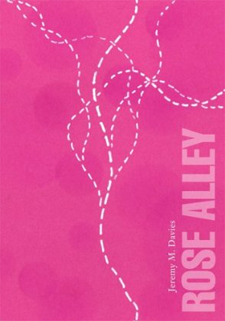
jeremy m. davies, “rose alley”

Jeremy M. Davies 
Rose Alley
(Counterpath, 2009)


It’s a bit surprising to me how poorly Perec’s novels are read in this country. Everyone knows of A Void, at least by reputation, though few seem to have actually read it, or to have any idea of the reasons that Perec might have for using a lipogram in that book. There was a smattering of interest in the new edition of Life a User’s Manual, but one didn’t really sense that a lot of people were picking that up with the enthusiasm it deserves; it’s a book that people seem afraid of, which is unjust. One almost never hears anything about W, maybe because it was out of print in English for a while, though it’s an astonishingly powerful book. The book of Perec’s that one sees most often, around New York at least, is Species of Spaces, maybe because it was taken up by architects. But it’s hard to point to much recent American fiction (with the obvious exclusion of Harry Mathews) that bears the influence of Perec, which is odd: the short shelf of his work would seem to be a cookbook full of recipes for potential books.

This, however, is an extremely Perec-y novel, down to its index of locations, people, and works of art; I will admit that I am a sucker for a novel with an index. (Stanley Crawford has also played with that form, in Some Instructions, and of course there’s The Sinking of the Odradek Stadium.) The novel is based around a failed film shot in Paris in 1969; the film, also to be titled Rose Alley, after the spot in London where John Dryden was attacked in 1679 by thugs who may have been hired by the libertine John Wilmot, the Earl of Rochester, who was upset with Dryden’s verse. 

A description of an earlier film by the director and screenwriter of Rose Alley (the film) seems like it could easily describe how Rose Alley (the book) works:

This was a collection of miniatures, thirteen still lifes in thirteen continuous shots, ninety seconds in duration each. An elaborate system of eleven predetermined categories, subcategories, and corresponding lists of objects matching each classification – either likely, unlikely, invented, or inconceivable – was coauthored by Krause and Wexler. (p. 8)

The book has thirteen chapters, all but one based around a character associated with the film; while each chapter takes off from a character, there is no dialogue, and no sense that any action is happening in real time, and stories tend to go backwards (and occasionally forwards) in time. Each chapter is structured around a character, but not in the voice of the character. The reader has the feeling that there’s some logic structuring these episodes, but what, exactly, that logic might be is never entirely clear. One thinks, of course, of Raymond Roussel, who came up with this method of structuring a book (I presume it’s not an accident that “Rose Alley” sounds like “Roussel-y”; other echoes of Roussel can be found through the text) and his followers: there are echoes of the organization of Life a User’s Manual and especially Mathews’s Cigarettes. (Mathews blurbed the book; he also appears obliquely inside the book, when the screenwriter has a poem rejected by Locus Solus, the journal he edited with Ashbery, Koch, and Schuyler. 

Chapter 12 is the work’s clinamen: titled “Poet Squab”, it tells the story of Dryden’s quarrel with Rochester through what seems to be collaged text. One function of the book’s index is here revealed: some sources can be gleaned from entries such as “Burnet, Gilbert, 151 (qtd.)“: text from Burnet’s Life of Rochester appears on that page, though Burnet’s name does not. The index also allows the reader to trace narratives through the book: Chapter 6 tells the story of Wilhelmina Princep, a name which hasn’t appeared in the book to that point. Turning to her entry in the index, however, the reader discovers that she’s made eight different appearances in the text under different names. This is a carefully constructed book, and one that demands re-reading.

An index begs the question of who’s constructing it: the shadowy narrator, one presumes, is the only one who might know all of Wilhelmina’s guises, and all of his textual borrowings. The first-person narrator appears in the first sentence of the book and disappears in the last; one might assume that he’s a film historian, tracing out what happened to Rose Alley. Curiously, in the first sentence, he declares that he’s never been to Paris. But we quickly forget the idea of the narrator as a real figure when we move into the minds of the characters themselves in his description of them; by the next paragraph, he’s deep inside of Evelyn Nevers’s head, describing how a saltcellar stands as an analogue for her lover Prosper Sforza in her mind. (One might find Duchamp in that saltcellar; maybe that’s a reach.) This narrator might be an overly presumptuous historian, trying to tie things together; there’s also the hint that the narrator might be the subject of the last chapter, the film’s director Selwyn Wexler. It’s Wexler, we’re told early on, who’s most interested in Dryden and Rochester; in the penultimate chapter, we’re finally given his project for the film:

Wexler’s idea was that the cast and crew would find out as much as they could about their characters and the background of the film. Read Rochester and Dryden. Writer their own dialogue. Even the ones who couldn’t speak English. Myrna would be unnecessary. Everyone would be unnecessary. There wouldn’t be any need for props or sets. Which they didn’t really have anyway. The only necessary thing would be an organizing intelligence. Wexler’s. And the camera. The characters would relate directly to this eye. They would make their own context. (p. 144)

The narrator, perhaps, might be the camera’s eye; the first sentence (and another sentence towards the end of the book, where the narrator says he’s only been to London once) might well be misdirection. In the final chapter, the narrator describes a succession of versions of Rose Alley, all unfinished; the twelfth is the film diaries of Wexler. The thirteenth, we are led to believe, is this book, which invites careful re-reading.