against the old establishment

“As this half of the countercultural ideal originated during the 1950s, it is appropriate that the evils of conformity are most conveniently summarized with images of 1950s suburban correctness. You know, that land of church-goers, tailfins, red-scares, smiling white people, lines of commuters, sedate music, sexual repression. An America of uptight patriarchs, friendly cops, buttoned-down collars, B-47s, and deference to authority – the America of such backward-looking creatures as Jerry Falwell. Constantly appearing as a symbol of arch-evil in advertising and movies, it is an image we find easy to evoke. Picking up at random a recent Utne Reader, for example, one finds an article which seeks to question the alternativeness of coffee by reminding the reader of its popularity during that cursed decade: ‘According to history – or sitcome reruns –’ the author writes, the ‘the ’50s were when Dad tanked up first thing in the morning with a pot of java, which set him on his jaunty way to a job that siphoned away his lifeblood in exchange for lifelong employment, a two-car garage, and Mom’s charge card.’ The correct response: What a nightmare! I’ll be sure to get my coffee at a hip place like Starbuck’s.”

(Tom Frank, “Dark Age,” pp. 13–14 in The Baffler no. 6, 1995.)

baffler #6: dark age

The Baffler #6: Dark Age
ed. Tom Frank


This is the last Baffler I have: I still haven’t seen 1, 2, 3, or 5. Issue 6 is a big one: at 192 pages, it’s thicker than any other issue until the most recent one. The content of this issue seems relatively familiar: I suspect that a lot of this was excerpted or reworked into Frank’s other work. The fourth issue seemed to be a Baffler still in utero, with a nicely amateurish edge; here, the Baffler as everyone remembers emerges, with an enormous “DARK AGE” emblazoned on the cover. Maybe the transition happened in issue 5; there’s a copy of that available on Amazon used for $19.95, which seems a bit hopeful. (Not the most hopeful, however: somebody’s trying to sell a copy of #9 for $89.41, more a tribute to the ridiculousness of the Amazon marketplace for used books than any real rarity or value.)

This is still much more zine than journal: a handful of the ads from the indie labels seem to be entirely hand-written. A handful of the ads have email addresses, some of which end in .edu: it was a different era. But here we see the establishment of the equivalence of post-punk indie rock (of the sort being advertised) and the left, maybe the attitude is remembered most about The Baffler. The Tom Frank essay that bookends the issue examines how the forces of capitalism and what opposes it seem to have set in stone since the 1960s, at least for cultural studies as it existed then:

The two come together in perfect synchronization in a figure like Camille Paglia whose annoying ravings are grounded in the absolutely non-controversial idea of the golden Sixties. According to Paglia, American business is still exactly what it was believed to have been in that beloved decade, that is, ‘puritanical and desensualized.’ Its great opponents are, of course, liberated figures like ‘the beatniks’, Bob Dylan, and the Beatles (needless to say, while Paglia proclaims herself a great fan of rock music, bands like Shellac, Slant 6, and the Subhumans never appear as recipients of her praise). Culture is, quite simply, a binary battle between the repressive Apollonian order of capitalism and the Dionysian impulses of the counterculture. Paglia thus validates the central official myth of the ‘Information Age,’ for rebellion makes no sense without repression; we must remain forever convinced of capitalism’s fundamental hostility to pleasure in order to consume capitalism’s rebel products as avidly as we do. It comes as little surprise when, after criticizing the ‘Apollonian capitalist machine’ in her new book, Paglia applauds American mass culture (in that same random issue of Utne Reader), the pre-eminent product of that ‘capitalist machine,’ as a ‘third great eruption’ of a Dionysian ‘paganism.’ For her, as for most other designated dissidents, there is no contradiction between replaying the standard critique of capitalist conformity and repressiveness and then endorsing its rebel products – for Paglia the car culture and Madonna – as the obvious solution: the Culture Trust offers both Establishment and Resistance in one convenient package. (pp. 15–16)

Paglia was as specious then as now; and her arguments deserve ridicule. Certainly I’m sympathetic to this; I grew up uninterested in the Beatles and Bob Dylan in no small part because of their omnipresence. Young men with guitars and drums can’t really be said to be revolutionary after being dominant for the past half-century. It’s not obvious, however, why indie rock – a slightly different variation on guys with guitars and drums – should be presented as a valid alternative here: why is the post-punk tradition any more ideologically pure than Madonna? Because it was existing outside the corporate tradition, as do-it-yourself culture? Indie rock would be assimilated just as surely as Madonna was; looked at from this distance, it seems more of a signifier of white upper-middle-class culture than anything else. I can’t imagine that anyone became a progressive through listening to Shellac, for all their charms. (See, for instance, a recent interview with Grant Hart of Hüsker Dü where he discusses the non-proletarian origins of their band.) Later Henry Rollins comes in for sustained criticism, in no small part because of how indistinguishable his rhetoric is from business language: a classic sell-out, Rollins is readily merchandisable as a symbol of revolution. One wonders, however, what was really being sold out.

(In the same essay, it’s worth pointing out, my occasional boss turns up, not mentioned by name: the new businessman, Frank writes, “is led by vanguard capitalists like the head of the CD-ROM pioneer Voyager, a former activist whose admiration of the Shining Path, as the New York Times notes, seems somehow appropriate amidst the current ‘information revolution.’ ” (p. 177.) Bob’s business sense and his politics intertwine in a complicated way; he never got rich, though he certainly could have if he’d occasionally set aside his politics. Simply paying lip service to the Shining Path would probably have been more lucrative.) 

Elsewhere in the issue, there’s an extremely good piece by Jesse Eisenger examining how business press releases work and are used by the business press. This isn’t flashy writing, but it does examine the history of the business press release (required by law after the 1929 crash) and their current usage. His description of PRNewswire is a great deal more informative than the Wikipedia page on the company; one wonders why more attention isn’t paid to this sort of infrastructure. Later he does a critical reading of the sort of language that’s used in the press release: today, we see this done occasionally in specific cases, but I don’t know that I’ve ever seen a critical eye turned on the systematics of the press release, especially in an extended fashion. This is why I miss the Baffler: there isn’t a great deal of critical literature on the business world that isn’t all-out boosterism. Also fantastic is a piece on Bill Boisvert on business literature: 

Whether they steal fire from the Harvard Business School or find enlightenment through a long pilgrimage in Oriental lands, all popular business books share certain idiosyncrasies. They euphemise their tautologies as “common sense” and their lists of slogans as “practical guides”, as if management theories are both self-evidently true and arcane enough to require a hands-on primer and costly seminars. Like nursery rhymes, they are fascinated by numerology and alliteration, freeze-drying their “findings” into nuggets of doggerel like “the Three C’s: Customers, Competition and Change” or Tom Peters’ typically long-winded “Seven S© Framework: Structure, Systems, Style, Staff, Skills, Strategy and Shared Values.” And to make reading fun for executives, they eschew logical exposition and an organized search for evidence in favor of brief, happy anecdotes about take-charge department heads, couched always in the cajoling rhetoric of cereal-box propaganda. (p. 70)

Always I want to see more criticism of the language of business: Doug Henwood’s Left Business Observer soldiers on, but this seems like an obvious subject for a popular blog. Maybe it’s too depressing to be carried out at this sort of length.

Keith White examines Wired, still brand-new: mostly this is what you’d expect, but it’s interesting to note that in 1995, it was still taken for granted that the Internet was a right-wing creation. At a certain point, the popular idea took hold that the internet was essentially a creation of the left-wing (Stewart Brand, etc.) rather than a military/corporate funded endeavor; somebody should trace this history out. It’s interesting as well that Wired was trumpeting video games as the most culturally significant artistic media even back then, claiming that the $6 million the industry was making then was the “single largest component of the infotainment industry,” whatever that means. Also odd to see is Jennifer Gonnerman’s “The Selling of Katie Roife,” a careful examination of the reactionary politics of Roife and how The New York Times tried to make her into a star in the early 1990s. One sees this sort of piece in media gossip circles – tracing out who knows who, and how a front-page-story gets made – but rarely in such depth. It’s also surprising how quickly this sort of thing is forgotten: Roife is still shilling her ill-sourced idiocy on the front of the Book Review. It’s similar to the examination of the creation of Donna Tartt in issue 4; but this one has more political bite. 

Ultimately, the Tom Frank essay is what makes this issue. I like the anger, and I can understand where it’s coming from, but I’m not sure exactly where he’s going with it. (Admittedly, at this point, Frank would have been right out of grad school, and it’s maybe too much to ask for answers from someone who’s just been set free of the academy.) The market, the last sentence of the issue declares, is “putting itself beyond our power of imagining because it has become our imagination, it has become our power to envision, and describe, and theorize, and resist” (p. 192). There’s a certain similarity to the injunction of Sven Birkerts at the end of The Gutenberg Elegies to resist: but how? In both cases, one senses that they’re right, but it’s hard to know what to do next.

aeschylus, “the oresteia”

Aeschylus
The Oresteia
(translated by Robert Fagles) 
(Penguin, 1975)


One of the problems of being an inveterate snob is finding a suitable book at airport bookstores. The severity of this problem varies from airport to airport: there’s a shop in Chicago-Midway where one can find Coetzee and a good selection of the Dalkey Archive, while I’ve seen copies of Finnegans Wake languishing in the “literature” section at one shop in Minneapolis/St. Paul. (The bleak situation one generally encounters is very much an American phenomenon: Canadian airport bookstores have very different contents. I once bought the latest Hardt & Negri in the Victoria airport.) But one always wants something new in an airport. I have a handful of books packed in my bag, to say nothing of the stack of unread Times Literary Supplements, but the second quarter of A Dance to the Music of Time isn’t engrossing me, and the idea of starting another Henry Green in the midst of so much stimulation seems daunting. Thus, a trip to the Hudson News in the Delta terminal of JFK yielded this, from the “classics” section, where it fell among that strange selection of books and authors that comprise the American high school canon. One notes that Edith Wharton is being pushed heavily right now alongside the Jane-Austen-with-monsters books.

What one particularly wants in an airport – besides the possibility of catching up on something one should by rights have read long ago so one can feel virtuous – is something with a long introduction, so it can be read while distracted: the virtue of a long introduction is that it’s likely to be digressive, letting the mind of the reader wander. Agamemnon doesn’t arrive until page 99 of this edition. This is exactly what I want in an airport book. One quickly realizes, however, that this is not actually an ideal airport book. I don’t imagine that this is the scholarly edition of the Oresteia that anyone really uses in English; but it’s not exactly an edition meant for reading. The commentary overwhelms the plays, when they finally arrive: it’s nice that there’s so much of it – there’s a note every ten lines or so, and it’s possible that there are as many words in the endnotes as in the actual text – but this isn’t very helpful for someone coming to the plays themselves for the first time. Maybe it’s too much to expect the classics to read themselves. 

This is a book, then, that I read in the following manner: first, I worked my way through the introduction, then I read each of the three plays twice, first stopping to read the notes as they appeared (callouts to the endnotes don’t exist, so one needs to keep flipping back and forth to see if you’ve missed something); then a second reading of the play straight through. Finally, back through the introduction again. This isn’t the best way of reading a book, but the slowness is necessary. Fagles’s version of these plays doesn’t provide much in the way of stage directions, or clues as to what backstory might be in play. In addition, his syntax in English appears to follow the Greek (which I don’t know), so one finds passages like this, in The Libation Bearers, from a speech given by Orestes, who has just introduced himself to his mother as a stranger:

. . . I met a perfect stranger, out of the blue,
who asks about my way and tells me his.
                                                                    Strophios,
‘Well, my friend,’ he says, ‘out for Argos
in any case? Remember to tell the parents
he is dead, Orestes . . .
                                      promise me please
(it’s only right), it will not slip your mind. (660–666)

The quoted speech goes on for five more lines. It’s difficult for the reader who doesn’t entirely know what’s going on to scan exactly what’s going on here: on first read, “Remember to tell the parents he is dead, Orestes” sounds much more like a statement being addressed to Orestes rather than being about Orestes. I imagine this works better in an inflected language; as English prose it doesn’t work very well, though there’s a certain poetic sense to it. 

It’s hard to imagine staging this translation as a drama on a stage: too many of the speeches are similarly inscrutable. This isn’t a dramatic translation: the virtue of this translation is its poetry, which does occasionally sing when it can be uncoupled from the history that entombs the works themselves. In Agamemnon, Cassandra stands out to the casual reader: she is is both a sympathetic character (abducted from her home, gifted with clairvoyance that goes unbelieved) and is given some of the best imagery. Here she sees Clytemnaestra murdering Agamemnon:

                                        Look out! look out!—
Ai, drag the great bull from the mate!—
     a thrash of robes, she traps him—
writhing—
          black horn glints, twists—
                                                  she gores him through!
          And now he buckles, look, the bath swirls read—
There’s stealth and murder in the cauldron, do you hear? (1127–1131)

There’s Yeats here, obviously: it’s hard for me whether that might be Fagles’s interpolation of “Leda and the Swan” or whether Yeats was taking his imagery from an earlier version of this play. Fagles’s introduction, with epigraphs from Hart Crane and D. H. Lawrence, makes me suspect the former. 

There’s a foreignness to these plays that’s hard to get around. It’s hard to understand, for example, why Orestes and Electra, in The Libation Bearers should be dead set against Clytaemnestra, their mother, for having killed their father, Agamemnon; in the first play, Agamemnon himself killed their sister, Iphigenia. Both parents consorted with others; but why killing a husband should be a more serious crime than killing a child is unclear in our distance. There seems to be an internal logic to their behavior, but it’s hard to suss out exactly what that is, even with the aid of the notes: when the gods appear in The Eumenides, they seem to be as capricious in their arguments as the humans. Everything is pitched up to a phenomenal degree: everyone seems to be insane. It reminds me, working through things in the wrong order, of Andrzej Żuławski’s On the Silver Globe, where the space colonists similarly fall into paroxysms of madness, shouting about faith and duty to the family, and end up killing each other. In his introduction, Fagles describes this trilogy as being a “grand parable of progress” (the words are originally Richard Lattimore’s), describing the formation of the state from the age of heroes; one might see that, but there’s still something strange and distant here. It’s hard for me to get past that; probably that’s my own failing.

claude lévi-strauss, “tristes tropiques”

Claude Lévi-Strauss
Tristes Tropiques
(trans. Doreen Weightman & John Weightman)
(Atheneum, 1974)


There are books that make one wonder what would have happened if one had read it earlier. What would I have made of this book in high school? There was no one to give it to me then, so this is a rhetorical question. Read then, it might have made me want to run off to be an anthropologist; but I wonder how receptive to the book, or how ready for it, I would have been then. I hadn’t traveled then, which helps to appreciate this book; nor had I read much Surrealist prose, to which this has affinities. Being unversed in anthropology, I can’t really speak to this book’s success or failure as anthropology; but one can’t help but admire this book as part of a continuum that goes back to Nerval’s Aurélia, narratives that try to elude both the reader and the writer.

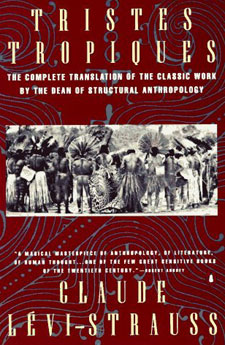
Start at the beginning. “I hate travelling and explorers” is the famous first line of Lévi-Strauss’s book, though the book the reader continues would appear to be as much about travel and exploration as it is anthropology. This is a book that seems to be running away from itself: not so much in denial, for L&eavute;vi-Strauss realizes that one can never run away from oneself, but more in its realization that the writer can never quite escape the text. Similarly, the photograph on the cover of this edition demands scrutiny: cropped, it is an image of a group of natives who seem to have turned their backs to the photographer and us. The back cover only identifies the photographer, René Silz; turning to the book’s “plates,” it turns out to be an image of a Bororo funeral ceremony. The final section of the book, “The Return,” sees Lévi-Strauss move from Brazil (where he observed the last days of the western Bororo people) to Ancient Rome to Martinique to Pakistan to what would become Bangladesh, with digressions to Paris and New York, seemingly in an attempt to throw the reader off any travel narrative that might emerge. Time is uncertain: a reader with a firm grasp of Lévi-Strauss’s biography could pin down exactly when everything in this book happens, but that seems immaterial. Tristes Tropiques is an investigation of loss, both cultural and personal; and Lévi-Strauss realizes that as a Westerner and as an observer he can’t help but be complicit in that loss.

Lévi-Strauss is always acutely aware of his position as an observer, as someone who’s never quite as outside as he wishes he might be. Visiting a newly independent India he notes, for example, how being surrounded with servants makes the served anxious: it’s exactly the same response I had in Delhi a few years ago, which at the time I chalked up to a Midwestern upbringing. Lévi-Strauss points out that this is natural consequence of the relationship. Or again when he looks at the the ever-present problem of dealing with a huge number of people:

India tried to solve the population problem some three thousand years ago by endeavouring, by means of the caste system, to change quantity into quality, that is, to differentiate between human groups so as to enable them to live side by side. . . . It is tragic for mankind that this great experiment failed; I mean that, in the course of history, the various castes did not succeed in reaching a state in which they could remain equal because they were different – equal in the sense that there would have been no common measure between them – and that a harmful element of homogeneity was introduced which made comparison possible, and consequently led to the creation of a hierarchy. Men can coexist on condition that they recognize each other as being all equally, though differently human, but they can also coexist by denying each other a comparable degree of humanity, and thus establishing a system of subordination. (p. 149)

This is an old book now – it’s fifty-five years old – and the world that Lévi-Strauss was describing was vanishing even then, but sections, like this enquiry into the problem of equality, still feel fresh. Parts resonate more strongly now: in a section on the role of the chief in polygamous society, he wanders into the idea of national health care, which he sees as “a return to the fundamental nature of social and political organization”. And here he describes the historical problem of scarcity, which we seem to be confronting now from the opposite direction:

In the old days, people used to risk their lives in India or in the Americas in order to bring back products which now seem to us to have been of comically little worth, such as brasil or brazilwood (from which the name Brazil was derived) – a red dye – and also pepper which had such a vogue in the time of Henry IV of France that courtiers used to carry the seeds in sweetmeat boxes and eat them like sweets. The visual or olfactory surprises they provided, since they were cheerfully warm to the eye or exquisitely hot on the tongue, added a new range of sense experience to a civilization which had never suspected its own insipidity. We might say, then, that, through a twofold reversal, from these same lands our modern Marco Polos now bring back the moral spices of which our society feels an increasing need as it is conscious of sinking futher into boredom, but that this time they take the form of photographs, books and travellers’ tales. (p.38)

I like the turn that Lévi-Strauss executes in this paragraph: moving from the colonies back to the colonizers, and their own self-recognition, which they almost certainly wouldn’t have stated in the same words. And then to bring it further: to see the same impulse in ourselves, the readers of travel books, including this travel book. We are not exempt: but how do we value scarcity now, when we are deluged with “photographs, books and travellers’ tales”? 

Writing itself comes into question: in an extended section, he wonders what writing historically does to people. This isn’t the restatement of Socrates’ position in the Phaedrus, as one might expect. Rather:

The only phenomenon with which writing has always been concomitant is the creation of cities and empires, that is the integration of large numbers of individuals into a political system, and their grading into castes or classes. Such, as any rate, is the typical pattern of development to be observed from Egypt to China, at the time when writing first emerged: it seems to have favoured the exploitation of human beings rather than their enlightenment. This exploitation, which made it possible to assemble thousands of workers and force them to carry out exhausting tasks, is a much more likely explanation of the birth of architecture than the direct link referred to above. My hypothesis, if correct, would oblige us to recognize the fact that the primary function of written communication is to facilitate slavery. The use of writing for disinterested purposes, and as a source of intellectual and aesthetic pleasure, is a secondary result, and more often than not it may even be turned into a means of strengthening, justifying or concealing the other. (p. 299)

This is an astonishing argument, and one that I haven’t seen resurrected in all the present talk about what’s happening to reading and writing in their present explosions. It’s an argument that could be cogently made today: I’d rather see someone arguing from this inflammatory position than from the tired old position that all reading is good reading. Perhaps it’s only an argument that can be buried in a book like this.

Tristes Tropiques is a valedictory book: Lévi-Strauss saw the world disappearing around him. It’s odd to read this book, originally published in 1955, and to realize that Lévi-Strauss would live longer after having written it than he would before: one senses that he never expected that. 

the problem of health care

“But, in the case of marriage, there is something more. By conceding the privilege of polygamy to the chief, the group exchanges the individual elements of security guaranteed by the rule of monogamy for collective security, which they expect to be ensured by the leader. Each man receives his wife from another man, but the chief receives several wives from the group. In return, he provides a guarantee against want and danger, not for the individuals whose sisters or daughters he marries, nor even for those men who are deprived of women as a consequence of his polygamy, but for the group considered as a whole, since it is the group as a whole which has suspended the common law for his benefit. Such considerations might be of some interest for a theoretical study of polygamy; but their chief importance is as a reminded that the conception of the state as a system of guarantees, which has been revived in recent years by discussions about systems of national insurance (such as the Beveridge Plan and other proposals), is not a purely modern development. It is a return to the fundamental nature of social and political organization.”

(Claude Lévi-Strauss, Tristes Tropiques, trans. Doreen Weightman & John Weightman, p. 315.)

the problem with servants

“Every European in India finds himself surrounded, whether he likes it or not, by a fair number of general manservants, called bearers. I cannot say whether their eagerness to serve is to be explained by the caste system, the tradition of social inequality or the demand for service on the part of the colonizers. However, their obsequiousness very quickly has the effect of making the atmosphere intolerable. If necessary, they would lie down on the ground to let you walk over them, and they suggest a bath ten times a day – if you blow your nose, eat fruit or dirty your fingers. Each time, they are there at once, begging for orders. There is something sexual in their anguished submission. And if your behaviour does not correspond to their expectations, if you do not behave on all occasions like their former British masters, their universe collapses: What, no pudding? A bath after dinner and not before? The world must be coming to an end&nbsp.&nbsp.&nbsp. Dismay is written all over their faces. I would have quickly to countermand my original instructions, abandon my usual habits and forgo rare opportunities. I would eat a pear as hard as a stone or swallow slimy custard, since to ask for a pineapple would have caused the moral collapse of a fellow human being.”

(Claude Lévi-Strauss, Tristes Tropiques, trans. Doreen Weightman & John Weightman, p. 138.)

gérard de nerval, “aurélia & other writings”

Gérard de Nerval
Aurélia & Other Writings
(trans. Geoffrey Wagner, Marc Lowenthal & Robert Duncan) 
(Exact Change, 2004)


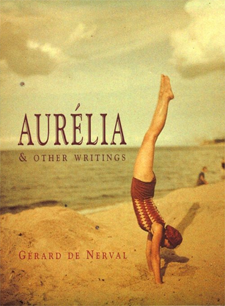
I first read Nerval about ten years ago in the Richard Sieburth edition from Penguin; I was on my way to reading Proust, and “Sylvie” is a natural stop along that way. I like the Sieburth Nerval; but one wonders what other Nervals might sound like. The Exact Change book is one that I’m constantly picking up in bookstores – one always hopes that by mistake one might discover something new in the Nerval section – but despite its splendid cover and my general love of Exact Change, I’ve always put it back in favor of something else: too many books to read. A few years ago I did find the Kendall Lapin translation of “Aurélia” and “Sylvie”; I didn’t like Lapin’s versions of these as much as I remembered liking Sieburth’s. But finally I actually bought the Exact Change edition. 

The Nerval that emerges here isn’t quite the same as Sieburth’s Nerval, even though there’s a fair amount of overlap in what the two books include. Both include “Aurélia,” “Sylvie,” “Octavie,” “Pandora,” and versions of “The Chimeras”. The Exact Change edition adds “Isis” and “Walks & Memories”. Eight pieces in the Sieburth edition aren’t in the Exact Change. There’s a fair amount of Nerval that doesn’t exist in English: a Selected Writings translated by Wagner adds “Emilie” to “Aueélia” and “Sylvia,” and a couple of smaller books have appeared over the years, but the Penguin edition remains the most comprehensive collection of his work in English. That book roughly follows the course of his life, with a little of everything – making me wish for something more comprehensive – concluding with “Aurélia” and a coda of the poetry, presented in French with an English crib. The Exact Change edition starts with “Aurélia” – Nerval’s memoir of his madness, ostensibly his last piece of writing – and then proceeds through the stories and “The Chimeras” (here in facing-page unrhymed translation by Robert Duncan) before finishing with another autobiographical piece from near the end of his life, “Walks & Memories”. The narrative that emerges is an autobiographical one: the names that Nerval uses for the overlapping loves in his life – Aurélia, Sylvie, Adrienne – bounce across pieces that are explicitly fictional and those that are not. Notes suggest how the fictional pieces were based on his life and how the non-fictional play with the verifiable truth. 

This Nerval is the Nerval loved by the Surrealists – it feels particularly like a precursor of Michel Leiris’s Aurora. There’s an obvious power in narratives of madness; but somehow I don’t like this Nerval as much as I remember liking the Sieburth Nerval. Maybe it’s that madness no longer seems as romantic as it once did: Aurélia no longer speaks to me as much as it once did. It’s as much, though, that this feels like a conflation of the authorial persona with the person of the author: too much a history of the different facets of one man’s work, unified by madness. It’s useful, perhaps, to know that Aurélia was Jenny Colon, minor star of the stage, but I don’t know what this really tells us about Nerval’s work, save that he was obsessed. From Sieburth’s introduction to his collection:

Catering to a readership increasingly eager to enter into the intimacy of its favorite writers – as Coleridge grumbled, literature had now entered into ‘the age of personality’ – Nerval discovered there was no deeper resource of fiction, no more powerful strategy of illusion than the autobiographical ‘I’. If he therefore adopted the first person in virtually all of his texts, it was paradoxically the better to guarantee his invisibility. Late in life, having come across a lithograph portrait of himself in a recently published biography, he inscribed the frontispiece with the enigmatic phrase ‘Je suis l’autre’ (‘I am the other’). It is perhaps a caveat addressed to any potential reader of his work: beware of mistaking me for myself. (p. ix)

To make Nerval autobiographical seems a misstep: especially as these pieces seem to be profoundly self-contained. When not presented as one stop on a man’s trip to the grave, “Sylvie” still seems perfect to me, prefiguring the wistful pastoral of Le Grand Meaulnes. Proust was glad that Sainte-Beuve hated it, and wished that the dream-logic of the story could remain his own private secret. Proust recognizes himself in the story:

. . . what we have here is one of those rainbow-painted pictures, never to be seen in real life, or even called up by words, but sometimes brought before us in a dream or called up by music. Sometimes in the moment of falling asleep we see them, and try to seize and define them. Then we wake up and they are gone, we give up the pursuit, and before we can be sure of their nature we are asleep again as though the sight of them were forbidden to the waking mind. (pp. 110–111 in Sylvia Townsend Warner’s translation)

There’s a universalism here that still works, but it’s harder to get at this when it immediately follows “Aurélia”; the reader can’t help but notice that Nerval is still talking about Jenny Colon in the first section of “Sylvie,” and the temptation is to continue reading the story in this fashion. We read “Sylvie,” of course, knowing that the one who wrote this would write “Aurélia” and kill himself; but in “Sylvie” this is held at bay, something the reader knows but doesn’t want to apply to the text. We know that the pastoral must end, as does the narrator of the piece; but we want to believe that it doesn’t have to be that way. 

Any Nerval is welcome, of course, and I feel like I shouldn’t be so hard on the presentation of this book. Wagner’s translations of “Sylvie” and “Aurélia” don’t seem quite as fluid as Sieburth’s; it’s those that I’ll return to, I suspect. But it’s fitting, perhaps, that one should seek to return to one’s first Nerval.