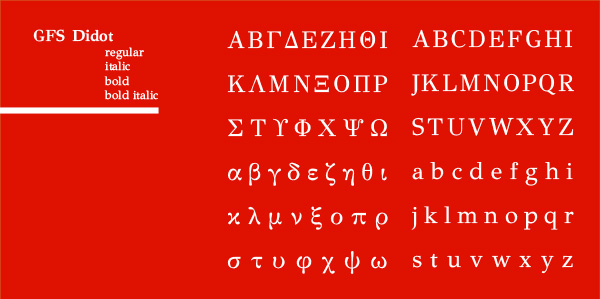
At the Greek Font Society – a Didot, a Bodoni, and an italic made to accompany the Didot.
At the Greek Font Society – a Didot, a Bodoni, and an italic made to accompany the Didot.

(from Metropolis, via BLDGBLOG).
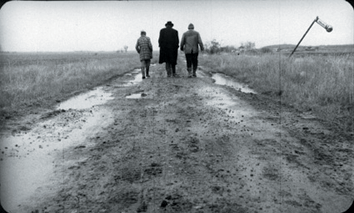
(representative still from Béla Tarr’s Sátántangó)
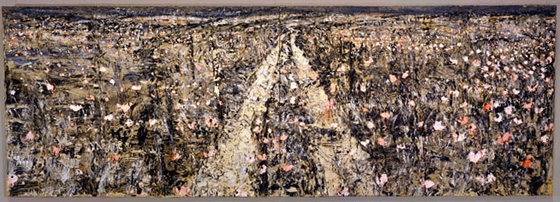
(Anselm Kiefer’s Böhmen liegt am Meer)
“Bohemia Lies by the Sea”
Are these houses green, I once more enter a house.
Are these bridges safe, to walk I have good ground.
All loving effort lost for ever, I lose it happily.
lf not I myself then someone else as good as I.
lf here a word adjoins to me, I let it join.
If Bohemia lies still on the sea, I believe the seas.
And if I believe in the sea, I still can hope for land.
lf it’s I myself it’s everyone just as much as I.
I have no wishes any more. I wish to run aground.
Aground – towards the sea, to find Bohemia.
Wrecked, I wake up peacefully.
I have grounded my belief and shall be lost no longer.
Come here, you from Bohemia, sailors, whores, and ships
without a staying. Won’t you be Bohemians, you Illyrians, Veronese
Venetians. Play those comedies to make us laugh
Before we cry. Go wrong a hundred times
as I went wrong and always failed examinations,
yet I passed them all, each and every time.
Passed them like Bohemia which one fine day
was relieved down to the sea and now lies on the shore.
Still I adjoin to a word and to another country,
and ever more adjoin to all there is however slightly,
Come from Bohemia here, a vagrant, who has nothing, whom nothing keeps,
gifted with vision to see from the sea-struggle land of my choice.
(Ingeborg Bachmann, trans. Peter Filkins)
“This was all that I had been able to make out, apart from a sharply defined nose (a rare thing in a child) in a thin face, which recalled the beaks of baby vultures.”
(Proust, The Captive, trans. C. K. Scott Moncrieff & Terence Kilmartin, pp.135–136)
“Haneke’s obsessions converge in Caché‘s final scene, a chilling long take that’s the most enigmatic conclusion in recent movie memory. ‘Using a fixed shot means there’s one less form of manipulation – the manipulation of time,’ Haneke says. ‘I’ve always wanted to create the freedom one has when reading a book, where one has all the possibilities because you create all the images in your head.’ Resolutely cryptic, he refuses to decode the scene’s meaning: ‘About half the viewers see something and the other half don’t, and it works both ways.’ He adds, invoking his protagonist’s own mental journey, ‘We always fill the screen with our own experiences. Ultimately, what we see comes from inside us.’ ”
(David Ng interview of Michael Haneke)
“. . . and I am not sure that it was not about this time that she learned to say, when she wanted to indicate that she thought a book badly-written: ‘It’s interesting, but really, it might have been written by a pig.’ ”
(Proust, The Captive, trans. C. K. Scott Moncrieff & Terence Kilmartin, p.10)
“People who learn some correct detail about another person’s life at once draw conclusions from it which are not accurate, and see in the newly discovered fact an explanation of things that have no connexion with it whatsoever.”
(Proust, The Captive, trans. C. K. Scott Moncrieff & Terence Kilmartin, pp.1–2)
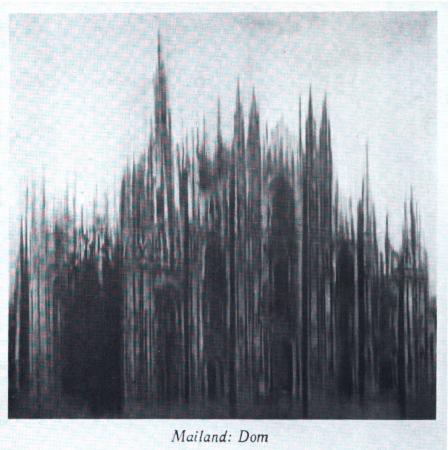
(Gerhard Richter, Mailand: Dom, 1964)
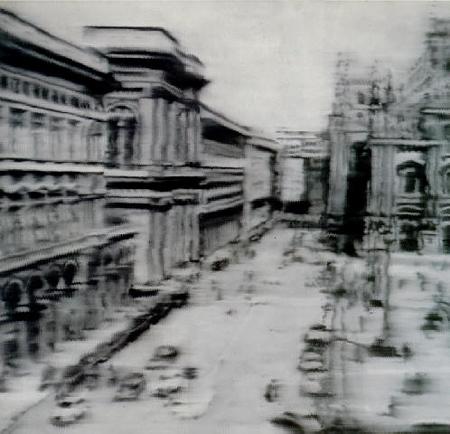
(Gerhard Richter, Domplatz – Mailand, 1968)
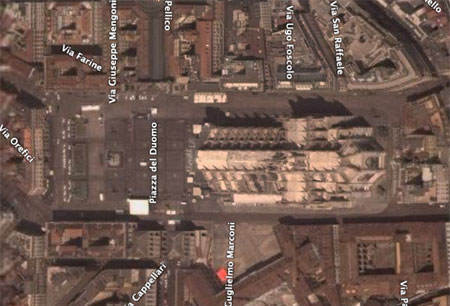
(from Google Earth)
requisite poem:
“Milan Cathedral”
Through light green haze, a rolling sea
Over gardens where redundance flows,
The fat old plain of Lombardy,
The White Cathedral shows.
Of Art the miracles
Its tribe of pinnacles
Gleam like to ice-peaks snowed; and higher,
Erect upon each airy spire
In concourse without end,
Statues of saints over saints ascend
Like multitudinous forks of fire.
What motive was the master-builder’s here?
Why these synodic hierarchies given,
Sublimely ranked in marble sessions clear,
Except to signify the host of heaven.
(Herman Melville, from Timoleon, 1891)
(from The Journal of Typographic Research, July 1968)
Figure 5. The Big Book, 1964–1967, by Alison Knowles. Courtesy of the artist.
The Big Book is not a product, but a process, and the person using the Book must accept himself as part of the process, discarding enough reserve to bend over and enter the Book – flexing, flowing, discarding stances. The Big Book cannot be know without being entered, and it cannot be entered without being modified – so that getting to know it alters it, even as it alters us, and there can be no one interpretation.
So down on hands and knees then, and through the cover, on through a hole burned in page of vinyl artifice, and down onto belly to crawl through a tunnel in a wall of artificial grass and water, imitating a descent, but actually remaining on floor level. After wiggling through the tunnel, one enters the apartment, an image of unpretentious Manhattan loft living in the 1950’s and early 1960’s. This apparent underworld, such as an epic hero usually enters, presents the processes of life nonchalantly, without varnish. Everything is useful here; there are aspirin, books, cans o soup, and other ordinary household objects. The telephone works, the stove will heat water for tea. The acceptance of this mundane, workaday underworld has the effect of elevating it, and while one enters through a tunnel, one exits through a window, and is free to examine the gallery of goats on page 4, or to climb a short ladder which moves on casters, simulating an experience of attaining precarious heights. Of course The Big Book can be read backwards or sideways, and anyone else who takes this journey will read it differently. But from any angle, to be in The Big Book is necessarily to be as mobile, kinetic, audial, visual, energetic, and beautiful, as it is.
—William S. Wilson, New York