john crowley, “lord byron’s novel: the evening land”

John Crowley
Lord Byron’s Novel: The Evening Land
(Harper Perennial, 2005)


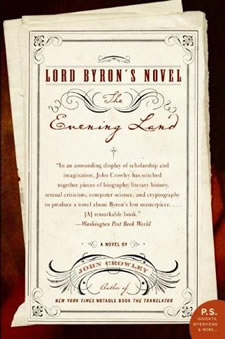
One of the virtues of John Crowley’s book is that they can often be found in awful bookstores when it doesn’t seem like anything readable can be dredged up. I started reading the Ægypt books in Idaho; here in rural Virginia, I found myself a paperback edition of Lord Byron’s Novel: The Evening Land, which I wisely hadn’t gotten around to reading yet. It’s pleasant to read his books when cut off from civilization, although they’re the sort that do cry out for the Internet for fact-checking. Did Dr. Merryweather’s Tempest Prognosticator really predict the weather by means of leaches? Wikipedia claims this is true; their entry on Ada Lovelace, though, reads like the Book of Genesis, multiple authors telling the same stories over and over again in the hopes of eventually getting it right. One wishes for a better version of Byron’s poetry than the easily accessible Project Gutenberg editions; you can’t have everything. The dictionary app on my iPhone has a definition for “operose”: that’s something.

Lord Byron’s Novel consists of three parallel narratives. The first is Lord Byron’s novel, given the title The Evening Land, ostensibly saved from destruction at the hands of his wife by his daughter, Ada Lovelace, whose notes to the novel, at the end of each chapter, create a second chronology, following her reading of the book. Byron’s text takes up the majority of the book. Interlarded between chapters is a discovery narrative, composed of a trail of correspondence, mostly emails, sent to and from Alexandra Novak, an American woman in London doing research on Ada Lovelace for a website devoted to the forgotten history of women in the sciences; Ada has encoded the novel, and Novak and her partner seek to decode it. There’s not a great deal of suspense in this, as the reader has been reading Byron’s novel and knows that it’s accomplished. Rather, this third narrative seems to be working at different ends, examining what coincidence means in fiction and in life. Another plot emerges: Alexandra’s father, conveniently enough a former Byron scholar, has been estranged from his daughter: having left academia for a career in the movies, he commits a Polanski-like crime for which he must flee the country; largely on account of this, he is estranged from his daughter. Relations between fathers and children form a dominant theme: between Byron and his daughter Ada, who he never talked to; between Alexandra and her father; and between Byron’s hero Ali and his fictional daughter Una. 

It’s neat, but not too neat. It’s difficult when reading a novel which consists of interplay between a text and its annotations, to avoid thinking of Pale Fire, which has almost always done the job more perfectly. Not that perfectly is necessarily the same thing as better: Nabokov’s book is constructed so tightly that it could only be fictional, and in its unrealistic world there’s no friction where the reader might be caught and held. Crowley doesn’t seem to be attempting to compete with this: his project here is different because there’s an interplay between the real biographical history of Byron and those around him and the fictionalizations that Crowley has created. When the reader is presented with a text ostensibly by Lord Byron with annotations by his daughter, Ada Lovelace, it’s clear that the exegesis in the notes actually operates in reverse. The similarities that Ada finds in Byron’s text to his own life aren’t the signs of a novelist disguising his own life by hiding it in fiction, but rather the raw materials that the reader knows that Crowley has used to construct a novel that might be Byron’s. The reader suspects that the notes might have preceded the novel: they’re the historical pieces from which fiction might be constructed. 

This works in other ways as well: when a character appears named “Lord Corydon,” we know that we understand the name “Corydon” differently from the way that Ada would have, as Gide’s work wouldn’t appear until well after her death. Ada’s notes point out that Byron’s account in his novel of how the Duke of Wellington won the Battle of Salamanca is counterfactual; but we also know that the very existence of Byron’s novel (and Ada’s notes on it) is counterfactual. The author is winking at us: in less deft hands, this might be annoying, but it doesn’t happen often enough here to wear out its welcome. The text that is to be decoded appears mysteriously, in the hands of a figure who might be the author himself; late in the process, he appears again, to cast doubt on the truth of the rediscovered novel. 

This isn’t experimental fiction, in the sense that Pale Fire was experimental when it appeared; rather, it takes a form (albeit one that hasn’t been used especially often) and puts it to good use. It’s a pleasant book, exactly right for vacation reading: hence my pleasure at being able to find John Crowley’s books in remote bookstores. The Evening Land might have stood alone: it’s an enjoyable pastiche of Romantic writing, a bit reminiscent of James Hogg’s Private Confessions of a Justified Sinner though without the supernatural aspects of that book. Someone must be compiling a dissertation on the appearance of the Internet in American fiction: Crowley’s grasp of the way people talk over email is surprisingly convincing and readable, and would belong in such a volume. In the earlier sections of the book, one finds oneself racing through the pseudo-Byron to reach the contemporary narrative; as the book progresses, interest reverses itself; it’s skilled writing that can maintain such interest.
alvin levin, “love is like park avenue”

Alvin Levin
Love Is like Park Avenue
(ed. James Reidel) 
(New Directions, 2009)


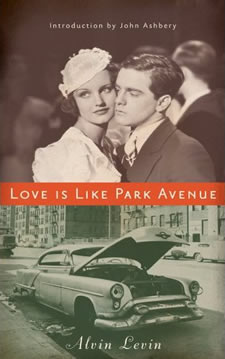
Love Is like Park Avenue collects the fiction of Alvin Levin, who was born in 1916, but seems to have given up writing fiction in 1943: seven years worth of writing, mainly short pieces, make up his entire literary output, not quite breaking 200 pages. The title, which appeared on two distinct pieces collected here, was to have been that of Levin’s novel, which never materialized; it’s hard to tell, from the content here, what form that novel would have taken, as Levin doesn’t seem to have been given to conventional unities of plot or character. The editor suggests that much of this material might have been part of a novel; but Levin has been dead since 1981, and his rumored novel was nowhere to be found in his possessions.

Levin, born in Paterson, New Jersey, grew up in the Bronx and attended City College; most, though not all, of his work seems to center around lower-middle class Jews in roughly similar situations. In his introduction, James Reidel notes that Levin had polio and walked with a crutch for most of his life; Reidel suggests that Levin lived vicariously through his younger sister, both in his life and in his fiction. (“A Cool Drink Is Refreshing,” written in 1939, might be the most straightforwardly autobiographical work here: the story is told from the perspective of a young woman who visits a boys’ school to tell her brother that their father has found him a job, delivering milk; the implication is that he’ll need to quit school.) It’s hard to tell how much to read into this: but Levin does have a pronounced sense of empathy, and he captures his women characters, narrators as often as not, remarkably well. Following the examples of Faulkner and Dos Passos, Levin generally uses a stream of consciousness narration; the point of view frequently shifts, and the narrator at the end of a piece (“story” seems the wrong word) often isn’t the one who started it. Names and locations sometimes shift capriciously; this seems to be intentional. His prose is always energetic: Levin is always an interested observer even if his exact position can be difficult to pin-point. The excerpt from a novel published in 1942 as “Love Is Like Park Avenue” is composed of a series of short vignettes, none longer than a few pages, each with different characters; there’s a unity to the world and vision that Levin presents, but the characters, their voices, and their situations are constantly shifting

Having grown up in the Depression, Levin’s subject is frequently the lower classes; but he never writes as a tourist, seeking to explain how the other half lives to an educated audience; nor is his writing polemical. There’s no disdain in his words; what he sees in life, and he puts it down on paper with the hope, perhaps, that someone will read it. It’s possible that this comes through most clearly because Alvin Levin was never actually a successful writer, though William Maxwell asked him to submit material to the New Yorker and the British poet Nicholas Moore asked him for a story for an anthology of avant-garde fiction. This doesn’t seem like writing for a mass audience or for an avant-garde audience; Levin appears to have been interested primarily in pleasing himself, a supposition that might be entertained because he seems to have voluntarily given up writing entirely. In Reidel’s telling, this seems to have been because he had many other interests keeping him busy: he was a lawyer, and seems to have run a successful pamphlet-publishing business for years. 

Reading Levin now, one notices the kinds of fiction that we don’t have today. The contemporary American novel, or that subset of it known as literary fiction, is generally written by the upper class because it is written for the upper class. The social structures that generate fiction and its writers – MFA programs – are, with a few notable exceptions, self-selecting, limited to those who don’t need to make a living. It’s not an accident that the New Yorker, the most prominent venue where new fiction might be seen, is aimed squarely at those who aspire to be upper class. This isn’t something unknown – Walter Benn Michaels was making this argument a few years ago, albeit hamfistedly – but it’s generally not discussed, as class doesn’t tend to be discussed in America. This isn’t solely a contemporary problem – writing itself has always tended to limit itself to those who have the time and leisure to engage in it – but Levin’s book suggests that things have not always been quite so stagnant as they are now. Writing, for Levin, seems to have been a possible agent of social mobility, an aspirational vehicle: the upper classes wrote, but he could write too; by doing so, he could earn the prestige of a millionaire like James Laughlin, who corresponds with him like a peer. But avant-garde writing isn’t a viable way out of the lower middle class, especially if you need to support yourself because you’ve been crippled by polio; Levin might have realized this, and this might be why he turned away from writing. It’s hard to blame him, but it’s our loss.

It’s worth noting that this is an unusually attractive book for New Directions, whose recent work has been deeply disappointing given the publisher’s long history of good book design. Levin sought to be published by James Laughlin; his most prominent publications were in New Directions annuals, but James Laughlin never seems to have coaxed the promised novel out of him. James Reidel arranges his work chronologically, interspersing correspondence to and from potential publishers; useful notes complete the volume, and John Ashbery’s brief preface recalls how exiting his voice was in 1942 and explains his part in Levin’s republication. We’re lucky that Levin found the young Ashbery as a reader.

july 21–august 1

Books

Films

  • Sun Ra: A Joyful Noise, directed by Robert Mugge
  • The Pajama Game, dir. George Abbott & Stanley Donen
  • Thomas Bernhard. Drei Tage (Thomas Bernhard – Three Days), dir. Ferry Radax

Exhibits

  • “Memories of the Future,” Sean Kelly Gallery
  • “Poems & Pictures: A Renaissance in the Art of the Book (1946–1981),” Center for Book Arts
  • “I will cut thrU: Pochoirs, Carvings, and Other Cuttings,” Center for Book Arts

tan lin, “seven controlled vocabularies”

Tan Lin
Seven Controlled Vocabularies and Obituary 2004. The Joy of Cooking
(Wesleyan University Press, 2010)


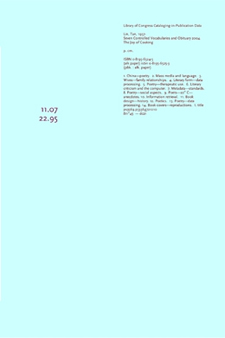
Like Tan Lin’s previous plagiarism/outsource, this is a book with a title in flux; I’m using the title on the spine, though the title page (appearing as a verso, not a recto) gives the title Seven Controlled Vocabularies 2004 [Airport Novel Musical Poem Painting Theory Film Photo Landscape], and the Library of Congress cataloging-in-publication data on the copyright page, recto, gives a further variation on those elements with different punctuation. (A first LoCC-I-PD appears on the front cover.) A spread after that gives the title as The Joy of Cooking; the next spread presents another variant. As far as I can tell, there are six different titles to this book. A foreword by Laura Riding Jackson appears, as the back cover promises, on page 162; this is not, of course, a foreword written for this book, but a photocopies of her foreword to her own Rational Meaning: A New Foundation for the Definition of Words and Supplementary Essays from 1986.

This is a book built from appropriations, from pieces of other books, as the title suggests; but more to the point, this is a book straining the forms of a book. Or possibly this is a book that explodes the bounds of books: at his recent book party at Printed Matter, Lin was a huge number of ancillary volumes created through Lulu; yet more material is floating around the web in various formats. I was given copies of Blurb and Selected Essays about a Bibliography, to which I contributed content; I’ve looked through these books and a number of the related works online, some of which, like the appendix seem integral to understanding Lin’s project. I certainly won’t pretend to have read everything: it seems impossible to tell where this book ends, or if it has ended.

How can we read Seven Controlled Vocabularies? The method suggested by the form is to dive in at random and float around for a while; to read it from front to back is perhaps to read this book against its grain, which is what I did. And one notices that despite the book’s chaotic appearance, the page numbers do march from the beginning of the book to the end in an entirely linear fashion, perhaps the most constant design feature of the book. The first text inside the book that one finds reading from the Western front cover is on what would be page 1 of the book: it says “[INSIDE BACK COVER]”. A Chinese edition of the book, available on Lulu, suggests that a front cover is sometimes a back cover; and so the front cover of this book might also be its back cover, and the back cover contains much of the same information available on the front. As one pages through the book, front matter appears, not necessarily where one might expect it; unexplained numbers (“11/07 2.21”) appear on one of the title spreads. 

The first page number appears on page 9, where there appear acknowledgements. These are set in the same type (Scala Sans) as the rest of the book; on first glance, this seems like it might be straightforward. Details pop out though: the last line, a paragraph by itself, says that the photo on page 182 is by the author. Flipping to page 182 reveals a small photo, which might be by the author. The paragraph above it suggests that the illustration on page 45 is Stanley Spencer’s The Resurrection, Cookham; turning to that page reveals what looks like a photograph that isn’t of any sort of resurrection, though it might be a detail. But the illustrations that ostensibly appear on pages 237 and 256 can’t actually be found, as the book doesn’t have that many pages. Re-reading the acknowledgements, one realizes that it’s been lifted from another book; probably the book was not written when Lin was a “Post-doctoral Research Fellow at Liverpool John Moores University between 1999 and 2002” as one might believe. Google, ever useful, suggests that these acknowledgments are from Timothy Bewes’ Reification, or the Anxiety of Late Capitalism. The following page contains an editorial note, an authorial note on methods used to produce the book; it appears to be “real” in that Lin could have conceivably written it, but the seeds of doubt have been sown. Opposite is text in Chinese; it seems to be a translation of the editorial note. 

The book proceeds: there’s a blank verso, then a recto with a heading. Flipping through the book reveals seven of these, presumably the Controlled Vocabularies of the title:

  1. A Field Guide to American Painting
  2. A Field Guide to the American Landscape
  3. American Architecture Meta Data Containers
  4. 2 Identical Novels
  5. A Dictionary of Systems Theory
  6. Various Library Standards
  7. A Field Guide to American Cinema

After the last, there’s an About the Author, which seems to be accurate. But out of the apparent chaos of this book, a structure can be discerned: inside each section, there does seem to be an internal grammar. The first section, for example, pairs text on the verso pages with labels for non-existent plates on the versos; the second section pairs text with photos, though the photos seem to be out of synch (in the style of Hollis Frampton’s film (nostalgia), obliquely referenced here) with the text. 

Themes emerge through the book, though they seem to disappear almost as often as they pop up: the changing form of the book, of course; the meaning of plagiarism in contemporary composition; the parallel changing world of food; metadata as it relates to reading; reality television; the obscurantism of computer jargon; and perhaps how the canon has become something personal rather than universal. The Joy of Cooking, for example, has a very personal meaning to Tan Lin (which can be understood by reading the unincluded Appendix to this book); reading this book without that leaves the reader in the dark. Parts of this book remain obscure to me: how the photos in it work, for example. Some are probably of personal significance, as seemed to be the case with the photos in Lin’s earlier books; but right now I can’t make sense of them. I suspect that there’s a definite meaning there: but it may only be as part of an ecosystem of other, related books that those meanings might emerge.

tom rachman, “the imperfectionists”

Tom Rachman
The Imperfectionists
(The Dial Press, 2010)


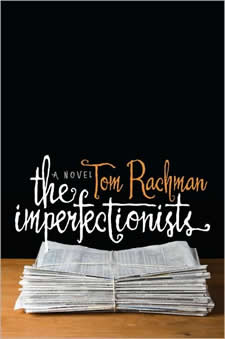
My friend C. sent me this book as a gift; several years ago, we wrote a travel guide to Rome together, and she had thought this book, written about a former AP staffer in Rome about a newspaper in Rome, might be interesting. She didn’t love it; I’d noticed the reviews and thought the book might have potential, even though the wrong sort of people were liking it, but after flipping through it in a bookstore I was confident that it wasn’t a book I needed to buy in hardcover. It’s nice to be sent a book as a gift, especially a book that someone has already read and marked up with their displeasure; there’s something nice about reading a book that you know you’re bound to dislike, figuring out exactly why you don’t like it.

What might be most interesting about this book is its structure: it’s constructed from 11 short stories, each given the title of a news story (a strategy that ends up coming off as a gimmick) and a subtitle with the name and position of a person who works at an English-language newspaper based in Rome which will close by the end of the book. Each story is relatively self-contained; there’s chronological progression through the stories, though they seem to happen from around November 2006 to around April 2007, dates which can be pegged by the news stories. Each story is told from the third-person perspective of a different character; characters recur, and complete stories can only be constructed by reading more that one story. This straitjacket approach to structure doesn’t always work; some characters are more extraneous than others (a judicious editor would have cut at least two and possibly three chapters) and a couple of major characters don’t get their own chapters. The success of such polyphony is decidedly mixed: the voices of the women, in particular, seem cartoonish – women in positions of power, for example, turn out to be vicious harpies with unsatisfactory sex lives – and the character that Rachman seems to be having the most fun writing, a veteran scoundrel reporter named Rich Snyder, is the most tangential to the greater narrative. 

Each chapter concludes with a separate section, set off in italics; these report the history of the newspaper, starting with the newspaper’s founding in 1953 and moving into the present to converge with the main narrative at the end of the book. The newspaper itself would be the main spine of the book; this isn’t, however, as compelling as the people around it. At the end of the book, one of the characters has the intention of writing a history of the newspaper; but this history, we are told, is never started, and the italicized history is from an omniscient third-person perspective that is not his. 

The book’s structure suffers from being similar to Georges Perec’s Life A User’s Manual, which also tells interlocking stories from multiple perspectives; Perec’s book constrains itself to a specific moment in time rather than a series of instants, as this book uses. Finishing Perec’s book, one feels compelled to go back to the beginning, to re-read the narratives, knowing how they will turn out; here, one notices clues, but the overall narratives aren’t enough to compel re-reading: one doesn’t feel that any more secrets are likely to reveal themselves. 

My disappointment with the book os partially personal: having lived in Rome, though not during those particular years, I expect a certain amount of local color, something that should be possible. Unfortunately, this book seems to be set in Rome almost at random: there are details here and there, but the story could be uprooted and moved to Paris or Brussels without much trouble: cartographic details would need to be changed, but the overall structure (and almost all of the characters) of the book could remain exactly the same. Most are Americans in Rome; they don’t behave so much like ex-pats in Italy (a type that could be carefully delineated) so much as they behave like American characters, uprooted from America by authorial whim. A sulking character, for example, shuts herself up in her room and starts shoveling down Häagen-Dasz. It’s possible that American brand is now available in Italy; but almost certainly Americans in Rome are still likely to go on and on about how superior Italian gelato is than any American version. A surprising number of Romans love ice cream cones from McDonald’s; ex-pats go on and on about cultural imperialism. Italy seems to have little effect on these characters; some have the requisite Italian boyfriends and girlfriends, but nothing is learned from them. This is, of course, a purely personal complaint: the author has no duty to gratify me by making this book about what I want it to be about, even if that is more interesting and would make it a better book all around. There are a number of solecisms in the book, some of which might be attributed to a lack of a copyeditor familiar with what Rachman is talking about: “Fiumicino Airport” is not, for example, a proper noun but rather the town where Leonardo da Vinci International is located. But again, these mistakes aren’t likely to annoy most readers. 

The biggest problem with the book, and one that might be related to its carelessness with setting, is how it strains credibility. I don’t have a problem with the rejection of conventional realism, of course; but this is a book which is using realism as its mode. (One exception, which triggered my earlier comparison to Life a User’s Manual: one character is a reader of the paper who has been making it her business to read everything in the paper, every day, with the consequent result that her chronology slips further and further from that of the outside world; finally, when she is missing a single issue, it breaks down entirely. But this is the only prominent instance of fabulism in the book.) When a book proceeds by realism, the reader losing faith in the book suggests a problem with the book. The premise of the book is that a billionaire sets out to run a world-class English newspaper out of Rome: this is problematic. Rome isn’t a place that anyone with a modicum of sense would think to do this; even limiting choices to Italy, it would make much more sense to work out of Milan, and if one were trying to get things done it would make much more sense to leave Italy entirely. Starting a major newspaper in Rome, romantic as it may sound, is somewhat akin to the idea of starting a major American newspaper somewhere like Albany. The reader wonders as well when it turns out that the newspaper doesn’t have a website. This might be believable if the book were set in 2000 or if the newspaper had some sort of specialist slant resistant to the Internet; when the paper seems to be modeled on the International Herald-Tribune and the book is set in 2006, when American newspapers were already on the point of collapse, it defies all belief, especially when this turns out to be a large part of the reason the paper collapses. That’s just not how businesses are run. One might suspend belief if there seemed to be some good reason for it, the setting, perhaps; but it’s not there. 

ettie stettheimer, “love days”

Ettie Stettheimer
Love Days
(in Memorial Volume of and by Ettie Stettheimer)
(Alfred E. Knopf, 1951)


Love Days, originally published under the pen name Henrie Waste (from HENRIEtta WAlter STEttheimer), has the strange full title “Love Days [Susanna Moore’s],” Susanna Moore being the protagonist; perhaps another Love Days had been recently published in 1923 and this was to avoid confusion. The Stettheimer sisters were friends of Marcel Duchamp in New York; this novel features a character based on Duchamp, which is my reason for picking up the book; his correspondence with Ettie Stettheimer suggests that he found the portrayal amusing. His correspondence with the Stettheimer sisters, and particularly Ettie, was one of his most sustained; I’ve seen her sister Florine’s paintings, some of which feature him, and Carrie’s immense dollhouse, now at the Museum of the City of New York featured a tiny version of Nude Descending a Staircase that he made to order. Ettie Stettheimer’s writing, however, seems to be neglected.

The book is presented from the perspective of Susanna Moore, a New York orphan who seems to be of considerable means, though that’s never quite explained. The book isn’t a roman-à-clef, though Duchamp appears rather transparently as the figure of Pierre Delaire; nor is he the only famous figure to appear in the book, as Maxim Gorky has a role as an extra in Capri, and a Cubist painter couple might be meant to be the Delaunays. The book follows Susanna Moore, first through Barnard, then studying in Germany; thus far, it might be said to follow the life of Ettie Stettheimer, who earned a doctorate in philosophy at Freiburg in 1907. She then returns to New York, where she sets herself up as an independent scholar of Greek; after soundly rejecting men for most of the book, she very suddenly falls madly in love with Grodz, a French painter of Finnish-Greek extraction, and marries him. Ettie Stettheimer, like her sisters, never married. 

As far as I can tell, this volume is the most recent publication of Ettie Stettheimer; there doesn’t seem to be much interest in her prose. This particular volume is a bit macabre: evidently after her sisters Carrie and Florine died and Ettie had put their affairs in order, she decided to provide for her own posterity by putting together this omnibus edition of her own work: this novel, an earlier novella (Philosophy: A Fragment, about an American girl studying philosophy in Germany), a philosophical work that had been her dissertation on the work of William James (which seems to have been her most widely read work), and four short stories. She adds an introduction to the whole; a few contemporary reviews are inserted as introductions to the individual volumes. The Memorial Volume was published by Knopf in 1951; nonetheless, this has the slightly sad feeling of a vanity project, right down to the dedication, to “E. S.”. 

This isn’t the most likable novel; at 350 pages, it’s probably twice as long as it needs to be, and fifty-page chapters are tiresome. The characters are predictable: the overly romantic French artist that she marries almost immediately is filled with jealousy before the honeymoon is over. Stylistically, there’s a rather excessive use of ellipses, designed to indicate emotion; there’s sometimes something about the writing that seems off.

Susanna folded the letter and gurgled. She gurgled when she laughed to herself and felt apologetic for finding herself amusing. (p. 62)

This gurgling is a one-time affair, but she is given to drawling, even in German. Later, when the heroine considers Ewart, an American she meets in Capri when he offers her a powder for a headache of convenience:

She decided that he looked like a smart twenty year old lounge lizard, and like a forty year old scientist, and she was pleasantly intrigued by the unresolved combination he presented. (p. 187)

This description is good enough for a reprise thirty pages later:

Ewart, the considerate and objective young lizard bulging with a brow that seemed a temple of wisdom, was saying, “Of course it has been proved statistically that the great majority of marriages are unsuccessful; one member is unfaithful to the other, which is probably perfectly natural, since according to psychological law people grow tired of anything after a time, etc. etc. . . .” (p. 216)

Susanna Moore’s marriage does collapse and end in divorce, though the actual collapse happens in a gap between chapters; it is blamed on pneumonia. While recovering from the pneumonia in a sanatorium, she first encourages the attentions of a Nietzscheian baron; then she finally finds love in the person of a English doctor who is the baron’s wife’s cousin and reputed lover but who has tuberculosis. This isn’t quite as interesting as it might sound: plot twists are telegraphed well in advance and the characterizations and varied geographic settings (hotels in Europe, mainly) aren’t particularly interesting. 

Susanna Moore seems, on the whole, rather full of herself and a bit tiresome. On the whole, she appears lacking in feminist consciousness; but there are strange passages that suggest that she might be more interesting. While she’s in her Greek class at Columbia, one of her friends, whom she dislikes, suggests that she should get married and settle down with children, a suggestion that Susanna has no truck with:

”No,” Susanna said in her languid way that never sounded final, but often was.— Whenever her potential motherhood, marriage or death were touched on in conversation she felt as though some one else were being referred to, and the chief emotion produced in her was one of estrangement from the speaker who so unpleasantly identified her with that other person. . . . “Let’s go on with Medea. She got married and didn’t settle down to a hum-drum existence,” she remarked, feeling much closer to Medea at this moment than to Blanche. (p. 17)

Frustratingly, this isn’t elaborated on; this is also the case later in Germany, where she complains to a would-be swain that she thinks is odd that an elderly German man should be explaining Sappho to her; then she asks Tom to explain what he thinks of Sappho, which isn’t much more helpful:

”In other words, because she made great poetry of perverse love, she must have been perverse?” she asked.
“Felt perverse, anyway.”
“And,” Susanna continued to educate herself, “why was she perverse; because she had no adequate normal love affair, did you say?”
Tom burst out laughing. “You seem to regard me as an authority, you funny Susan, or are you trying to find out something else? I wasn’t there, you know; I mentioned this as a probably cause of perversity: often men and women are driven to perverse practices because the normal satisfactions obtainable are of an unbeautiful nature, more unbeautiful than the perverse ones seem to them at any rate to be. This is the most favourable interpretation of perversity, reserved for artists and people who seem to have some pretensions to a sense of – of fastidiousness.” Tom paused; he had seen Susanna’s face frowning like a perplexed child’s trying to understand. His strident voice grew softer. “All in all, my dear, it’s not an attractive subject, and it’s hard for healthy people to grasp, so don’t be alarmed if you don’t ‘get’ it; neither does the Professor. Susan, child, where are we going?” (p. 70)

With that, the subject is dropped entirely. It’s vexing, because there is obviously an interesting subject here; but again it’s simply pushed aside. While in Germany, she is pursued by countless lovelorn Germans, a romantic people; she wants none of their attentions, and realizes that she can escape them by saying Mir ist schlecht, I feel sick. There’s an echo of this at the end of the book: Hugh, her English doctor, is the perfect object for her love because he is sick, and loving him will make her sick. He refuses; she seemingly kills herself by covering her mouth and holding her breath. It’s a bit too clumsy to be affecting, and Susanna Moore isn’t quite a model feminist: but the novel does provide a picture of a woman trying to make her way through an uncomprehending and unjust world. 

The character based on Duchamp has a walk-on part; he visits her once, and stays for five pages. Susanna Moore appears to have no real friends; a few appear, but each is jettisoned in their turn. Pierre Delaire seems to be the only one to escape this. He isn’t a romantic figure to her: she thinks that “his delicate fairish classicality of a dry and cerebral quality had all of beauty except beauty’s particular thrill” (p. 95) and he disappoints her by having shaved his head. He explains his new canvases:

”In form Cubist – but there is an ulterior intention which removes them from Cubism. I wanted to produce those impressions so painful to the eye which it sometimes receives from a moving picture when several objects more simultaneously at different velocities, – for instance in the picture of a race. Do you remember that we once saw one together and remarked on it? The eye became confused and the head a little dizzy. Eh bien, it interested me to get these same effects through static means.” (p. 96)

Susanna Moore refused to take voyages with Delaire, just as Ettie Stettheimer refused to set sail for Buenos Aires with Duchamp; Moore and Delaire fall into a discussion of their lives as a solar system, a mythologization which might, at a stretch, be seen to reflect Duchamp’s myth-making in the notes for The Large Glass. And then he wanders out of the book: he doesn’t seem to have missed much.

noted

  • My interview with Bob Stein is up at Triple Canopy as part of Issue 9.
  • A thread at MetaFilter about Jack Green’s Fire the Bastards!. Tangentially related: David Markson’s library appears at The Strand; some of his Gaddis annotations have appeared online.
  • Gary Shteyngart & Joshua Cohen on the Tablet podcast.
  • More of Robert Walser’s poetry is coming out in English.
  • Joseph McElroy’s Preparations for Search is available from Small Anchor Press; the text was originally published in Formations in Spring 1984 as part of Women and Men, but cut before that book’s publication; Small Anchor’s edition has been “slightly revised”.
  • Trevor Winkfield, Miles Champion & Steve Clay present “Poems and Pictures: A Renaissance in the Art of the Book (1946–1981) tonight at 6:30 p.m. at the Center for Book Arts.
  • Tomorrow: a release party for Tan Lin’s Seven Controlled Vocabularies at Printed Matter from 5–7.
  • Also tomorrow night: Ferry Radax’s documentary Thomas Bernhard – Drei Tage shows at Anthology Film Archives at 7:15 p.m. Also shows on Friday at 9 p.m.

frederick rolfe, “the desire and pursuit of the whole”

Frederick Rolfe, Baron Corvo 
The Desire and Pursuit of the Whole: A Romance of Modern Venice
(Cassell & Company Ltd., 1951; first published 1934, written 1909.) 


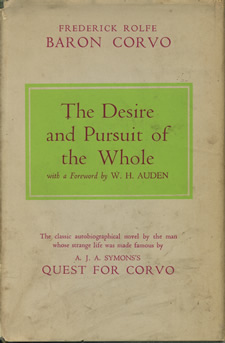
This book gives the reader pause from the first sentence; following an epigraph from Plato, we learn:

The text chosen, o most affable reader, on which to hang these ana of Nicholas and Gilda for your admiration, will require such a lot of expounding that we must get at the heart of explanations (as to how it all happened) without undue delay.

And we’re off and running. “Ana” is not a misprint; nobody writes books, or uses the English language, quite like Frederick Rolfe did. Baron Corvo, as Rolfe also presented himself, is best know for Hadrian the Seventh, in which a down-on-his luck Englishman becomes Pope; Rolfe’s rather odd life – he was repeatedly foiled from his attempts to become a priest – suggests that this plot was wish fulfillment. The introduction of this book, by A. J. A. Symons, Rolfe’s first biographer (The Quest for Corvo) presents this book as being a further fictionalized autobiography. On reaching page 36, where the many affronts against the life of Nicholas Crabbe to that point have been narrated, the reader is confronted with a footnote, presumably by Symons:

Readers of The Quest for Corvo will need no telling that Rolfe is following the lines of his own life very closely in the description he gives of Nicholas Crabbe’s career. Peter of England is Hadrian the Seventh, Don Superbo is Don Tarquinio, Sieur Rènè is Don Renato, and Songs of Gadara represents Songs of Meleager.

At the bottom of the next page, another note:

Here again Rolfe is, of course, drawing from life. “Bonsen” is the late Mgr. R. H. Benson; and The Sensiblist is The Sentimentalist, a novel which aroused much discussion when it was first published. The central character, Chris Dell, was in some part drawn from Rolfe.

(The annotator commits a solecism: Benson’s book is The Sentimentalists (1906).) It’s hard, when there are such footnotes, to avoid reading this book as a roman à clef: Nicholas Crabbe, Rolfe’s hero, is beleaguered by the world to such a degree to put any modern novelist with a blog to shame. Here, for example, is described the double of Robert Hugh Benson, who seems to have been an inoffensive Catholic novelist who, Symons reports in his introduction, tried to help Rolfe by giving him work but drew his ire by refusing to pay his excessive hotel bills in Venice:

The Reverend Bobugo Bonsen was a stuttering little Chrysostom of a priest, with the Cambridge manners of a Vaughan’s Dove, the face of the Mad Hatter out of Alice in Wonderland, and the figure of an Etonian who insanely neglects to take any pains at all with his temple of the Holy Ghost, but wears paper collars and a black straw hat. (p. 36)

Crabbe and the narrator of this book are Catholic (with the zealotry that only the convert can muster) and vitriolic in equal measure, which is a great deal of the pleasure of this text. The story being told is insane; but Crabbe constantly has recourse to the logic of the Church (as he understands it) to back up his logic. The Church, of course, rejects him entirely (he would have been a priest but was blackballed); but that might be to be expected as he is holier than the Church. If only he were Pope, of course, these problems would be solved; but things aren’t so easy:

Beside, he had published a book of personal experiments with priests, Peter of England, an awful audacious book which flayed whom it did not scald; and his mood was not to compete for reprisals. ‘It is not I who have lost the Athenians; it is the Athenians who have lost me,’ he superbly said. So, when priests slank up to him, he civilly warned them off: if they merited kindness and persisted, he gave them double: but, never any more would he admit them beyond the barbican of his lifted drawbridge, never any more would he go beyond parleys from the height of his impregnable battlements – unless they should come, at high noon, with a flag of truce and suitable gages – never any more would he on any account seek them, but to serve him as ministers of grace. (pp. 60–61.)

Crabbe goes to Mass every day, denounces the local Anglicans as Erastian heretics, and quarrels with almost every priest he meets. What’s most surprising in this book, though, isn’t Crabbe’s love/hate relationship with Catholicism (a continuation of Hadrian the Seventh) but its bizarre treatment of gender. Crabbe, sailing alone in the Adriatic Sea, rescues a young girl, her village’s only survivor of an earthquake; but Crabbe is aghast with the impropriety of being along on his boat with a woman. His solution is to declare the androgynous Zilda (the Venetian abbreviation for “Ermenegilda”) to be a boy, Zildo; the girl is more than happy to go along with this, and for the rest of the book, she is a he, with the odd lapse, happily playing the role of Crabbe’s manservant and straining dictionaries just like his master when he’s not speaking in Venetian dialect:

‘I do not understand why this eximious Signor Caloprin will pay me thirty-five franchi every Monday at 8 o’clock, and also a hundred more at 8 of every fourth Monday, just for writing my name.’ (p. 111)

What Crabbe feels for Zildo certainly seems to be love; but it’s a love that Crabbe doesn’t seem to know what to do with. He moves Zildo into a remote apartment so that they might not always be seen together; but Crabbe seems to avoid Zildo, who nonetheless remains devoted. In a moment of crisis, Crabbe considers desperate options, including finding a wife with money:

O god of Love, never! Infinitely far better to marry not-Zildo – if not-Zildo would. But – would not-Zildo? Well, why not? ‘He, who dispenses with woman, lives in sin.’ said Maimonides. (p. 178)

This doesn’t happen; Zildo and Crabbe continue to keep their distance. At the end of the book, however, there’s an odd turnaround: Zildo rescues Crabbe, who is dying of starvation in her boat; when Crabbe recognizes that Zildo has saved his life, he suddenly declares Zildo to be Gilda, and they are in love. This final sex change happens two pages from the end of the book; they appear to be on their way to get married, as Zildo/Gilda has arranged things with the local priest. A check arrives; there’s a happy ending. 

It’s hard to know what to make of this. One would certainly be inclined to read Crabbe as being gay: he huffs and puffs about how terrible women are; he moves Zildo to other quarters because he feels tempted by him; he describes young men in loving detail. Crabbe claims to have been chaste for the past twenty years, as he had intended to take Holy Orders; he seems to regard the priesthood as a homosocial paradise, but one that won’t accept him. He and Bonsen have their own private quasi-religious order (at least until Crabbe angrily resigns); at one point, Bonsen writes him about the advisability of recruiting Italian naval officers.

There’s a monstrous solipsism to this book: it is a record of the genius of Nicholas Crabbe, and its world is seen entirely through his eyes. A first-person narrator occasionally raises his head to reveal himself to be wholly in awe of Crabbe: “Despite his peculiarities, there’s no denying that Nicholas Crabbe was a man of insight and intelligence: though I admit that there is a great deal of difficulty in making this point clear, seeing that he entered into such very close relations with priests and Scotchmen.” (p. 141) One suspects that this narrator is Crabbe himself, at a later date. Zildo, the novel’s second character, exists almost entirely through the eyes of Crabbe, who has been allowed to determine his character down to the level of gender; maybe this could be read as metafiction, though this book doesn’t seem particularly self-conscious in that way. Everyone else barely exists; they are an enemy of Crabbe or insignificant. 

The book is not without considerable flaws. Its misogyny (on the part of both Crabbe and the narrator) has been pointed out; as might be expected, there’s also casual antisemitism. The writing also has curious faults. In the second chapter, it’s pointed out that Crabbe is astrologically a Cancer; there follows an extended metaphor about his crab-like nature, and throughout the book he is constantly said to be rearing up, crablike, or “clashing his awful claws” or his “portentous pincers.” He is frequently furious because it is his nature. This becomes tiresome extremely quickly, not least because of how weirdly clumsy it seems: “He was still Crabbe, and as crabby as ever: but he began to exercise his crabbiness in directions which he had never tried or cared to try.” (pp. 155–6) I can’t tell what Rolfe is trying to do with this; maybe this is an attempt at humor that hasn’t aged well, but it can hardly be imagined that this would ever have been that funny, aside from the initial passage, directing the reader to boil and dissect a crab if they would know the true nature of those born under the sign of Cancer. Likewise tiresome is the subject of the writer complaining about his financial situation and the failure of his publishers to pay him; Crabbe’s vitriol is entertaining, of course, but the pecuniary detail is grueling.

But this is a lovely book if only for the diction: “cagotism,” “latebrose,” “dedecorous,” “physidoyls,” “vexilla,” “amoenely,” “succursale,” and the verb “ostends” (to pick largely at random) aren’t words one runs into every day. Rolfe’s English is glossed with Venetian and the occasional Latin; it would be hard to confuse a page of this book for that of any other, even one of Rolfe’s. In no other book, for example, is a servant likely to declare that “He preached so long, sir, that Mr Barbolan went to bed and left him; and Little Peter and Parisotto took him home, at 2½ o’clock, preaching imbriagally all the way, so that a vizile followed them” as one does on p. 208 of this book. And it’s hard not to like a book filled with imponderabilia like this: “Truth is tarter than taradiddles; and nothing is tarter, terser, than truth on the track of tired trash in a trance.” (p. 157) A copy of Don Renato, his book that includes a glossary of the macaronic language of Italian, Greek, and Latin in the back is waiting on my shelf: it’s tempting.

july 16–july 20

Books

Films

  • Big Top Pee-Wee, directed by Randal Kleiser
  • American Splendor, dir. Shari Springer Berman & Robert Pulcini

Exhibits

  • “Richard Diebenkorn in Context: 1949–1952,” Leslie Feely Fine Art
  • “Off the Wall: Part 1—Thirty Performative Actions,” Whitney Museum
  • “Christian Marclay: Festival,” Whitney Museum
  • “Jill Magid: A Reasonable Man in a Box,” Whitney Museum
  • “Heat Waves in a Swamp: The Paintings of Charles Burchfield,” Whitney Museum
  • “Christian Marclay: Festival,” Whitney Museum
  • “Facing the Artist: Portraits by John Jonas Gruen,” Whitney Museum
  • Nicholas Roerich Museum, New York