stanley crawford, “the river in winter”

Stanley Crawford
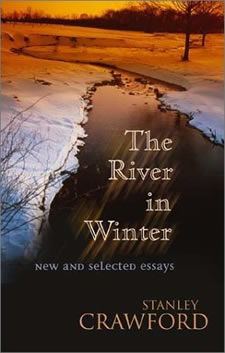
The River in Winter: New and Selected Essays
(University of New Mexico Press, 2004)


A consequence of growing up in the rural Midwest is a sort of pragmatism when considering art. This isn’t a pragmatism that Peirce or James wouldn’t recognize; rather, it’s a need to know what something’s good for, if anything. There are two causes of this: first, an environment in which art doesn’t exist as a matter of course; and second, the Midwesterner’s deep-seated belief that they are normal. I left the Midwest a long time ago, but I still find this attitude in myself from time to time; I’m not very good at appreciating architecture, for example, in no small part because the buildings that I grew up with were functional and nothing more. It’s an attitude I find in my reaction to reading as well: wondering who would read anything comes naturally when you grow up in an environment where no one reads anything. Obviously, the Midwest is not a yardstick against which anything should be measured; but it’s hard to step outside yourself.

There’s thus something that I find reassuring in Stanley Crawford’s writing: a sense of balance between art and work. Crawford’s fiction doesn’t appear to have reached a very large readership, which is a shame, as he’s a fine writer: his novels are modest and have been spaced out across forty years, but each is distinct and inventive. In his non-fiction – Mayordomo and A Garlic Testament – a philosophy becomes more apparent. Crawford makes a living as a garlic farmer in New Mexico; it’s an occupation that he’s put as much thought into as his fiction. Crawford’s someone who’s thought a great deal about how he and his writing fit into the world: I find this easier to stomach than the Monsieur Teste-like figure that most contemporary writers cut. This isn’t the most reasoned response; it’s more instinctual than not, but it is there. 

The River in Winter is not the sort of book of essays that one expects from a fiction writer: only one of the essays in this book, “The Village Novel,” has anything to do with fiction writing, and even there Crawford is oblique (his “village novel” is metaphorical rather than a book), pointing out that living successfully in a community (in his case, Dixon, New Mexico) largely precludes writing about it:

Writers who grow up hearing episodes and chapters of the village novel at the knees of parents and grandparents and aunts and uncles set out into the literary world with something far better than a formal education – but this is also the source of the grief they can suffer when they offer up the contents of the village novel as a real book, a novel. They will then be charged with betraying confidences and appropriating something that belongs to no one person, or for quite simply getting it all wrong. (p. 146)

Crawford’s concern in this book isn’t writing; rather, it’s about figuring out how to live. He adopts a “small is beautiful” stance, following E. F. Schumacher; he observes the natural world around him and the way that people live in it. A third of the book has to do with water, as did Mayordomo, his chronicle of his time spent running a community irrigation ditch; while that book was concerned with how one particular ditch was run, here his eye roves, considering the myriad forces at play controlling water rights (especially the longstanding water adjudication batter) in northern New Mexico:

The ultimate effect of the adjudication process is to allow land to be separated from water, with complex consequences at the local level . . . . I have long argued that the fatal flaw of the adjudication process is that it allows the “commons value” of a water right to be privatized away and dissipated. Much of the commons value of water resides in the acequia system, which conveys the water from the river to the individual landowner. When that landowner is allowed to sell off his water right, he is also selling something which does not properly belong to him as an individual property owner, in the form of that portion of a commons which until then has underpinned and sustained the equity of his property as land and water. (pp. 69–70)

Crawford is talking about northern New Mexico’s idiosyncratic system of water distribution from his perspective as a small farmer; but he’s also aware that he’s suggesting the broader situation that all of us are in, a world increasingly full of reifications. While Crawford is too polite to make this a political book, his politics are apparent; as is a clear sense of morality. Comparisons might be drawn to Lewis Hyde; but Crawford seems to be more interested in people than in art. Later he considers the role of the funeral in his village and how we treat death in general:

Perhaps one of the reasons people leave villages all over the world is that they want to live in places where the lesson is not so relentlessly taught. Suburbs are places without graveyards, without necropolises. They zone out the dead. Like garbage and sewage, the dead are ferried away to special ghettos elsewhere – or anywhere. The modern liberal solution of scattering ashes to the wind seems to solve the problem nicely. By making the dead disappear in a puff of gray ash, we can conquer death itself. (p. 152)

It’s not all doom and gloom, of course; a number of these essays are attentive to the physical world. He considers the mud floor of his house and the apple crates that he’s reused for years in a manner not entirely dissimilar from Francis Ponge; but his is also an interest in human use and how we shape objects and the environment in which we live. His mud floor:

There are times when I have fretted over the unevenness of the floor, but in repairing it again last summer I realized that under our wear and tear it will continue to evolve in ways that other surfaces within the house will not, surfaces that will be recovered, smoothed down, painted over, again and again. The history inscribed in the surface of our mud floor is a version of the history of the house we built with our own hands and of our lives in it since 1971. (p. 9)

The reader will notice some repetitions in this book: the essays’s disparate original publications are doubtless to blame for this. This isn’t to say that the essays are repetitious: each stands alone complete, and might best be read that way rather than being gulped done all at once. This book feels like a coda to Mayordomo; while Crawford makes this seem entirely normal, the situation that he describes is so outside the experience of most Americans’ civil interactions that it stands redescription. It would be nice to have more from Crawford; but one senses that he’s busy living. 
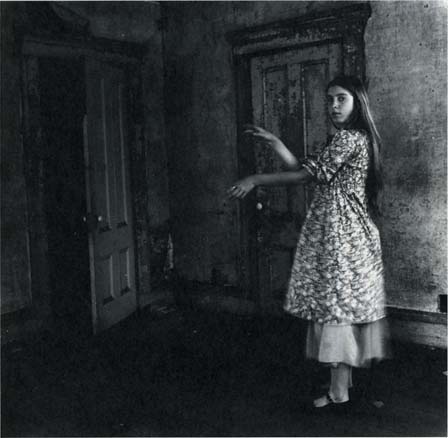
jane bowles, “two serious ladies”

Jane Bowles
Two Serious Ladies
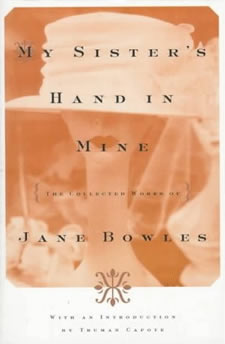
(originally 1943; published in 1966 as part of My Sister’s Hand in Mine: The Collected Writings of Jane Bowles, Farrar, Straus & Giroux.)


It’s a crying shame that Two Serious Ladies is only in print as part of Jane Bowles’s Collected Works: not that there’s anything wrong with the rest of her Collected Works, it’s simply that Two Serious Ladies is so perfectly complete on its own; it deserves to be a Penguin Classic, not one of the ugly redesigned ones, but one of the differently ugly older ones with the light green covers that didn’t smack of marketing, only belief in the power of literature. At one point, it could have been a New York Review Book, shelved between James Schuyler’s Alfred & Guinevere and James McCourt’s Mawrdew Czgowchwz. I don’t know what happened to Two Serious Ladies that it should be tied up so; maybe this is FSG’s fault.

Two Serious Ladies is a weirdly structured book. The first chapter, 34 pages long, introduces Christina Goering, a rich woman, strange from her religion-obsessed youth. Much later, she is visited by Lucy Gamelon, the cousin of her governess, who has heard stories about Christina; though Lucy worked in publishing, she is not up to anything, and she promptly moves in with Christina after her second visit. Some months later, Christina is invited to a party; she sees her acquaintance Frieda Copperfield, who is distraught about a trip she will have to take. She is then distracted by a morose man named Arnold, who she goes home with, thinking this is the interesting thing to do; she stays the night at Arnold’s house, where she meets his parents, who she likes better than Arnold. Christina sells her house and moves to a smaller house on an island. The second chapter, 75 pages long, is about Mrs. Copperfield’s trip to Panama with her husband; Mrs. Copperfield evidently hates to travel, but she leaves her husband for Pacifica, a prostitute. The third chapter, 90 pages long, returns to Christina Goering: she is now living in a house on an island with Arnold and Lucy Gamelon; eventually, they are joined by Arnold’s father. Christina has an affair with Andy, a man she meets in a bar; she leaves him after a week for a monstrous man named Ben who takes her for a prostitute. Five pages from the end of the book, Frieda Copperfield returns, evidently having returned to the city with Pacifica, who is running after a boy. 

The plot is not why I find myself reading this book over and over again; rather, it’s the way in which the characters behave. In a characteristic passage, Christina Goering and Lucy Gamelon are sitting outside their house; Lucy is thinking about how much she hates Arnold. “He is even too lazy to court either of us,” she tells Christina, “which is a most unnatural thing you must admit – if you have any conception at all of the male physical make-up. Of course he is not a man. He is an elephant.” But Lucy most hates Arnold for freeloading on Christina, which is of course something that Lucy is also doing:

They sat in silence for a few minutes. Miss Gamelon was thinking seriously about all these things when suddenly a bottle broke against her head, inundating her with perfume and making quite a deep cut just above her forehead. She started to bleed profusely and sat for a moment with her hands over her eyes.
     “I didn’t actually mean to draw blood,” said Arnold leaning out of the window. “I just meant to give her a start.”
     Miss Goering, although she was beginning to regard Miss Gamelon more and more as the embodiment of evil, made a swift and compassionate gesture towards her friend. (p. 115)

Within ten pages of this scene, Arnold is calling Lucy “Bubbles” and they are sharing a room, united, perhaps, by their dislike for each other. None of the characters in Two Serious Ladies are likeable. They are not pleasant; at one point Arnold describes Lucy as “constantly in either a surly or melancholic mood,” which could be said about any of these characters. There is no pretense of redemption: these characters start out terrible and they will end terrible. This makes it a very funny book; but, in a way, it’s also more realistic. 

There’s something interestingly off in the way the characters in this book make choices; they are all inscrutable. Here, an interaction between Christina Goering and Andy, her would-be paramour:

“Step back a little farther, please,” he said. “Look carefully at your man and then say whether or not you want him.”
     Miss Goering did not see how she could possibly answer anything but yes. He was standing now with his head cocked to one side, looking very much as though he were trying to refrain from blinking his eyes, the way people do when they are having snapshots taken.
     “Very well,” said Miss Goering, “I do want you to be my man.” She smiled at him sweetly, but she was not thinking very hard of what she was saying. (p. 166)

There’s a disconnect between thought and action that’s funny as well as terrifying: none of their behavior is at all predictable. In another novel, this sort of action could be accounted for by drugs, which would feel like a narrative copout; but these characters are entirely straitlaced, and even drinking doesn’t reliably change their inhibitions. 

This isn’t quite surrealistic whimsy, though the characters do appear to move in dream-like trances: at least in the sections based around Miss Goering, the sense is less of a world gone strange than it is of strange characters who don’t fit into the regular world, characters who could not be described as surrealist dreamers. Miss Goering and her friends appear to move from Manhattan to a largely rural Staten Island, perhaps the Staten Island that Arshille Gorky painted to look like the south of France; the setting is identified by geography rather than by name, but it maintains the prosaic stolidity one expects from that borough. For excitement, they take a ferry to New Jersey, where things seem to be much the same. (There’s a certain similarity to Kafka’s Amerika, though that would have been published in English after Two Serious Ladies.) The Panama that Frieda Copperfield visits is more fantastical; I find myself less drawn to this part of the plot partially because we’re used to seeing Latin America described as a fantastical place where anything can happen. The drama there is still very much more personal than based on its setting: what happens to Mrs. Copperfield on her trip is not what would happen to anyone else, but Mrs. Copperfield and Pacifica don’t sparkle quite as brightly as Christina Goering and her followers.

It’s left to the reader to discern what exactly the narrative of Mrs. Copperfield and Pacifica has to do with the story of Christina Goering; presumably Copperfield & Goering are the eponymous two serious ladies of the title, although Lucy Gamelon appears more often in the book than Frieda Copperfield does. In their final discussion, Frieda gives an idea of what she might have been trying to do:

“But you have gone to pieces, or do I misjudge you dreadfully?”
     “True enough,” said Mrs. Copperfield, bringing her fist down on the table and looking very mean. “I have gone to pieces, which is a thing I’ve wanted to do for years. I know I am as guilty as I can be, but I have my happiness, which I guard like a wolf, and I have authority now and a certain amount of daring, which, if you remember correctly, I never had before.” (p. 197)

Ms. Goering promptly admits her dislike for Mrs. Copperfield; there seems to be something incompatible about the way that the two of them are working out their lives. When we first meet Christina, she is purifying a young friend’s sins in a ceremony involving a burlap sack and a great deal of mud; through her narrative, talk of sin comes up from time to time. Christina and Lucy, for example, get into an argument about whether sports give Christina a feeling of sinning. Near the end of their affair, Christina realizes that Andy’s self-image has improved and he no longer thinks of himself as a bum:

This would have pleased her greatly had she been interested in reforming her friends, but unfortunately she was only interested in the course that she was following in order to attain her own salvation. (p. 172)

Christina’s theology seems to be her own brand of gnosticism: like Irenaeus’s description of the libertine gnostics, she seems to be trying to save herself through absorbing the sin of the world, which must be destroyed for truth to appear. Frieda, by contrast, appears to finally be enjoying the broken world as it is.

elif batuman, “the possessed”

Elif Batuman
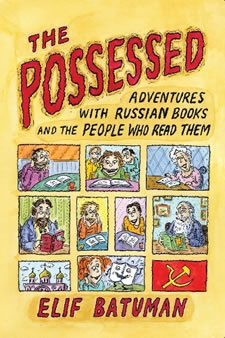
The Possessed: Adventures with Russian Books and the People Who Read Them
(Farrar, Straus & Giroux, 2010)


One of the most embarrassing section of almost any bookstore is that reserved for those books termed “belles lettres”: those books damned by not being full-on literary criticism (in which case they would appear in the bookstore at all) or biography, a safe area. Plenty of books that fall into this category are published; few end up on the shelves of Barnes & Noble; plenty get shelved elsewhere: the cultural studies section, or philosophy. There’s something anachronistic about “belles lettres,” down to the name; it’s a subject that one might imagine to have vanished with the nineteenth century, before literature was thoroughly professionalized. I’ve always had a weakness for the category: the specialist writing for a general audience is something that should be applauded, of course, as it provides a way in for those who wouldn’t necessarily have one; these are the sort of books for those who browse by nature, a species that might be increasingly threatened. It’s not a form that’s generally respected by academics: this sort of book won’t win academic acclaim, no matter what other good it might do. (Witness, for example, how little Susan Sontag is read, outside of the obligatory essay or two, in the academy: her audience, for better or worse, was the general public, and the academy reacted accordingly. The same might be said for Guy Davenport or John Berger; Marshall MacLuhan also fell into this space.) But for all its perils, “belles lettres” is a term that might helpfully be attached to Elif Batuman’s book, though I suspect that it’s more likely to be shoehorned into the memoir category: books need to be sold for readers to read them.

The risk being run here (and what makes academics wary of this sort of books, I think) is that of the derivative: writing about writing about books seems slighter than writing about books. Often this is only a pretext for memoir, a genre with embarrassments of its own; but in a few cases (Geoff Dyer’s Out of Sheer Rage comes immediately to mind) this can be pulled off. Dyer’s book, like Batuman’s, is written in the first person; the author is a primary subject, though crucially not the only one. Both also shade into travel literature; but in both, there’s something elliptical about the author’s self-presentation. At the end of the book, the reader has a sense of a sensibility; but there’s also the feeling that something has been withheld. Perhaps it’s propriety; I have a distaste for memoirs in general, but these work for me. Batuman’s life, like Dyer’s, is more interesting than the lives of most people, let alone those writing memoirs; but there’s the implicit feeling that it would be tacky to give everything away. The writing is what’s important; the life of the writer is necessarily a component, but it’s not the reason for the writing.

There’s a danger, of course, if one is to swing too far the other way; it’s the reason that most academic writing on literature leaves me cold, as it’s focused on the book rather than on how the book affects us. Batuman’s focus is on the intersection between the book and life, and the difficulty of finding a balance between the two; this becomes most clear in the final essay of the book, “The Possessed,” simultaneously a consideration of Dostoevsky’s novel sometimes given that name and a derangement of her friends studying Russian in grad school. It’s the most serious essay in the book, though not without levity: a point-by-point retelling of what actually happens in Demons, for example, comes across as hilarious and impervious to logic. Batuman maps her and her friends’ descent into madness against Dostoevsky’s odd novel about terrorism, a juxtaposition that risks going wrong in any number of ways. It works; partially because Demons resists the sort of easy allegorization that one could get with Crime & Punishment or The Idiot, but in large part because Batuman is deeply interested in the effect that books have on people: they are driving her classmates and her crazy, to the point where one eventually drops out and becomes a monk. (There are echoes here of characters glimpsed earlier in the book, similarly driven crazy by books; in the context of a Tolstoy conference, this seems hilarious, but viewed threw a personal lens, it becomes something different.) The book has the power to be a dangerous thing (one of the easy morals of Demons); at the end of the affair, Dostoevsky’s novel appears differently than it did before. It becomes clear why Batuman uses The Possessed as the title: possession requires a possessor, which demons might be doing their own work. The relationship between the book and the reader is what’s really important here. At the end of Batuman’s book, I’m tempted to go back to Dostoevsky’s; I remember muddling through it when I was much younger, though I suspect that time would have changed me. But it’s hard to want to be in the emotional state required to really appreciate a book that demands as much as that one.

This shouldn’t suggest that this book is a tough slog: it’s not that at all. The book before the last essay has an appealing lightness to it. A good chunk of this book (the “Summer in Samarkand” saga, which takes up nearly half the book, the visit to the Tolstoy estate) could be described as travel writing, which is something that Batuman’s very good at: everything, no matter how ordinary, becomes strange in her descriptions. Most of what she’s describing (Uzbekistan, how Russian scholars behave) is already going to be unfamiliar to most readers. Her focus cuts the sweetness of too many novelties and keeps the book compelling: for being a collection of essays, most of which have previously stood on their own, this turns out to be a book with a spine, a seriousness concealed by her writing’s lightness.

marcel proust, “the prisoner”

Marcel Proust
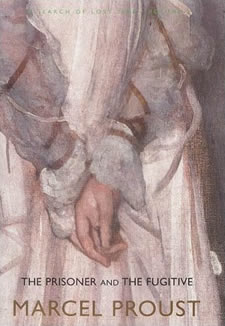
The Prisoner
(trans. Carol Clark) 
(Penguin, 2003)


The last three books of Proust are the ones I find myself coming back to; this time I return because of seeing Chantal Akerman’s filmed version of this book (La captive, 2000); it was so different than what I remembered of my first viewing three years ago that I thought it was time to turn back to Proust to see how he’d changed. I preferred the new translation of this book to the Moncrieff last time through; but this volume is handier, which is a large part of why I’m using this version. It’s vexing that this book & the final volume still aren’t available in this country because of copyright, though I kind of hate the chunkiness of the American paperback versions of this translation.

What I like about this section of the book is how with the Albertine captivity narrative, the novel jumps the rails of realism. The narrator’s problems in this book are not, on the face of them, the problems of anyone real; rather, it’s an imagined picture of heterosexual desire, a thought-experiment on Proust’s part. I’m not especially interested in how life in early twentieth-century Paris; that isn’t without interest, of course, but it’s the behavior of Proust’s characters and the narrator’s changing understanding of this behavior that I really care about. There’s not a huge amount of depiction of society in this volume (where I found myself losing interest in the earlier volumes); rather, the action is mostly interior. 

This is a book about jealousy; Albertine is the focus of the narrator’s jealousy, of course, but her person is almost immaterial, a blank screen on which the narrator can project (or reflect) his own fantasies:

But what I could not bear to imagine in Albertine was my own unceasing desire to attract new women, to sketch out new novels in which they would figure; it was the thought of her casting her eye, as I had not been able to restrain myself from doing the other day, even when seated beside her, at the young girl cyclists sitting at the tables in the Bois de Boulogne. Just as one can know only oneself, one could almost say that one can be jealous only of oneself. Observation is of little use. Only from one’s own pleasure can one derive both knowledge and pain. (pp. 356–7.)

With such a narrator, it’s hopeless to imagine Albertine as a real character; rather, she’s a fantastic projection. He reasons that he should have a great love, but doesn’t really have any idea what to do with it when he finds himself in one. There’s no romance in their external relationship – at one point, the narrator wonders whether he ought to buy her a yacht, as if that were what one did in the situation he finds himself in. Their relationship takes place almost entirely in the narrator’s mind, and one wonders if he’d prefer the physical Albertine not to exist; certainly he doesn’t do very much with her, and he comes across as absent-minded, more caught up in this thoughts than in anything that might be going on around him. They talk, but the narrator drifts off, and gets caught up in his own thoughts; early in the book, they discuss noises on the street, which leads to a five-page passage where the narrator considers waking from sleep. It’s virtuosic, of course, some of the nicest passages in the book, but it suggests solipsism:

Wasn’t it perhaps Françoise who had been sleeping, and I who had wakened her? Or rather, wasn’t Françoise somehow enclosed within me, for distinctions between people and their interactions hardly exist in that sepia darkness where reality is no more translucent than in the body of a porcupine, and where our minimal perceptions can perhaps give an idea of those of certain animals? (p. 109)

Albertine is beside the narrator on his bed, but she has been forgotten entirely, replaced her even as a stand-in for the other person by Françoise. It’s difficult to fault the narration for this, of course. At the end of the passage, where the narrator considers the cries of street vendors, we are told that “the cries rolled on for me like an echo of the waves where Albertine left to herself could have been lost, and took on the sweetness of a Suave mari magno” (p. 113). The reference is to the beginning of Book II of Lucretius’ De rerum natura, where he considers how nice it is, when safe on the shore, to watch someone drowning at sea; this is almost exactly the position of the reader, watching the narrator bumble through his jealousy.

This is being narrated retrospectively, of course, an old man reflecting on a younger man’s folly, but sometimes one wonders how well is is being done. A dumbfounding moment late in the book:

Albertine had never told me that she suspected me of being jealous of her, of spying on everything she did. The only words we had exchanged about jealousy, a long time before, seemed to suggest the opposite. (p. 306)

The narrator throughout the book has been acting like a lunatic; one wonders if he thinks that Albertine is an idiot and doesn’t notice anything, or whether he really doesn’t understand how strange his behavior actually is. (The narrator, as mentioned, is somewhat disconnected from reality; early in the book, for example, there’s a hilarious interlude where he fails to understand how a telephone works; a bit later he describes an airplane taking off in such a way as to make it appear that it suddenly moves vertically.) Maybe it’s simply that he’s more interested in jealousy than in other people; a few pages after he considers that Albertine couldn’t have noticed his jealousy, this passage appears:

And no doubt that is how it always is when two people face each other, since each of them is unaware of a part of what is inside the other, even what he is aware of he only partly understands, and each of them shows the other only what is least personal in him, whether because they have not understood themselves and think that the rest is unimportant, or because certain attractions which are not truly part of them seem to them more important and more flattering, or because there are other qualities which they think they need in order not to be despised, but do not have, and so they pretend to care nothing for them, and these are the things which they seem to despise above all and even to abominate. But in love this misunderstanding is carried to the highest degree since, except perhaps when we are children, we try to ensure that the impression we give, rather than being an exact reflection of our thoughts, should be what these thoughts conclude will have the best chance of getting us what we want . . . (pp. 317–8.)

It’s for passages like this that I go back to Proust; and going back, of course, is a pleasure in and of itself, noticing what I marked up the last time through, a record of change in different colors of ink. It’s hard not to think, when re-reading Proust, that it’s more worthwhile doing that that keeping up with what’s new. 

(This edition does, it should be noted, have weird punctuation issues: stretches of dialogue within a paragraph are kept inside single quotes, and “he saids” and “she saids” appear inside those single quotes; different speakers are introduced with a dash. I assume this is an attempt to follow French convention; it appears jarring and unnecessarily strange to the reader of English books. The American versions of the new translation didn’t have this punctuation issue; but I suspect that I care more about the translation of punctuation than most people do.)

it is useful to have dreams

“Desire, therefore, can be useful to the man of letters, first by keeping him at a distance from other men and from resembling them, then by restoring some movement to a spiritual machine which otherwise, beyond a certain age, tends to seize up. None of this makes us happy, but we can examine the reasons that keep us from being so, reasons which would have remained hidden from us if not for these sudden irruptions of disappointment. And dreams cannot be made real, we know that; still, perhaps we would not form any without desire, and it is useful to have dreams so that we can see their collapse and learn from it.”

(Proust, The Prisoner, trans. Carol Clark, p. 166.)

where reality is no more translucent than in the body of a porcupine

“Or rather, wasn’t Françoise somehow enclosed within me, for distinctions between people and their interactions hardly exist in that sepia darkness where reality is no more translucent than in the body of a porcupine, and where our minimal perceptions can perhaps give an idea of those of certain animals?”

(Proust, The Prisoner, trans. Carol Clark, p. 109.)